
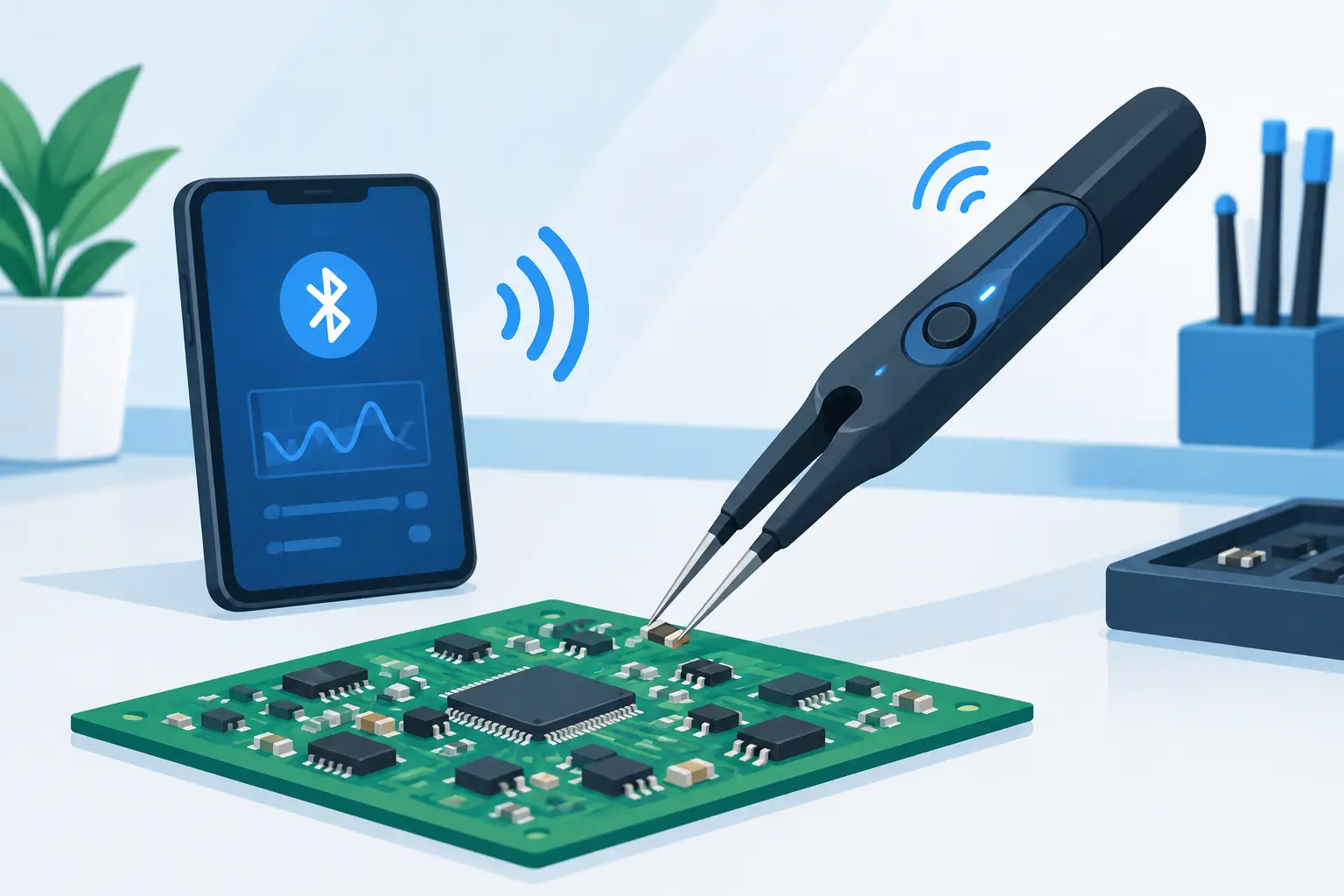
A Bluetooth tweezers review should answer more than whether a meter can send readings to a phone. For component-level work, the useful question is whether wireless data adds speed and traceability without compromising the fast, direct measurement workflow that makes tweezer meters valuable in the first place.
For SMT repair, incoming inspection, and board troubleshooting, a handheld LCR meter with tweezer probes already removes several steps from the traditional process. There is no need to select a range, connect long test leads, or move a tiny 0402 component from the board simply to identify it. Bluetooth can extend that advantage when readings must be documented, compared, shared, or observed away from the immediate work area.
Bluetooth Tweezers Review: What Matters at the Bench
Bluetooth is not a measurement function. It is a data and workflow function. The meter still needs stable contacts, appropriate test conditions, useful resolution, and verified accuracy. A wireless connection cannot correct poor probe placement, contamination, or a measurement made in circuit when parallel paths are affecting the result.
A good Bluetooth tweezer meter begins with the same fundamentals expected from any serious handheld LCR instrument: automatic component recognition, automatic test-parameter selection, a readable local display, and a probe geometry that can reliably contact small SMD terminations. Resistance, capacitance, inductance, and ESR readings must remain immediately available on the instrument itself. If a technician must open an app to see every result, Bluetooth has added friction rather than value.
The practical advantage appears when measurements need a record. A repair technician can capture suspect capacitor ESR values before and after replacement. A quality-control operator can retain readings from a sampling run. An engineer can compare a component population against expected values while documenting an investigation. In each case, the wireless feature is useful because it reduces transcription errors and preserves context.
Local Measurement Comes First
Bluetooth-enabled tools should be evaluated as instruments first and connected devices second. The local display needs to be clear enough for one-handed troubleshooting. Readings should update quickly, and the meter should identify the likely component type without repeated menu navigation.
This is especially relevant on dense assemblies. When probing a small ceramic capacitor beside active circuitry, the operator needs immediate confirmation that both tips have made contact and that the displayed value has settled. A companion application can be helpful for logging, but it should not become a required intermediary between the probes and the measurement.
Accuracy Is More Than a Datasheet Number
Published basic accuracy is important, but it does not tell the whole story. Measurement usefulness depends on the selected test frequency, test signal level, measurement range, contact resistance, and whether the component is isolated from the rest of the circuit.
For example, a low-value capacitor or an inductor may produce substantially different readings at different frequencies. ESR evaluation also depends on the frequency and the capacitor technology under test. Bluetooth does not change these electrical realities. Advanced users should look for models that provide manual frequency selection or other controls when automatic settings are not appropriate for the job.
Calibration support is another differentiator. A portable meter used for production verification, incoming inspection, or documented repair should have a defined calibration process and access to suitable fixtures or certified calibration service. The wireless log may be valuable evidence, but it is only as credible as the measurement system behind it.
Where Bluetooth Improves the Workflow
The strongest case for Bluetooth is repeatable documentation. Manual note-taking is slow, and reading a small screen while recording values on a computer or worksheet creates avoidable opportunities for mistakes. A connected meter can move readings into a digital record while the operator stays focused on the component.
This benefit is most apparent in a few common situations:
- Failure analysis: Record capacitance, ESR, and resistance checks as a board is investigated, including comparison measurements from known-good locations.
- Incoming inspection: Build a traceable sample record for reels, trays, or loose component lots without relying on handwritten notes.
- Production support: Share measurements with engineering when a line issue is found, rather than communicating values verbally or sending incomplete photos.
- Training and demonstrations: Let another person observe readings remotely while the operator explains probe placement and circuit effects.
For field work, Bluetooth can also be convenient when the board is inside equipment, in a rack, or positioned where the meter display is difficult to view. The operator can keep the instrument at the measurement point while viewing or storing results on a nearby device. This is useful, but it should be considered a secondary benefit. In most bench troubleshooting, the meter’s own display remains the fastest reference.
Trade-Offs to Consider Before Buying
A Bluetooth connection introduces a few practical considerations. Battery use can increase when wireless communication is active. Pairing must be reliable, and the software needs to be compatible with the mobile device or computer used in the shop. If records are essential, confirm how data is stored, exported, and retained. A live display is not the same as an inspection-ready measurement log.
There is also a question of operational discipline. In a high-volume repair environment, automatic logging can create a large amount of low-value data if technicians do not identify the board, location, and test purpose. The best workflow captures the readings that support a decision, not every probe contact made during diagnosis.
For users who only need to identify a resistor or check a capacitor quickly, a non-Bluetooth automatic tweezer meter may be the more cost-effective choice. It provides the core speed advantage without paying for connectivity that will not be used. Conversely, engineers who routinely compare samples, create reports, or need controlled test conditions may benefit more from an advanced Bluetooth model with manual frequency options and extended measurement capability.
In-Circuit Measurements Need Judgment
Tweezer-style LCR meters are exceptionally effective for loose parts and accessible SMD components, but no handheld instrument can ignore the surrounding circuit. Parallel components, semiconductor junctions, power rails, and leakage paths can alter an in-circuit result.
Bluetooth logging can make this easier to manage by preserving readings from both the suspect board and a known-good board. Still, the log should state whether the part was measured in circuit, partially lifted, or removed. This distinction is often more important than the last displayed digit.
When a reading is questionable, use a disciplined sequence: inspect the component and pads, clean the probe tips, check the measurement against a known reference, compare the same circuit location on a working assembly, and isolate one end of the component if the result must be definitive. Wireless reporting supports that process, but it cannot replace it.
Features Worth Comparing
Not all Bluetooth tweezers are aimed at the same user. Compare the measurement system and the data workflow together.
| Feature | Why it matters in real work | |—|—| | Automatic component identification | Speeds routine checking of unknown SMD parts and reduces setup errors. | | Manual test frequency selection | Helps evaluate frequency-sensitive capacitors, inductors, and ESR behavior. | | ESR measurement capability | Supports capacitor screening and troubleshooting where capacitance alone is insufficient. | | Bluetooth data display and logging | Reduces transcription effort and helps maintain a measurement record. | | Calibration options | Supports confidence in measurements used for quality, repair documentation, or process control. | | Probe-tip design and replacement support | Determines how well the meter can contact small packages over long-term use. | | Battery operation and power management | Affects practical uptime in field service and daily bench work. |
Do not evaluate range in isolation. A broad capacitance or resistance range is useful only if resolution and accuracy are suitable in the values you work with most often. Similarly, a high-resolution display is valuable only if readings are stable enough to support decisions. For a technician primarily handling 0201 through 1206 parts, tip access and contact repeatability may matter more than an impressive maximum range.
Choosing the Right User Level
An entry-level automatic tweezer meter is often sufficient for sorting components, identifying values, and basic board repair. It is a practical choice for hobbyists, technicians, and small repair operations that need immediate answers at the component level.
A Bluetooth-enabled model becomes more compelling when measurements must leave the bench. That includes repair shops producing service records, engineering teams sharing data, manufacturing groups checking samples, and educators documenting demonstrations. The connection should be treated as a productivity feature, not the main reason to accept weak measurement performance.
For advanced diagnostics, select an instrument based on test frequencies, ESR functionality, manual controls, resolution, and calibration requirements. In a product family such as LCR-Reader, the appropriate choice is usually determined by workflow: fast automatic identification for routine work, or expanded control and data handling for more demanding analysis.
The best connected tweezer meter is the one that makes the next measurement easier to trust. Keep the probe tips clean, verify the instrument with known standards, record enough context to explain each reading, and let Bluetooth handle the documentation rather than distract from the diagnosis.