
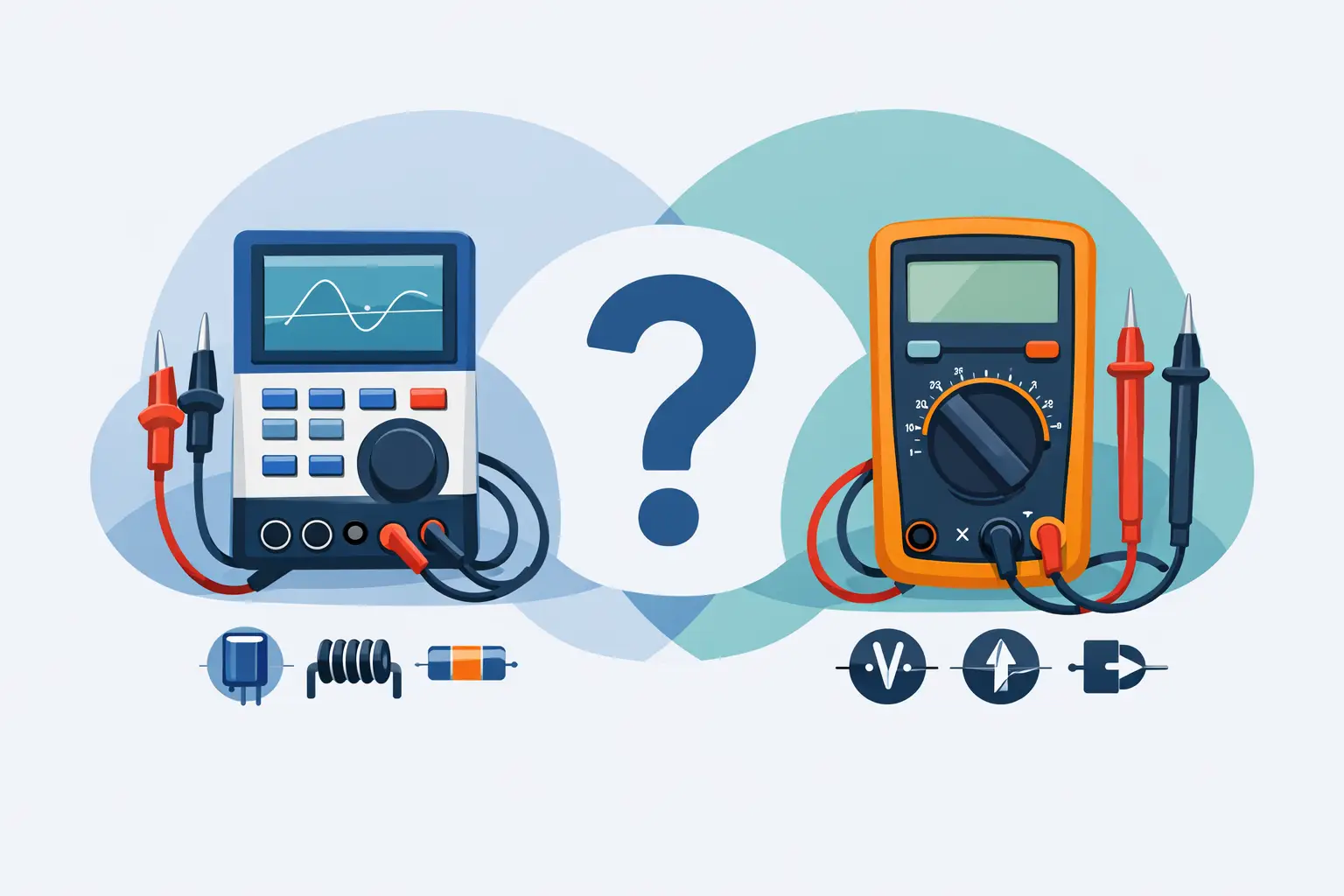
A dead-stable 10 uF capacitor can look fine on a basic continuity check and still be the reason a board fails. That is where the lcr meter vs multimeter question stops being academic and starts affecting repair time, rework risk, and measurement confidence. If your work involves surface-mount parts, passives sorting, incoming inspection, or board-level troubleshooting, the difference between these two instruments is not minor.
LCR meter vs multimeter: the real difference
A multimeter is a general-purpose electrical tester. It is built to measure voltage, current, resistance, and often continuity, diode drop, and sometimes capacitance or frequency. It is the standard first tool on almost every bench because it answers broad questions quickly: Is power present? Is a fuse open? Is a rail shorted? Is a resistor roughly the right value?
An LCR meter is a component analyzer. It is designed to measure inductance, capacitance, and resistance with test conditions intended for passive components rather than live circuits. More importantly, it usually reports the secondary parameters that matter in real parts selection and troubleshooting, such as ESR, dissipation factor, quality factor, phase angle, and test frequency behavior.
That distinction matters because a resistor on a schematic is not just resistance in practice, and a capacitor that nominally reads close to value can still be unusable in circuit. A multimeter tells you whether something is present and roughly behaves as expected. An LCR meter tells you how the component actually performs.
What a multimeter does well
For general electrical work, a multimeter remains essential. It is the right tool for energized circuits, DC rails, current checks, continuity tracing, diode orientation, and fast go or no-go verification. If you are diagnosing a power input stage, checking whether 5 V is reaching a regulator, or confirming an open trace, a multimeter is usually the first instrument you pick up.
Even when a multimeter includes capacitance mode, that feature is often limited in context. It may require the capacitor to be discharged and removed from circuit, and it typically reports only capacitance value. That can be enough for simple field checks, but not for determining whether a low-ESR capacitor has drifted into failure territory or whether a small ceramic capacitor is actually the value marked on the reel.
For technicians who work across power electronics, automotive systems, industrial maintenance, or general electronics assembly, the multimeter stays valuable because it covers many tasks with one instrument. It is versatile, durable, and familiar.
Where an LCR meter earns its place
An LCR meter becomes the better choice when the part itself is the problem to solve. That includes identifying unmarked SMD components, sorting similar values, verifying tolerance, checking ESR in capacitors, measuring inductors accurately, and comparing suspect parts against known-good samples.
The biggest advantage is controlled component measurement. LCR instruments use AC test signals at defined frequencies, which is how passive parts should be characterized. Since capacitance and inductance are frequency-dependent, measuring them at the right test conditions produces more meaningful results than a simplified capacitance function on a multimeter.
That is especially true in SMT work. Small components are hard to grip with standard probes, and lead resistance or poor probe contact can distort readings. Tweezer-style LCR tools reduce that friction by letting the user contact both ends of the component directly, often with automatic identification and range selection. For bench repair and production environments, that speeds up measurement and reduces handling errors.
Accuracy is not just a spec sheet issue
Users often compare only the headline accuracy number, but the lcr meter vs multimeter decision depends on what is being measured and how. A multimeter may have excellent DC voltage accuracy and still be a poor choice for evaluating small capacitors or inductors. That is not a flaw. It is simply outside its primary design target.
An LCR meter is optimized around passive component measurement, often with Kelvin-style methods or low-resistance compensation that reduce fixture and contact effects. On very small values, those details matter. Measuring a low-ohm resistor, a tiny inductor, or a sub-microfarad capacitor with generic probes can introduce enough parasitic error to make the result less useful.
For quality control, component verification, and precision troubleshooting, repeatability matters as much as nominal accuracy. If the same part measures consistently and predictably across repeated tests, decision-making gets faster. That is where purpose-built LCR instruments tend to justify their cost.
ESR, parasitics, and why multimeters miss failures
One of the clearest examples is ESR. A capacitor can still show near-nominal capacitance and fail under load because its equivalent series resistance has risen. A standard multimeter usually will not report ESR at all. That means it can miss a component that is technically present but functionally degraded.
The same issue appears with inductors and coils. Inductance value alone does not tell the whole story if Q, series resistance, or frequency response has shifted. In RF, switching power supplies, and timing networks, those secondary parameters can affect performance enough to create intermittent or hard-to-find faults.
This is why repair technicians and engineers working at the component level often reach for an LCR meter first when the board symptom suggests a passive failure. It is simply a more informative measurement.
Workflow matters on a real bench
The right tool is not chosen by theory alone. It is chosen by how quickly it gets you to a trustworthy answer.
A multimeter is usually faster for live-circuit checks because it is built for them. You can move from continuity to DC voltage to diode mode in seconds. If your day involves harnesses, connectors, power supplies, relays, and wiring faults, that speed is hard to beat.
An LCR meter is faster when the task is component-centric. On a bench full of reels, loose SMD parts, or suspect capacitors removed from a board, automatic component identification and direct-contact tweezers save meaningful time. You are not swapping leads, guessing ranges, or trying to stabilize a tiny 0402 component under large probes. You touch the part, read the value, and move on.
That workflow difference is one reason handheld tweezer-style instruments have become popular in SMT diagnostics and small-part verification. They reduce setup overhead and keep the operator focused on the board, not the instrument menu.
When one tool is enough and when it is not
If your work is mostly electrical maintenance, field service, or basic electronics repair, a good multimeter may cover the majority of your needs. You can verify supply rails, check current draw, test continuity, and confirm many common faults without adding another instrument.
If your work regularly involves passive components as decision points, a multimeter alone becomes limiting. That includes SMT rework, incoming inspection, R and D, failure analysis, and component matching. In those cases, an LCR meter is not redundant. It fills a measurement gap.
Many professionals end up using both. The multimeter answers what the circuit is doing. The LCR meter answers whether the component is healthy, correctly valued, and suitable for the application.
Buying based on use case, not marketing
A common mistake is buying a multimeter with a long feature list and expecting it to replace a dedicated LCR instrument. Another is buying an LCR meter for work that is really about electrical troubleshooting in live systems. Both choices create friction.
If you need live voltage and current measurements, safety category ratings, and broad utility across energized equipment, buy the better multimeter. If you need accurate passive component characterization, ESR visibility, and efficient testing of small SMD parts, buy the better LCR meter.
For users working with dense boards and small passives, form factor deserves more attention than it often gets. A compact tweezer-style LCR meter can be more productive than a larger instrument with deeper menus because it fits the task better. That practical efficiency is a technical advantage, not just a convenience. Brands such as LCR-Reader built their product design around that exact requirement.
Which one should you choose?
Choose a multimeter if your primary questions are about power, continuity, polarity, current, and live-circuit behavior. Choose an LCR meter if your primary questions are about component value, ESR, tolerance, and passive part quality. If you troubleshoot modern electronics at the board level, especially with SMD components, the strongest setup is usually not lcr meter vs multimeter as an either-or choice. It is knowing which instrument solves the problem in front of you with the least uncertainty.
The best bench is not the one with the most tools. It is the one where each tool answers a specific question quickly and accurately.