
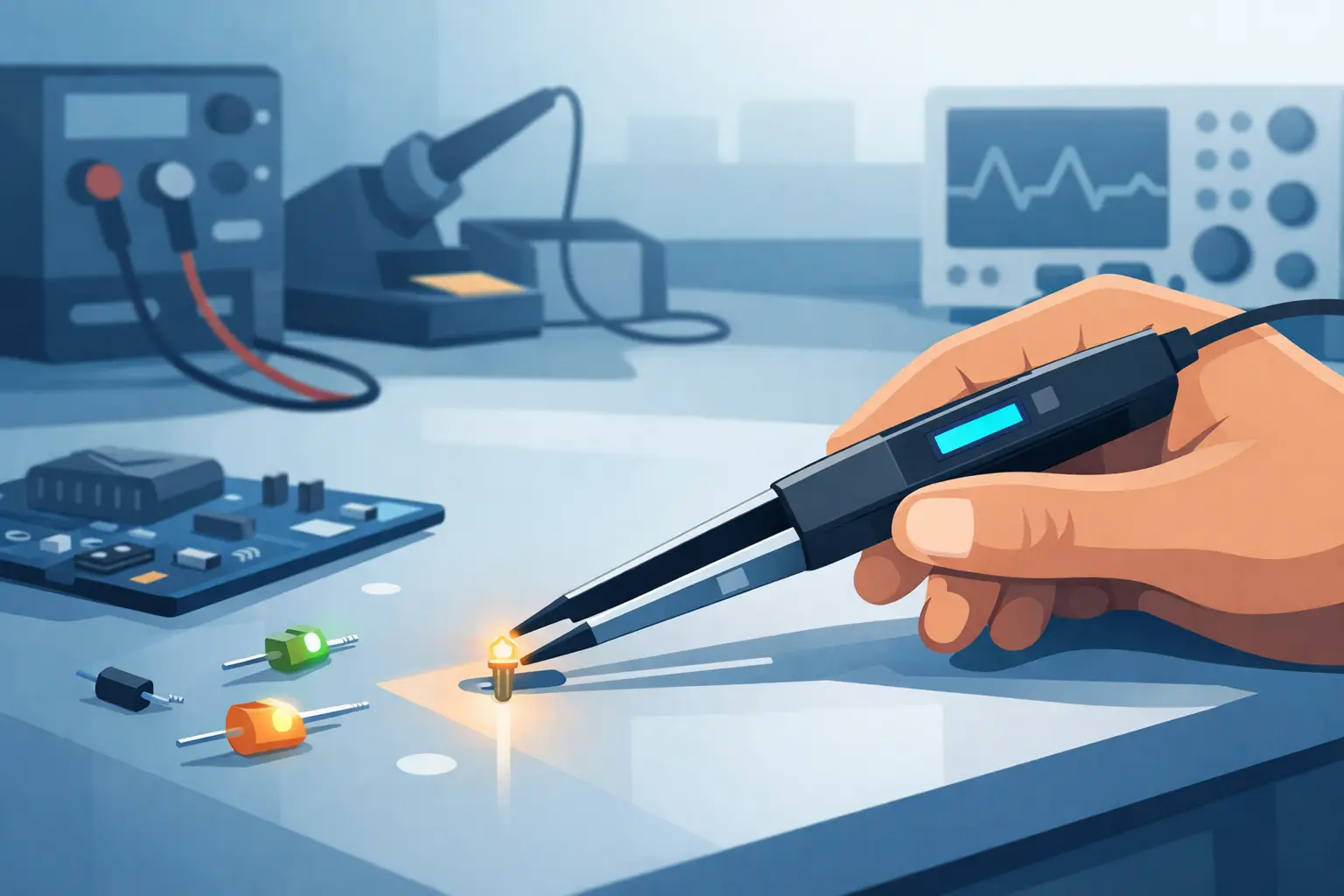
A bad LED check wastes more time than it should. You pick up a loose SMD LED, try to hold probe tips on pads the size of dust, and either the contact slips or the result is too uncertain to trust. That is exactly where an LED test tweezers review matters – not as a novelty tool check, but as a workflow question for repair, assembly, and incoming inspection.
What LED test tweezers are supposed to fix
Standard multimeter probes are not ideal for tiny diode packages. They are workable on through-hole leads and larger pads, but once the part size drops, stability becomes the problem. The issue is not just physical access. It is repeatability. If contact pressure varies, or the tips skate across solder residue, the result can look like a failed part when the problem is really the probing method.
LED test tweezers address that by combining tweezer-style handling with a dedicated LED test function. The basic idea is simple. You grip the component the same way you would place or inspect it, the tips maintain contact on both ends, and the tool applies a suitable test condition to verify polarity and illumination. For SMD work, that can be much faster than switching between probes, clips, and manual handling.
In practical bench use, the value comes down to three questions. Do they make contact reliably on small packages? Do they give a clear pass or fail indication without guesswork? And do they save enough time to earn a permanent place next to the soldering station?
LED test tweezers review: where they help most
The strongest use case is loose component handling. If you are sorting reels, checking suspect LEDs from stock, or confirming polarity before placement, tweezers are a natural format. You are already handling the part with tweezers in many assembly and rework tasks, so combining pickup and electrical check reduces motion and setup.
They are also useful when troubleshooting boards with visible LED devices that can be contacted directly. For simple in-circuit checks, a dedicated LED test function can quickly show whether the device lights and whether polarity is as expected. This is especially helpful in repair work where the first question is not the exact diode curve but whether the LED responds at all.
That said, the phrase “LED test” can mean different things depending on the instrument. Some tools only confirm forward conduction. Others provide enough drive to visibly illuminate many common LEDs. That difference matters. A continuity-style diode test may indicate that something conducts, but it does not always give the immediate visual confirmation technicians want during fault isolation.
Contact geometry matters more than marketing
Most buyers focus first on voltage or current capability, but tip design deserves equal attention. A tweezer tester is only as good as its ability to contact miniature terminations without slipping or shorting adjacent pads. Fine, well-aligned tips are critical for 0402 and similar packages. If the tip spacing, shape, or spring tension is poorly controlled, the test becomes inconsistent.
Good LED test tweezers should feel balanced in the hand and predictable under light pressure. Too much stiffness can crack fragile components or make hand fatigue set in early during repetitive inspection. Too little tension can make the grip unstable. For technicians who process many parts in one session, these mechanical details affect productivity as much as electrical specs.
Tip replacement and long-term alignment are worth checking too. In a production or repair environment, consumable wear is not theoretical. Oxidized, bent, or contaminated tips degrade contact quality and can turn a capable tester into an unreliable one.
Electrical performance: what to look for in real use
A useful LED tweezer tester should do more than simply react to any semiconductor junction. For bench relevance, it should apply a test condition suitable for common LED types and present the result clearly. Visible illumination is often the fastest confirmation because it removes ambiguity. If the LED lights at expected polarity, the operator gets an immediate answer.
However, there are limits. White, blue, and some higher-forward-voltage LEDs may need more headroom than a basic tester provides. In those cases, a tool may still indicate conduction differently, or it may not fully illuminate the part. That does not automatically mean the LED is defective. It may simply be outside the effective drive range of that specific tester.
This is where a careful LED test tweezers review should separate convenience from complete characterization. These tools are designed for quick screening and polarity verification, not detailed diode analysis. If your job requires exact forward voltage under controlled current, leakage behavior, or deeper in-circuit fault interpretation, a dedicated bench instrument may still be necessary.
Workflow advantages over standard probes
For technicians who handle surface-mount parts daily, speed is the main argument. A tweezer format reduces the awkward two-hand probe balancing act that standard DMM leads require. You can pick up the part, contact both terminations, and verify response in one motion. That is a small change, but repeated across dozens or hundreds of parts, it becomes meaningful.
The format also reduces accidental slips. With traditional probes, a tiny movement can lose contact or short across nearby pads. Tweezers stabilize both points at once. On densely populated assemblies, that can lower the chance of misreading a part simply because the probe angle was poor.
For incoming inspection, educational labs, and field repair kits, portability is another advantage. A compact dedicated tool is easier to keep within reach than a full benchtop setup. If the instrument powers on quickly and requires no menu setup, it is more likely to be used for every suspected LED instead of only when the failure becomes stubborn.
Where LED test tweezers fall short
No review is complete without the trade-offs. First, these tools are specialized. If you expect one instrument to replace a full LCR meter, ESR meter, and diode analyzer, that is unrealistic. LED test tweezers are efficient for a narrow task set, but they do not eliminate the need for broader measurement capability elsewhere on the bench.
Second, in-circuit testing always depends on the surrounding network. Parallel paths, driver ICs, resistors, and protection components can affect what you see. A lit LED is useful information, but a dark LED does not always prove the component itself is bad. Board context still matters.
Third, package size and board access set practical limits. Even a well-designed tweezer tip cannot solve every clearance problem. If the LED sits between tall components or under conformal coating, access may be too restricted for reliable contact.
Who benefits most from this kind of tool
Repair technicians are the obvious fit because they need quick answers under time pressure. The tool is equally valuable for SMT assembly operators checking orientation and for quality-control teams validating sampled parts from inventory. Serious hobbyists who work on LED boards, consumer electronics, and embedded hardware can benefit too, especially if they regularly handle loose SMD parts.
For engineering labs, the decision depends on use frequency. If LED verification is a routine task, dedicated tweezers can reduce bench friction. If it only comes up occasionally, a general-purpose instrument with a suitable diode mode may be enough.
A practical lineup often includes both. A dedicated LED tester handles fast pass-fail work, while a more advanced tweezer LCR platform covers resistors, capacitors, inductors, ESR, and broader component identification. That combination makes sense for users who move between troubleshooting and part verification throughout the day.
LED test tweezers review verdict
As a category, LED test tweezers make sense because they solve a real handling problem, not a marketing problem. The best units are fast, mechanically stable, and electrically matched to common LED verification tasks. They are most effective when the goal is to confirm polarity, basic function, and visible response on small parts without setting up a larger instrument.
Their value is lower if your work rarely involves loose SMD LEDs, or if you need detailed diode characterization rather than quick screening. It also depends on how often you test in circuit versus out of circuit. The more your workflow involves small discrete LED handling, the stronger the case becomes.
For users already working with precision tweezer instruments, adding a dedicated LED-focused option can be a logical extension rather than a separate workflow. Brands such as LCR-Reader have shown why the tweezer form factor works so well on compact components – speed and control matter as much as raw specification.
If you are evaluating one for your bench, look past the promise of “easy testing” and focus on tip quality, contact stability, LED drive capability, and how often the tool will replace a slower manual method. The right answer is not whether LED test tweezers are useful in general. It is whether they remove enough friction from your actual bench routine to become the tool you reach for first.