
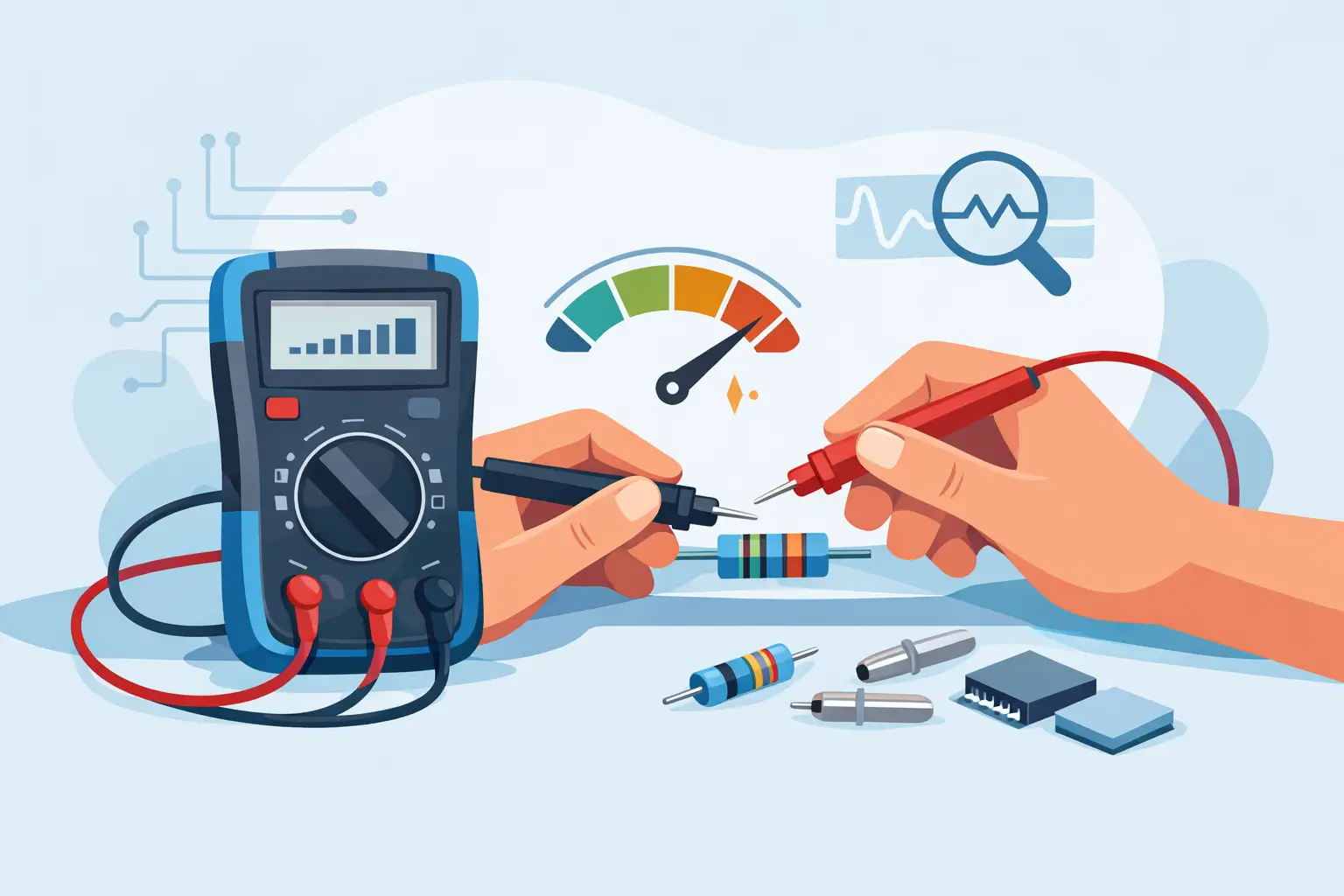
A resistor marked 0.22 ohm can look fine, measure wrong, and still waste an hour of troubleshooting. That is why knowing how to check low ohm resistors matters in real repair and production work. At these values, the resistance of your test leads, probe contact, solder joints, and even finger pressure can distort the reading enough to make a good part look bad or hide a failed one.
Low-value resistors show up in current-sense circuits, power supplies, motor control boards, battery management systems, and protection networks. They are often physically small, run hot, and fail in ways that are not obvious from a visual inspection. Measuring them correctly is less about the resistor itself and more about controlling the measurement error around it.
Why low ohm measurements are tricky
With a 10 kOhm resistor, an extra 0.1 ohm from your probes means nothing. With a 0.1 ohm resistor, that same error is large enough to shift the result by a full percent or more. If your meter resolution is limited or the contact is unstable, the displayed value may drift between readings and lead you to the wrong conclusion.
This is the main reason technicians get inconsistent results with low ohm parts. Standard handheld multimeters are useful, but they are not always optimized for sub-ohm work, especially on small SMT components. The problem is usually not that the resistor cannot be measured. The problem is that the total measurement path includes more than the resistor.
Temperature also matters. Many current-sense resistors have low temperature coefficients, but heating from circuit operation or even prolonged handling can still shift the reading. If the part was under load a moment ago, let it cool before deciding whether it is out of tolerance.
How to check low ohm resistors with the right method
The best method depends on the resistor value, package size, and whether it is still soldered into the circuit. For through-hole parts above about 1 ohm, a decent DMM may be enough if you first account for lead resistance. For SMT resistors below 1 ohm, especially in dense boards, dedicated LCR tweezers or a Kelvin-style method is usually the more reliable choice.
If you are using a standard meter, start by shorting the probes together and noting the displayed resistance. Some meters provide a relative or zero function that subtracts this value automatically. If yours does not, subtract it mentally from the final reading. This does not solve every error source, but it removes the most obvious one.
Probe placement is critical. Pressing harder does not guarantee a better result. Oxidized pads, solder mask contamination, and unstable tip contact can all add variation. Use clean probe tips and touch the resistor terminals directly, not adjacent copper that may include trace resistance.
For SMT parts, tweezer-style instruments are often faster and more repeatable because they reduce lead length and improve contact consistency. A tool designed for component measurement can also auto-identify the part and select the proper mode without extra setup, which helps when you are moving through multiple suspect components on a board.
In-circuit vs out-of-circuit testing
In-circuit measurement is convenient, but it always comes with a warning. Parallel paths can make a resistor read lower than its actual value. In low-ohm networks, nearby copper, coils, MOSFET body paths, or other current-sense elements can influence the result enough to make the reading ambiguous.
If the measured value is close to expected and the surrounding circuit is simple, in-circuit testing may be sufficient for a quick pass or fail decision. If the value is significantly lower than expected, do not assume the resistor is defective until you isolate at least one end or confirm the circuit path around it.
A resistor that reads higher than expected in circuit is often more meaningful, because parallel paths usually pull the value down, not up. Even then, poor contact or damaged solder joints can mimic a high reading. When the diagnosis matters, lift one side and measure again.
When in-circuit measurement is usually acceptable
If you are checking a known current-sense resistor in a simple path, comparing identical channels, or screening for obvious opens, in-circuit measurement is often practical. It is also useful when board access is limited and the goal is fast troubleshooting rather than formal inspection.
When to remove or isolate the resistor
If the resistor is under 1 ohm, sits in a complex power stage, or the measured value determines whether you replace an expensive assembly, isolate it. This is especially true in QC work, failure analysis, and any case where tolerance margins are tight.
A practical test procedure
Start with the resistor specification. Read the marking, schematic, BOM, or board documentation so you know the target value and tolerance. A 0.05 ohm resistor with 1 percent tolerance leaves little room for casual measurement technique.
Next, power the circuit down fully and discharge capacitors if the resistor is on a power board. Measuring resistance in a live or partially charged circuit can damage the instrument or produce meaningless readings.
Zero your measurement path. On a DMM, short the probes and use relative mode if available. On a precision tweezer or LCR meter, perform the recommended offset or calibration step for the fixture being used. This is not optional when you are working near the bottom of the resistance range.
Measure the resistor at its terminals with stable contact. Take more than one reading. If the value moves around, the first suspect should be contact stability, not the resistor. Rotate probe angle slightly, clean the pads if needed, and repeat.
Compare the measured result to the tolerance band or datasheet value. If the reading is marginal, let the part cool and measure again. If it is still questionable and the part is in circuit, isolate one side and retest.
Common mistakes that cause false readings
The most common mistake is forgetting that test leads have resistance. The second is measuring through solder joints, vias, or copper traces instead of directly across the resistor element. The third is trusting a single unstable reading.
Another frequent issue is using a meter with insufficient resolution. If your instrument only shows one or two meaningful digits in the sub-ohm range, you may not have enough data to judge tolerance. In that case, the meter is not defective. It is simply the wrong tool for that level of measurement.
Contact pressure can also create problems. Sliding probes on small SMT terminations changes the contact resistance from moment to moment. A tweezer-style instrument reduces this variable because both contacts are aligned for the part geometry.
Finally, do not ignore thermal effects. A current-sense resistor near a hot regulator or MOSFET may not settle to its nominal room-temperature value right away. If you test immediately after operation, your result may reflect operating temperature rather than actual failure.
Choosing the right instrument
If low-ohm measurement is occasional, a quality DMM with relative mode can be enough for basic work. If it is part of your routine workflow, instrument selection starts to affect both speed and confidence.
For SMT troubleshooting, a handheld LCR tweezer meter is usually the more efficient option. Short test path, automatic component detection, and stable contact geometry help reduce setup friction and operator error. On densely populated boards, that matters more than feature count on paper. A dedicated component tester such as an LCR-Reader can be particularly useful when you need quick, repeatable readings without switching modes or fighting with long leads.
For the lowest values and the highest accuracy requirements, four-wire Kelvin measurement remains the benchmark. It separates current injection from voltage sensing, which minimizes lead and contact resistance error. That approach is common in benchtop and lab environments, though it is less convenient for fast field work.
What a good result actually looks like
A good low-ohm reading is not just a number that matches the label. It is a stable number, repeatable across multiple touches, and sensible within the context of the circuit. If one channel measures 0.101 ohm, another identical channel measures 0.099 ohm, and the suspect board measures 0.178 ohm, that pattern tells you more than any isolated reading.
The goal is not theoretical perfection. It is dependable measurement with known error sources under control. Once you treat probes, contact quality, and circuit context as part of the measurement, low-ohm resistors become much easier to evaluate – and troubleshooting gets faster for all the right reasons.
When the resistor value is small, the measurement details are not small. Get those details right, and the answer is usually clear.