
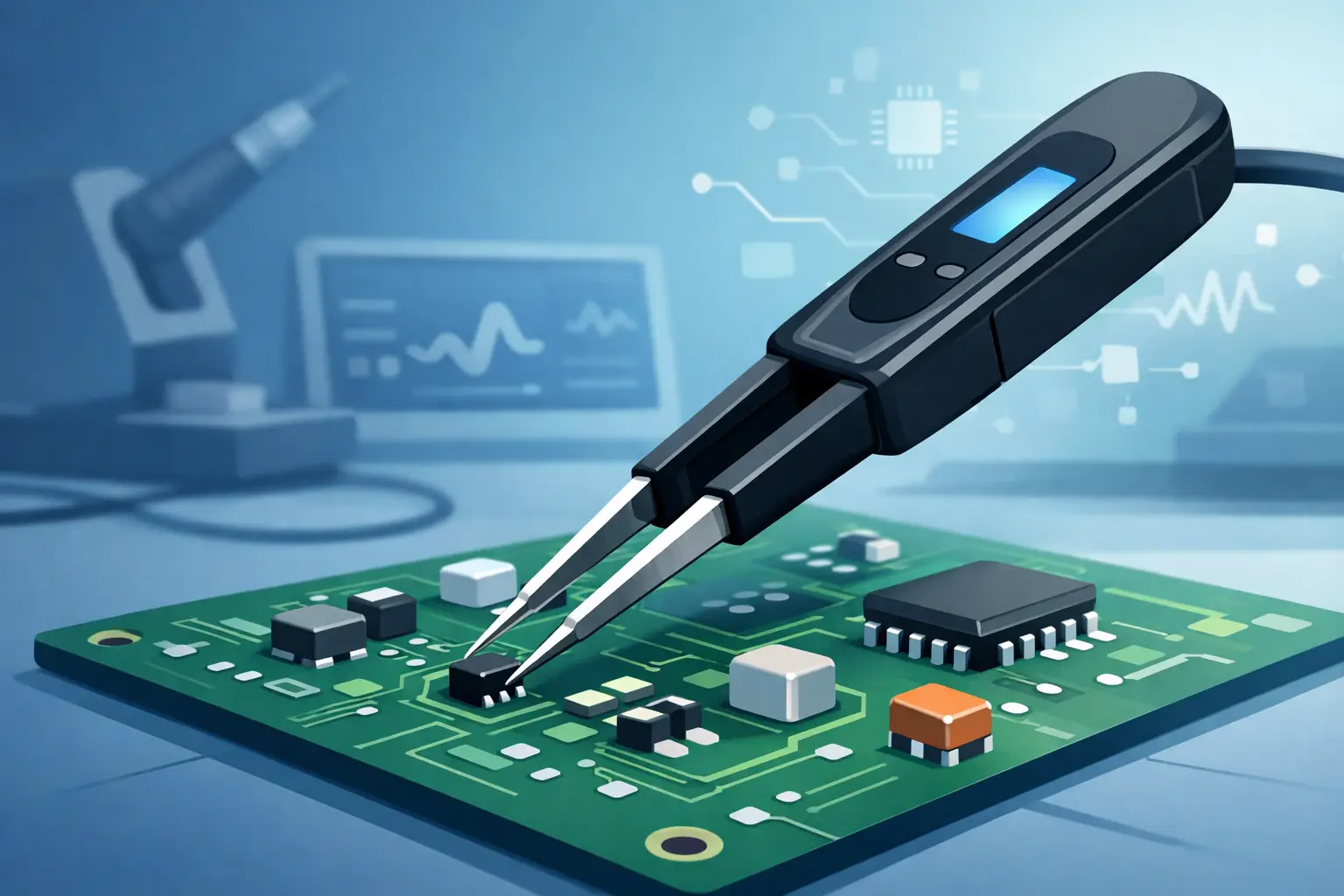
If you troubleshoot densely packed boards, the value of a good smart tweezers review shows up fast – usually the first time you need to identify a tiny capacitor in circuit, verify an inductor from a tape reel, or check ESR without stopping to wire up clips and select ranges. The appeal is simple: touch the part, get a reading, move on. The problem is that not all tweezers-style LCR meters deliver the same speed, stability, or measurement confidence.
For professional SMT work, the right evaluation criteria are not marketing claims. They are measurement accuracy, repeatability, frequency options, ESR performance, tip control, display readability, and how the instrument behaves on real components instead of ideal lab samples. That is where a useful review should focus.
Smart tweezers review: what actually matters
At a glance, most smart tweezers promise similar benefits. They combine tweezer probes with automatic component identification and handheld operation. For technicians, that sounds ideal, and often it is. But the differences appear once you start measuring low-value resistors, small inductors, multilayer ceramic capacitors, or aged electrolytics where ESR is the deciding factor.
Automatic detection is the first feature buyers notice, but it is not the only one that matters. A meter can identify R, C, and L correctly most of the time and still be frustrating in daily use if readings drift, update too slowly, or struggle with small-value SMD parts. In bench repair and incoming inspection, speed only helps when the result is dependable.
A serious review should also separate convenience from precision. Handheld smart tweezers are built for rapid component handling, not to replace every benchtop LCR meter in every measurement scenario. If you need full fixture-based characterization, wider test conditions, or advanced statistical logging, a bench instrument still has the advantage. If you need fast sorting, fault isolation, and component verification directly at the board, tweezers-style meters are often the better tool.
Measurement performance under real bench conditions
The core job of a smart tweezers device is straightforward: identify the component type and apply an appropriate test signal without manual setup. In practice, that means the instrument must decide whether it is looking at resistance, capacitance, or inductance, then display the primary value and useful secondary data such as ESR.
For SMT technicians, ESR support is especially important. A capacitance value alone does not always tell you whether a capacitor is healthy enough for switching supplies, filtering stages, or repair validation. A device that reports capacitance and ESR clearly can cut troubleshooting time significantly. This is one of the strongest reasons tweezers-style LCR meters remain popular in repair environments.
Accuracy claims deserve careful reading. Published specifications matter, but they are only meaningful when you consider test frequency, component value range, and whether the part is measured in circuit or out of circuit. Small parasitics from the probes, contact resistance at the tips, and operator hand position all affect low-value measurements. Better instruments compensate for some of this through stable front-end design and calibration support, but no handheld tweezer meter is immune to bad contact technique.
That leads to a practical point often missed in a generic smart tweezers review: repeatability is as important as single-shot accuracy. If you touch the same resistor three times, the readings should settle close together. If they jump around, the issue may be probe pressure, tip contamination, or weak contact geometry. It may also reflect the limits of the meter itself.
Usability is not a minor feature
A smart tweezer meter succeeds or fails on ergonomics. The entire purpose of the form factor is to reduce setup time, so the instrument has to feel natural in hand. Tip alignment, spring tension, body balance, and display angle all affect usability during repetitive work.
On boards populated with small 0402 or 0603 parts, poor tip control becomes obvious immediately. If the tips are too bulky, too flexible, or hard to align, the meter loses one of its biggest advantages. The best units make it easy to land on both ends of a component without slipping into adjacent pads.
Display behavior also matters more than it may seem on paper. A compact instrument should still present the main reading quickly and without visual clutter. In field service or production environments, technicians are not interested in scrolling through menus to confirm whether a part is 10 kOhm or 10 nF. They want a stable reading with the right unit, plus ESR or other secondary data when relevant.
Battery life and startup time belong in the same discussion. A handheld meter that drains quickly or takes too long to become measurement-ready adds friction back into the workflow. Fast wake-up, reliable auto power-off behavior, and predictable charging or battery replacement are practical features, not luxury extras.
Where smart tweezers perform well – and where they do not
The strongest use cases are SMD identification, incoming inspection, quick sorting, repair diagnostics, and board-level troubleshooting. If you regularly work with loose reels, mixed-value passives, or rework stations, the speed advantage is real. Touch-and-read measurement is faster than clip leads, faster than many bench setups, and much less disruptive during repairs.
They are also well suited for educational labs and mobile service kits. A technician can carry one instrument instead of a larger meter plus accessories, and still cover the most common passive component checks.
There are limits. In-circuit readings can be misleading when parallel paths influence the result. Low-ohm measurements are sensitive to probe resistance and contact quality. Inductance readings on complex boards may be affected by surrounding circuitry. Some devices handle these conditions better than others, but the limitation is tied to the measurement environment, not just the product.
That is why a fair smart tweezers review should not promise laboratory certainty in every situation. The better claim is efficiency with good measurement confidence when the tool is used correctly.
Features worth comparing before you buy
The most useful comparisons are not cosmetic. Start with supported measurement parameters and the ranges that matter for your work. If you rarely measure inductors but constantly evaluate ceramic capacitors and ESR on electrolytics, prioritize those strengths. If you sort components from production stock, repeatability and speed may matter more than advanced manual controls.
Frequency selection is another differentiator. Automatic mode is convenient, but advanced users often benefit from manual frequency options when evaluating parts under more specific conditions. This can be especially relevant when comparing capacitor behavior or verifying parts against a datasheet reference point.
Calibration support deserves more attention than it usually gets. Any precision handheld instrument benefits from proper calibration practice, and buyers who rely on traceable measurements should confirm whether the device supports certified calibration workflows. That matters in quality control, production, and professional service settings where confidence in the reading is part of the process.
Some users also need expanded features such as diode testing, continuity behavior, Bluetooth data handling, or accessory compatibility. Those are not mandatory for everyone, but they can shift the value equation. A lower-cost meter may be the better choice for basic identification and bench repair, while a higher-tier model makes sense if you need more control, more reporting options, or broader test capability. Product families such as LCR-Reader often separate these tiers clearly, which helps buyers match function to budget instead of overbuying.
How to read smart tweezers reviews critically
Start by checking whether the review was written from actual electronics use or from general gadget testing. A serious evaluator will mention SMD package sizes, ESR behavior, low-value stability, and in-circuit limitations. If the review spends more time on packaging than on measurement behavior, it is unlikely to help a technician make a good purchase.
Look for comments on tip quality, display stability, and the time required to settle on a reading. Those points tell you more about daily usability than broad phrases like easy to use. Also pay attention to whether the reviewer distinguishes between automatic convenience and actual metrology performance.
It also helps to match the review to your own workflow. A repair technician diagnosing failed boards may value speed and ESR access above all else. A design engineer may care more about measurement range and frequency control. A purchasing decision can be rational even when two reviewers disagree, because they may be solving different problems.
The right verdict depends on the job
For SMT professionals, smart tweezers are not a novelty category anymore. They are a practical measurement format that can save time every day when the instrument is accurate, stable, and well suited to the components being handled. The best models justify their cost by reducing setup steps, shortening troubleshooting time, and making small-part verification far less tedious.
Still, there is no single winner for every bench. If your work centers on rapid SMD checks and board repair, a good smart tweezer meter can become the tool you reach for first. If your work demands deeper characterization under tightly controlled conditions, it should complement, not replace, a benchtop LCR meter. The useful question is not whether smart tweezers are good in general. It is whether the specific device gives you reliable answers fast enough to improve your actual workflow.
That is the standard worth using before you buy, and it is usually the difference between a tool that stays on the bench and one that ends up in a drawer.