
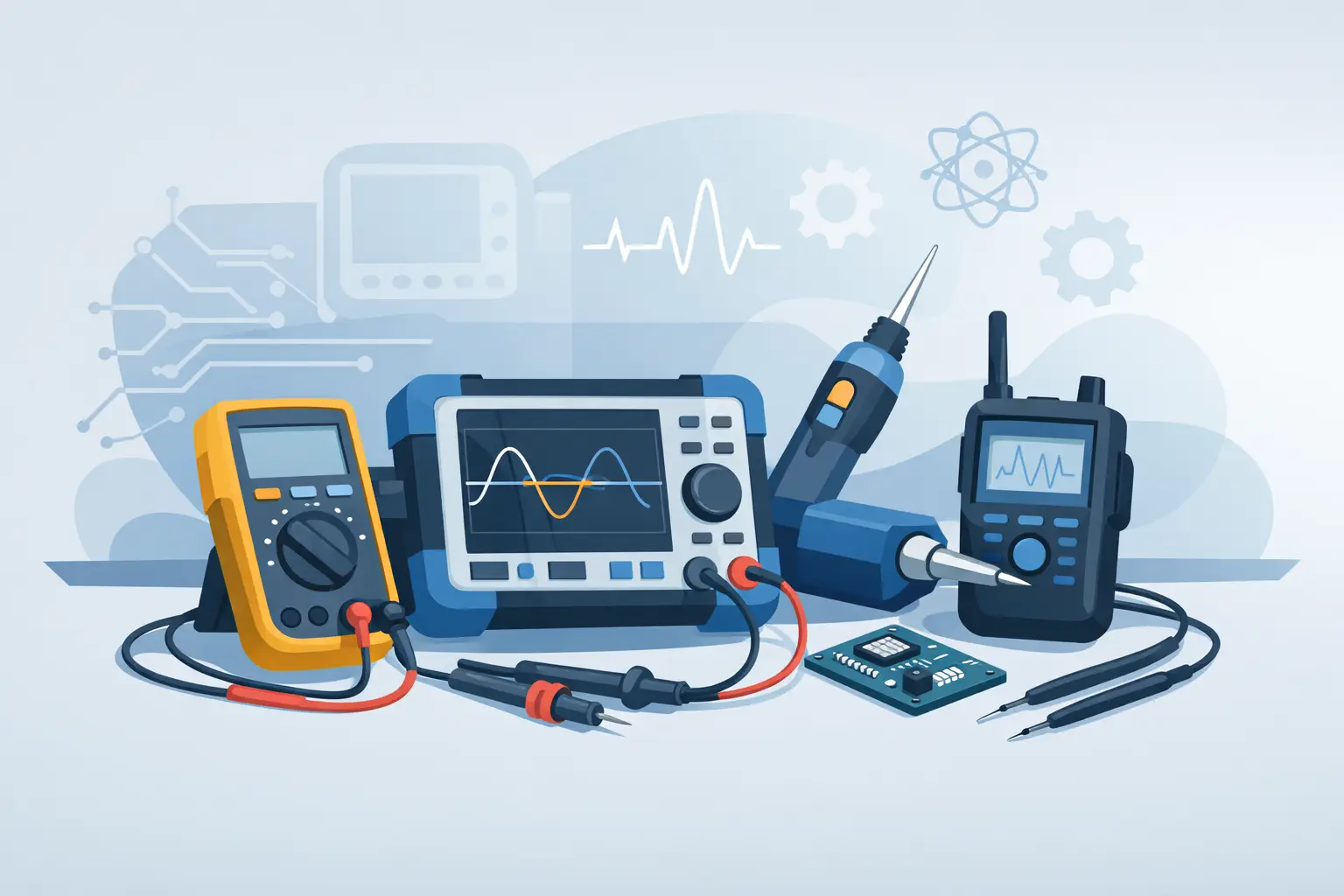
A dead board on the bench rarely gives you much room. You may have a few square inches around an IC, a handful of suspect passives, and a short window to find the fault before the next unit lands in queue. That is exactly where top portable test instruments earn their place. The best handheld tools do more than fit in a pocket. They reduce setup time, improve repeatability, and let you verify components where they sit instead of pulling half the board apart.
For electronics troubleshooting, portability is not just about size. It is about how quickly an instrument gets to a valid measurement, how well it handles real component geometries, and whether its accuracy is good enough to trust when values are close or parts are degraded. A compact tool that saves 20 seconds on every check can easily outperform a more capable benchtop unit for day-to-day field and production work.
What separates top portable test instruments from average handheld tools
The difference usually starts with measurement confidence. A portable meter may look impressive on a spec sheet, but if it requires menu digging, manual range changes, or awkward probe placement, it slows down real work. For technicians dealing with SMT parts, dense layouts, or repetitive inspection, usability is a performance parameter.
Accuracy matters, but so do contact stability, test speed, and automatic parameter selection. A good instrument should tell you what you need with minimal interpretation. If it cannot reliably distinguish a low-value resistor from a damaged inductor, or if it struggles with ESR checks on in-circuit capacitors, it may create more doubt than clarity.
Another separator is application fit. There is no single best portable tester for every bench. A field service engineer may prioritize ruggedness and multimeter functions. An SMT technician may care more about tweezer geometry, low parasitic error, and automatic R, C, L identification. A quality-control user may value calibration traceability and repeatable readings across operators.
The core categories to consider
Most buyers searching for top portable test instruments are really choosing among a few core tool types. Each solves a different part of the workflow.
Digital multimeters
A handheld DMM remains the baseline tool for voltage, continuity, current, and general resistance checks. It is the first instrument most technicians reach for because it answers broad questions quickly. Is power present? Is a fuse open? Is there a short to ground? Those are DMM jobs.
The trade-off is that a DMM is not ideal for component characterization, especially with small surface-mount parts. Standard probes are often too large for compact pads, and basic resistance mode does not tell you capacitance quality, inductance, or ESR with enough depth for serious board-level analysis.
Oscilloscopes and scope meters
Portable scopes are useful when the problem is dynamic rather than static. Clock activity, ripple, switching behavior, and transient faults all demand waveform visibility. For field diagnostics and industrial electronics, a battery-powered scope meter can replace carrying a full bench scope into places where that is impractical.
The downside is cost, battery drain, and complexity. If your daily work centers on passive component verification or sorting reels of SMT parts, a portable scope is not the fastest answer.
Component and LCR meters
This is where many electronics professionals gain the most efficiency. Portable LCR meters are built to measure resistance, capacitance, and inductance directly, often with better relevance than a general-purpose DMM. For repair and assembly work, that matters because many faults involve drifted capacitors, incorrect component values, or damaged inductors.
The better handheld models automate component identification and range selection. That removes the friction of selecting measurement modes for every part and reduces operator error.
ESR meters and specialized passive testers
When capacitor health is the question, ESR matters as much as capacitance. A capacitor can measure near nominal capacitance and still fail under load because ESR has climbed. A dedicated ESR-capable portable tester helps catch this quickly.
Specialized passive testers also make sense when speed is more important than broad functionality. If your job is repetitive board repair, incoming inspection, or SMT verification, a focused instrument may outperform a general one.
Why tweezer-style LCR tools stand out
Among top portable test instruments for electronics work, tweezer-style LCR meters solve a very specific problem extremely well. They allow direct contact with both ends of an SMD component using a single hand, which is faster and more stable than managing two loose probes on tiny parts.
That difference sounds small until you are measuring 0402 or 0603 components on a populated board. Stable contact affects reading quality. It also affects how long the measurement takes and whether you trust the result enough to move forward.
A well-designed tweezer meter should automatically identify whether the part is resistive, capacitive, or inductive, then apply the proper test parameters without forcing the user into manual setup. That is one reason these tools have become standard for SMT troubleshooting, rework verification, and component sorting.
For this category, details matter. Frequency options, basic accuracy, ESR capability, and calibration support are not just marketing points. They define whether the instrument is good for quick hobby checks or reliable enough for production and professional service. LCR-Reader instruments are designed around that workflow, with automatic measurement, handheld tweezer geometry, and model options that scale from entry-level use to more advanced requirements.
How to evaluate the right instrument for your bench or field kit
The first question is what you measure most often. If the answer is live circuits, wiring, and power rails, start with a strong DMM. If the answer is small passive components, especially surface-mount devices, an LCR or ESR-capable tweezer instrument may deliver more value per use.
The second question is whether you measure in circuit, out of circuit, or both. In-circuit checks are faster, but they introduce parallel paths and surrounding component influence. Instruments that provide stable readings and appropriate test methods for board-level work reduce false calls. For out-of-circuit verification, precision and repeatability become the bigger priorities.
The third question is speed versus flexibility. A menu-heavy instrument may offer more modes, but if routine measurements take longer, that cost appears every day. Many users are better served by a tool that handles the common 90 percent of tasks immediately.
Calibration is another practical buying factor. If measurements support quality decisions, service documentation, or production acceptance, traceable calibration and known accuracy are essential. A cheap meter without calibration credibility may be fine for informal checks, but it can become expensive when it creates bad decisions.
Battery life, display readability, and probe mechanics are easy to overlook until they become daily annoyances. Good portable instruments reduce fatigue. That matters in repetitive inspection and repair work.
Common buying mistakes
One common mistake is choosing a general-purpose meter for a specialized workflow. If your main task is identifying and verifying SMT passives, a standard DMM with capacitance mode is usually not enough. It can measure something, but not necessarily with the speed or certainty the job demands.
Another mistake is overbuying features that rarely get used. If you do not need waveform capture or advanced logging, a more focused tool may offer better return. The goal is not to own the most functions. It is to remove friction from measurement.
There is also the issue of contact method. Users often compare only electrical specs and ignore how the instrument physically interfaces with the part. For miniature components, probe style can matter as much as stated accuracy.
Building a practical portable test setup
For many technicians, the most effective solution is not one instrument but a compact combination. A reliable DMM covers electrical basics. A portable LCR or ESR-capable tweezer tool covers passive component analysis. If signal behavior is part of your work, a portable scope becomes the third layer.
That setup handles most repair, inspection, and field diagnostics without forcing every problem onto one device. It also lets you choose the right level of precision and speed for the task instead of compromising each time.
Top portable test instruments are the ones that match the measurement to the work with the least wasted motion. If your bench time is valuable, look past feature count and pay attention to contact method, automatic measurement behavior, calibration support, and how often the tool will actually be the fastest way to a trustworthy answer. The right handheld instrument should feel less like a gadget and more like a direct extension of your troubleshooting process.