
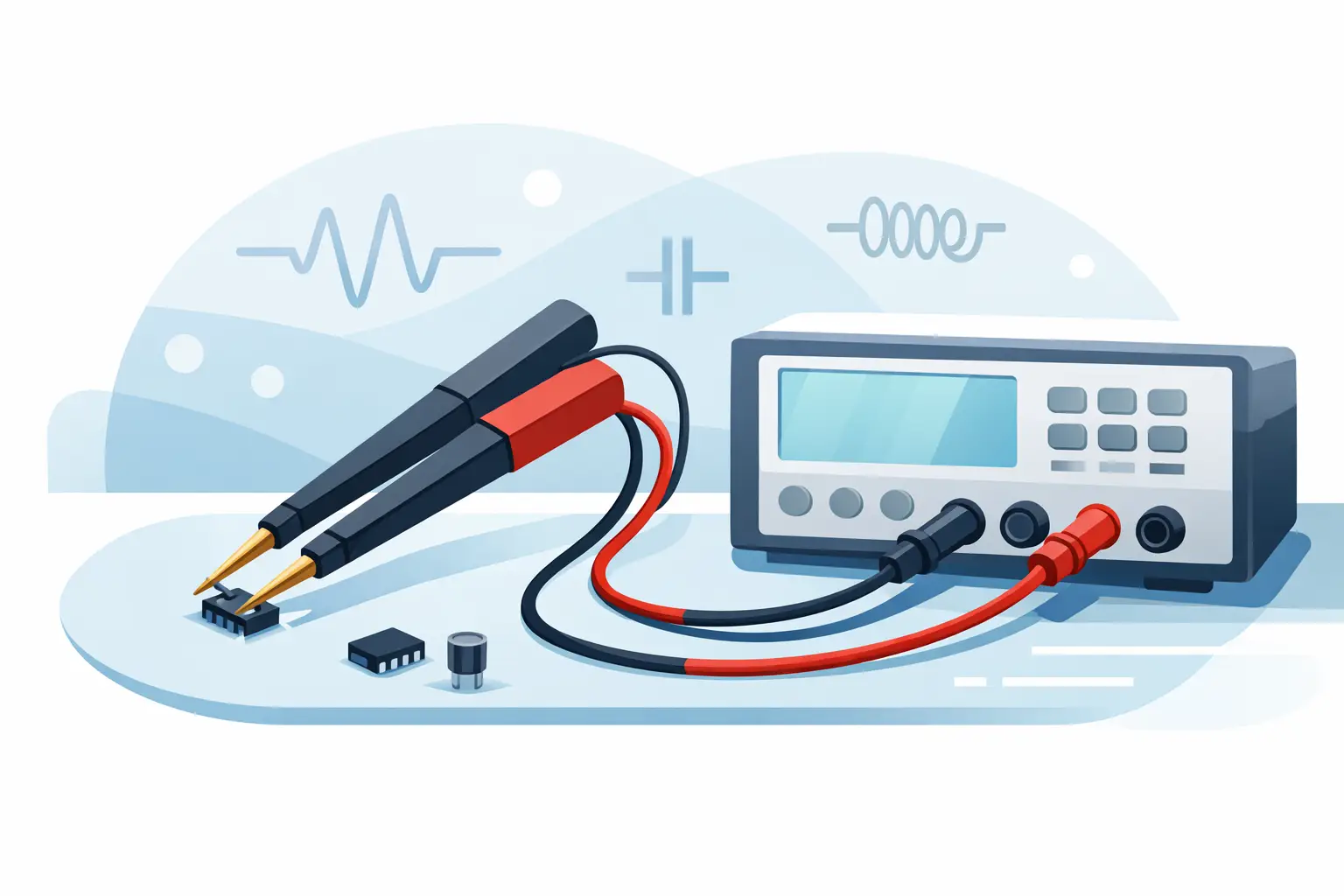
A capacitor that looks fine on the reel can still fail your tolerance target once fixture resistance and contact errors get into the measurement path. That is where a kelvin probe connector for lcr meter testing starts to matter. If you are measuring low impedances, small SMT parts, or parts that are sensitive to lead and contact resistance, the connector and probe arrangement can affect the reading as much as the meter itself.
For many users, the question is not whether a Kelvin accessory is better in theory. It is whether it solves a real measurement problem on the bench. The answer depends on what you measure, how often you switch component types, and how much uncertainty you can tolerate in production, incoming inspection, or repair work.
What a kelvin probe connector for LCR meter actually does
A Kelvin connection uses separate force and sense paths. The force leads apply the test signal to the device under test, while the sense leads measure the voltage directly at the component. That separation reduces the effect of lead resistance, contact resistance, and some fixture-related losses that would otherwise be included in the result.
In a standard 2-wire measurement, the same path handles both current and voltage sensing. That is simple and often good enough for general-purpose work, especially when component values are moderate and lead lengths are short. But as resistance drops, or as ESR becomes the parameter of interest, the resistance in probes, clips, joints, and oxide-contaminated contacts starts to distort the reading.
With a Kelvin probe connector, the goal is straightforward: move the measurement reference as close as possible to the component under test. For low-value resistors, low-ESR capacitors, and many production checks, that difference is not academic. It can determine whether a part passes or fails.
When Kelvin measurement matters most
The strongest case for a kelvin probe connector for lcr meter setups is low-impedance work. Measuring milliohm-range resistance, checking ESR on capacitors, or validating very small inductors can expose the limits of ordinary leads and clips. Even a small amount of series resistance from worn contacts can shift results enough to create false rejects or inconsistent comparisons between operators.
Surface-mount components add another complication. Their geometry is small, contact area is limited, and hand pressure changes the interface. Tweezers-style meters are popular because they shorten the path and reduce setup friction, but there are still jobs where a dedicated Kelvin accessory gives better stability or easier access to the part.
This matters in several common bench scenarios. A repair technician comparing suspect MLCCs may need repeatable capacitance and ESR readings without fixture variation. A quality-control operator may need tighter agreement between stations. An engineer characterizing low-value chip resistors may want to reduce the effect of cable and probe losses before blaming the component lot.
Why connector quality matters as much as meter specs
Users often focus on the LCR meter accuracy specification and overlook the connector system. That is a mistake. The meter can only report what the measurement path delivers. If the Kelvin connector has poor contact integrity, loose mechanical fit, or inconsistent probe pressure, the benefit of 4-wire measurement is reduced.
A good connector needs stable electrical contact, low parasitics, and solid mechanical alignment. It also needs to maintain repeatability when moved repeatedly during normal bench use. For portable instruments, strain relief and connector durability matter more than they do on a fixed bench setup, because the accessory is handled more often and packed away between tasks.
Probe tip design also changes the result. Fine tips help with densely packed SMT boards, but they may concentrate force into a smaller area and wear faster. Broader contact surfaces can improve stability on larger terminations, though they are less useful in crowded layouts. There is no single best tip style for every application.
Trade-offs between tweezers and Kelvin probes
Tweezer-style LCR meters are fast because they minimize setup. Touch the component, let the instrument identify the parameter, and move on. For troubleshooting and sorting, that workflow is hard to beat. It is one reason these tools are widely used for SMT work, field repair, and incoming inspection.
A Kelvin probe accessory changes that balance slightly. You gain improved measurement integrity in demanding cases, but you may lose some speed and convenience compared with direct tweezer contact. If your daily work is general capacitor and resistor identification, the extra fixture may not provide enough benefit to justify the handling overhead.
On the other hand, if your work regularly involves low ESR, low resistance, or measurement disputes between stations, Kelvin measurement can save time by reducing retests and operator doubt. In other words, the accessory adds complexity, but it can remove uncertainty. For many professional users, that is a good trade.
Choosing the right kelvin probe connector for LCR meter setups
Start with compatibility. The connector must match the meter’s electrical design and physical interface. An adapter that fits mechanically but alters the intended measurement path can introduce parasitic errors, offset shifts, or calibration problems. Check whether the meter supports the accessory directly and whether open and short compensation are recommended after connection.
Next, look at the actual measurement range you care about. If you mainly test medium-value capacitors and resistors, the connector may not change your results enough to matter. If you work near the lower end of resistance or ESR, small improvements in fixture error become meaningful. The lower the DUT impedance, the more attention you should give to the connector and probe assembly.
Cable length is another practical factor. Shorter paths usually mean lower parasitic inductance and resistance. Longer cables can make handling easier, especially under a microscope or around larger fixtures, but they can work against high-accuracy measurement. For LCR work, convenience and electrical performance are always linked.
Calibration support should not be treated as optional. If the accessory is part of a measurement system used for production or documentation, you need to know how compensation and calibration are handled. A connector that cannot be integrated cleanly into your verification process may become a weak point, even if the raw readings look acceptable.
Common mistakes that reduce accuracy
The most common problem is assuming 4-wire measurement fixes everything automatically. It does not. Dirty probe tips, oxidized pads, unstable hand pressure, and poor zeroing can still cause drift and inconsistency. Kelvin measurement reduces specific errors. It does not eliminate bad technique.
Another issue is skipping open and short compensation when changing fixtures. If you connect a Kelvin probe and continue measuring with compensation values from a different setup, the results may look precise but still be wrong. Parasitic capacitance and residual impedance belong to the fixture, not just the meter.
Contact location also matters. On a component lead or terminal, measuring at different points changes the effective path. With very low-value parts, even a small difference in where force and sense contacts land can affect repeatability. Consistent placement is part of good metrology, even on a handheld instrument.
Finally, users sometimes push a Kelvin probe into jobs better suited to dedicated tweezers. On crowded boards, poor access can create unstable contact or accidental bridging. If the accessory makes contact worse, theoretical 4-wire advantages may disappear in practice.
Best-fit applications
A Kelvin probe connector makes the most sense when measurement confidence has direct value. That includes sorting low-value passives, checking ESR with tighter repeatability, verifying borderline components, and reducing fixture-related uncertainty in inspection workflows. It is also useful when comparing parts across operators or locations, where a more controlled connection can narrow the variation.
For technicians who need maximum speed on mixed SMT assemblies, integrated tweezer-style measurement may still be the better daily tool. For users who move between quick diagnostics and precision checks, a meter ecosystem that supports both direct tweezer use and Kelvin accessories offers the most flexibility. That approach lets you stay fast when speed matters and become more rigorous when the part or specification demands it.
This is where product design matters. A well-matched handheld meter and accessory system can provide practical portability without giving up the measurement discipline expected in professional electronics work. LCR-Reader users often value that balance because it supports both rapid troubleshooting and more controlled component evaluation on the same bench.
The right question is not whether a Kelvin connector is more advanced. It is whether it reduces enough uncertainty in your actual workflow to justify using it. If your measurements live close to the limits of contact resistance and fixture error, the answer is often yes. When the numbers are small, the connection is part of the instrument – and treating it that way usually leads to better decisions at the bench.