
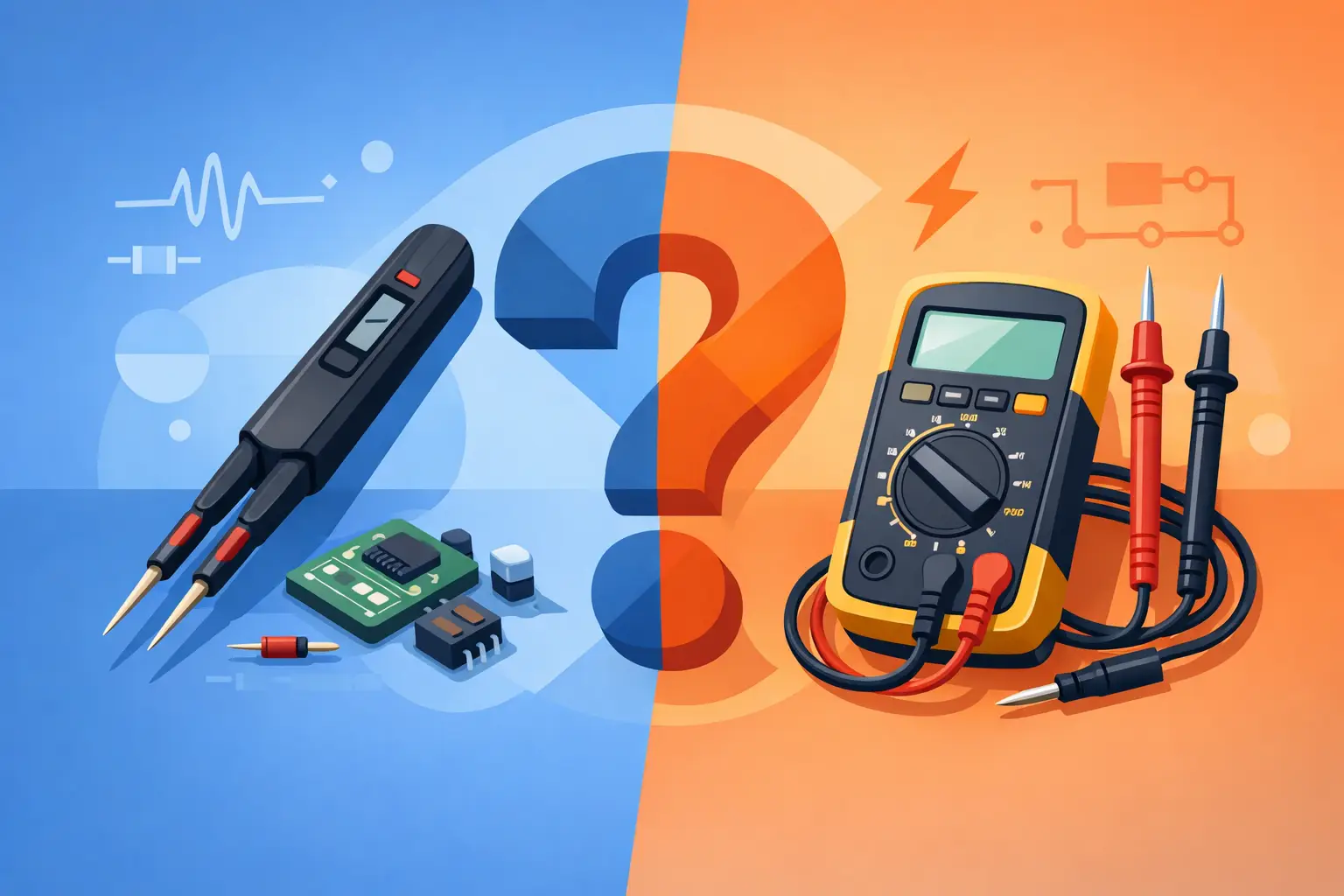
If you work with 0402 passives, packed PCBs, or incoming component bins, the question is not whether you need a meter. It is whether a tweezer meter vs multimeter gives you the faster, more reliable answer for the job in front of you. Both tools measure electrical values, but they are built around very different workflows, and that difference matters when seconds and accuracy both count.
Tweezer meter vs multimeter: the real difference
A multimeter is a general-purpose electrical test instrument. It is designed to measure voltage, current, resistance, continuity, and often diode drop, frequency, and capacitance. For field service, power troubleshooting, and general electronics work, it is often the first tool on the bench.
A tweezer meter is a component-focused instrument. Instead of two loose probes on leads, it uses tweezer-style tips to contact both ends of a component directly. In most cases, it is built to identify and measure passive components such as resistance, capacitance, and inductance, often with ESR support and automatic component recognition. That makes it fundamentally better suited to surface-mount work, where grabbing a tiny part quickly and getting a stable reading is more valuable than broad electrical test coverage.
The trade-off is simple. A multimeter does more categories of measurement. A tweezer meter does fewer categories, but does them faster and more naturally on small components.
Where a multimeter still makes more sense
For many technicians, the multimeter remains non-negotiable. If you need to check rail voltage, verify current draw, trace a short on a power input, or test continuity across a harness, a tweezer meter is not a substitute. Those jobs require flexible leads, broader ranges, and functions designed for energized circuits or general-purpose diagnostics.
A good multimeter is also the better choice when component size is not the issue. Through-hole resistors, large capacitors, connectors, switches, cables, and power supplies all fit comfortably within a multimeter workflow. Even when a multimeter includes capacitance measurement, though, that function is usually secondary to its core role. It can confirm a value, but it is rarely optimized for rapid in-circuit sorting of dense SMT parts.
This is where users sometimes expect too much from one instrument. A multimeter can be a very capable all-around tool, but it is not shaped around component handling. When you are balancing probe tips on a 0603 capacitor, the limitation is not always measurement circuitry. It is the physical interface.
Why tweezer meters are faster on SMT components
The advantage of a tweezer meter starts with contact geometry. Two aligned tips let you grip a component in one motion, rather than placing separate probes at each end and trying not to slip. On a crowded board, that cuts handling time and reduces bad readings caused by unstable contact.
Modern tweezer meters also reduce setup friction. Instead of selecting mode, range, and sometimes test conditions before every reading, many units automatically identify whether the part is a resistor, capacitor, or inductor and apply appropriate measurement parameters. For troubleshooting and part verification, that changes the pace of the work. You touch the component and read the result.
That speed matters in several common situations. If you are checking reels before assembly, verifying removed parts during repair, comparing suspect passives against known-good values, or sorting mixed components on the bench, the measurement process needs to be almost immediate. A general meter can perform some of these tasks, but it usually introduces more hand movement, more setup, and more opportunities for contact error.
Accuracy is not just a number on a spec sheet
In a tweezer meter vs multimeter comparison, users often focus on which instrument looks more accurate on paper. That is only part of the story. Measurement quality depends on what you are measuring, how you are contacting it, and whether the test method matches the component.
For low-value resistors, small capacitances, and inductive parts, lead effects and contact quality can distort readings. A purpose-built tweezer meter often minimizes these issues through short measurement paths, Kelvin-style approaches in some designs or accessories, and test routines intended for passive components. That can produce more consistent results in real bench use, especially on small SMD parts.
A multimeter may still publish good basic resistance accuracy, but that does not mean it is the better instrument for evaluating ESR or identifying a tiny inductor quickly. Likewise, a tweezer meter may be extremely strong in passive component measurement while offering little or no value for live circuit voltage checks. Accuracy has to be matched to application.
Calibration also deserves attention. If your work involves QC, documented service processes, or production support, traceable calibration and repeatability are more useful than raw marketing claims. Instrument choice should reflect the quality standard your workflow actually requires.
Tweezer meter vs multimeter for in-circuit testing
This is where the answer becomes more nuanced. A tweezer meter is excellent for quick in-circuit checks on many passive components, but in-circuit readings always depend on the surrounding network. Parallel paths, semiconductors, and adjacent components can skew measured values. No handheld meter can completely eliminate circuit influence.
What a tweezer meter does well is make these checks practical. It lets you move quickly from part to part, compare behavior across similar locations, and isolate suspicious values without the overhead of clip leads or awkward probe placement. For board-level troubleshooting, that speed often leads to faster fault localization.
A multimeter can perform some in-circuit resistance and continuity testing just fine, and it remains better for checking whether power is present where it should be. But once the task becomes identifying whether a specific capacitor or resistor in a dense area is out of family, the tweezer format usually has the advantage.
The best technicians understand the limitation: neither tool gives perfect in-circuit truth in every case. When readings are ambiguous, lifting one side of the component may still be necessary.
What to look for in a tweezer meter
If your work points toward a tweezer meter, the details matter. Automatic L, C, and R identification is a major time saver, but stability and measurement speed matter just as much. A tool that auto-detects slowly or hunts between modes can interrupt workflow instead of improving it.
Tip quality, spacing, and replaceability also matter in daily use. Fine-pitch SMT work demands precise alignment and reliable contact pressure. The display should be readable at bench angle, and the unit should feel balanced enough for repeated one-handed use.
For more advanced users, features such as selectable test frequency, ESR measurement, diode testing, data logging, or Bluetooth can be worth paying for. The right choice depends on whether you are doing quick service checks, formal inspection, or deeper component analysis. LCR-Reader instruments are built around this exact use case: fast, automatic passive component measurement in a handheld tweezer format, with models that scale from straightforward bench troubleshooting to more advanced professional requirements.
When you need both
For many electronics professionals, this is not an either-or purchase. It is a two-tool bench. The multimeter handles electrical system checks: voltage, current, continuity, and general diagnostics. The tweezer meter handles passive component identification, SMD measurement, ESR checks, and rapid verification.
That combination removes compromise. Instead of forcing a multimeter into fine-pitch component work or expecting a tweezer meter to replace live electrical testing, you use each instrument where it performs best. The result is less wasted motion, fewer questionable readings, and faster troubleshooting.
If you are a hobbyist building occasional kits, a multimeter may be enough at first. If you repair boards regularly, work with SMT every day, or spend too much time chasing stable contact on tiny passives, a dedicated tweezer meter stops being a specialty tool and starts being a productivity tool.
Which one should you buy first?
If you do not already own a meter, start with a multimeter if your work includes power, wiring, continuity, or general electronics service. It covers more basic tasks and gives you broader diagnostic reach.
If you already have a multimeter and your bottleneck is component handling, especially on modern compact boards, a tweezer meter is the smarter next purchase. It solves a specific problem that general-purpose meters do not solve well: fast, accurate measurement of small passive components with minimal setup.
That is the practical answer to tweezer meter vs multimeter. One is broad. One is specialized. The better tool is the one that matches the measurement problem you need to solve most often. If your bench work keeps pulling you toward SMD passives, choose the instrument that lets you touch, read, and move on.