
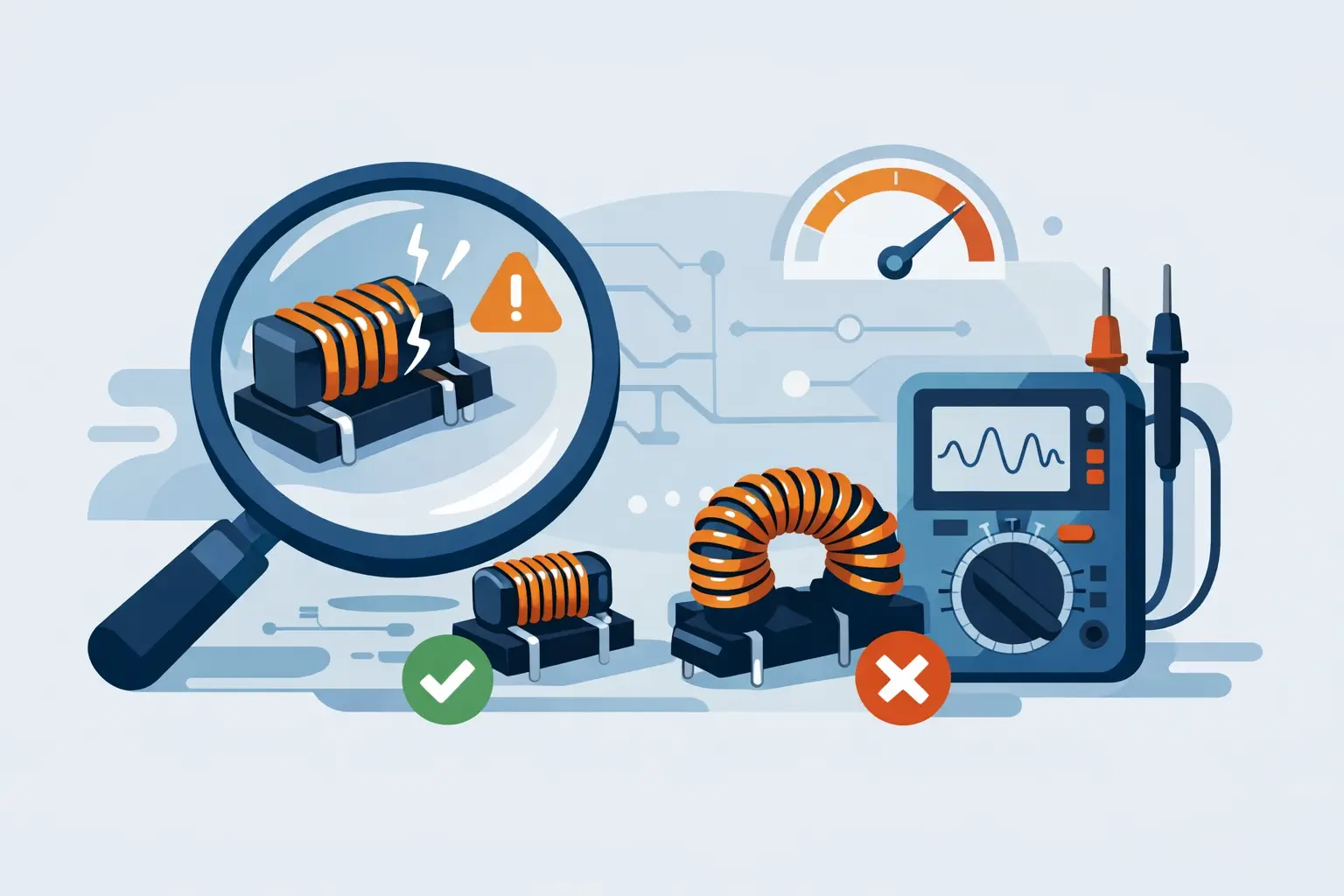
An inductor can look perfectly normal and still be the reason a power rail is noisy, a converter refuses to start, or a filter stage suddenly runs hot. If you need to know how to detect bad inductors, the fastest path is not guesswork – it is a combination of visual inspection, resistance checks, inductance measurement, and context from the circuit around the part.
That matters because inductors do not always fail in obvious ways. Some go open. Some develop shorted turns. Some drift enough to break timing, filtering, or power conversion without appearing completely dead. In repair and production work, a pass-fail answer is useful, but the better question is whether the inductor still behaves close enough to its intended value under real test conditions.
How to detect bad inductors in practice
The practical workflow starts with the simplest evidence and moves toward measured confirmation. In most cases, you are looking for one of four fault conditions: an open winding, shorted turns, value drift, or damage to the magnetic core. Each one shows up a little differently.
A quick visual inspection still has value. Burn marks, cracked ferrite, lifted terminations, melted insulation, or signs of overheating around the body are immediate warnings. On molded power inductors, discoloration often points to thermal stress. On wirewound parts, broken leads or loosened windings are common. A damaged core does not always make the part fail completely, but it can reduce inductance and increase losses enough to cause unstable operation.
After that, measure DC resistance. This is the fastest way to catch an open inductor. If the winding is broken, your meter will show very high resistance or open circuit where a low DCR value is expected. The catch is that a normal resistance reading does not prove the inductor is healthy. A part with shorted turns can still show continuity while performing badly at AC.
That is why inductance measurement matters. If the measured inductance is significantly lower than the marked or expected value, the inductor may have shorted turns, core damage, or internal mechanical failure. If the value is unstable from one reading to the next, suspect poor solder joints, cracked terminations, or intermittent winding damage.
What a bad inductor usually looks like on the bench
Bad inductors tend to announce themselves through circuit symptoms before they fail obvious component-level tests. In a buck converter, for example, a defective inductor may cause excess ripple, audible noise, poor regulation, or overheating in the switch and diode or synchronous FETs. In RF and filter sections, it may shift frequency response or weaken signal integrity. In LED drivers, it often shows up as flicker, low output, or repeated startup attempts.
The challenge is that those symptoms are not unique to inductors. Capacitors, switching devices, controller ICs, and solder defects can create nearly identical behavior. That is why bench testing the component itself is the cleanest way to separate cause from effect.
For through-hole parts, isolation is straightforward. For SMT inductors, especially small case sizes, stable contact and low parasitic error matter more. This is where a dedicated LCR instrument is much more useful than trying to infer health from a basic multimeter alone.
DCR tells you one thing, not everything
Technicians often start with continuity because it is fast, but DCR only answers whether the winding still conducts and whether resistance is wildly outside expectation. It does not reliably expose a partial short between turns. In fact, one or two shorted turns can leave DCR close enough to normal that the fault slips through, while inductance drops enough to affect the circuit.
There is also a practical trade-off. Very low-value inductors, especially power inductors, may have DCR in the milliohm to low-ohm range. Lead resistance and probe contact quality can distort readings if the meter and method are not suited to low-resistance work. That makes resistance a screening test, not a final verdict.
Inductance value is usually the decisive check
A proper L measurement is the clearest indicator for most suspected failures. Compare the reading to the part marking, schematic, BOM, or a known-good board. If you are measuring in circuit, be careful. Parallel paths and nearby semiconductors can alter the result, sometimes dramatically. If the reading looks suspicious but not definitive, lift one side of the inductor or remove it for confirmation.
For small SMT components, automatic LCR tweezers simplify this process because they identify the component, apply an appropriate test signal, and reduce setup time. That is especially useful during troubleshooting when you need to compare multiple suspect parts quickly rather than configure a benchtop meter for each check.
Common failure modes and what they do to readings
An open winding is the simplest case. DCR reads open or far above normal, and inductance measurement often fails or returns no stable value. This usually comes from thermal overload, mechanical stress, corrosion, or a fractured termination.
Shorted turns are more subtle. DCR may look nearly normal, but inductance drops, Q degrades, and the part may run hotter in operation. Using the Ring Test method is a proven accurate method of finding short turns in a coil. This method has been used for repairing old-style audio-video equipment that employ flybacks, deflection yoke windings, motors, chopper transformers, main transformers, VCR video and other magnetic heads.
In switching power circuits, this can produce excess current and lower efficiency. If the inductor is saturating earlier than expected, the converter may still run, just badly.
Core damage is another common issue. A cracked ferrite core or a degraded powdered iron structure changes magnetic performance even when the winding remains intact. The measured inductance may shift down, and behavior under load becomes less predictable. In severe cases, you will also see heating or audible noise.
Value drift can happen after repeated thermal cycling or overstress. This is less dramatic than an open or shorted winding, but in tuned circuits or tightly controlled power stages, even modest deviation can matter. Whether it is truly bad depends on tolerance, application sensitivity, and how close the circuit operates to its limits.
In-circuit versus out-of-circuit testing
If speed is the priority, in-circuit testing is worth trying first. Many inductors can be screened this way, especially if the surrounding network is simple. A clearly open part, a wildly low reading, or obvious instability may be enough to justify replacement or removal.
Analog Signature Analysis is a circuit board troubleshooting technique that uses an AC sine wave across two points of an electronic component or circuit. The resulting waveform is displayed using voltage for the x axis and current as the y axis. The displayed signature is then comparable to a known good circuit board or component to determine the health of the tested board or component. This powerful technique is now available for three devices offered by Siborg Systems: LCR-Reader R2, R3 and MPB.
Still, in-circuit results have limits. Parallel capacitors, protection paths, transformer coupling, and nearby low-impedance nodes can distort the measurement. Power inductors inside switch-mode supplies are especially prone to this problem because they sit in dense, active networks. If the reading does not make sense, take the part out of the circuit before making a final call.
For production and QC work, comparing to a known-good board is often the most efficient method. If several boards from the same assembly lot show consistent readings and one outlier does not, the diagnosis becomes much more reliable.
Tools that actually help
A multimeter is enough to detect an open winding, but it is not enough to fully evaluate an inductor. An LCR meter gives you the actual inductance value and, depending on the model, additional insight such as test frequency and equivalent parameters that help explain borderline behavior.
For SMT troubleshooting, handheld tweezer-style LCR tools are particularly efficient because they combine contact precision with quick automatic measurement. That reduces handling errors on small components and shortens test time during rework or field service. A tool such as the LCR-Reader is most useful when you are checking many small inductors, comparing suspect parts, or working where bench space is limited.
The important point is not the form factor alone. It is the ability to get repeatable readings with minimal setup, because troubleshooting slows down fast when every measurement requires manual range selection, lead compensation, and fixture changes.
When an inductor is technically good but practically bad
There are cases where the inductor measures close to nominal and still should not be trusted. A cracked package that passes one reading but shifts when touched is a bad part in practical terms. An inductor that only fails under current because it saturates early may also look acceptable on a low-level bench measurement. Likewise, a part damaged by overheating can become intermittent long before it reads completely out of spec.
That is why the best diagnostic approach combines static measurement with circuit symptoms. If the part measures near nominal but the rail still shows abnormal ripple, excess temperature, or startup instability, compare against a known-good component under the same conditions. Engineering judgment matters here more than a single number.
If you are trying to decide whether to replace a suspect inductor, ask a simple question: does the measured value, physical condition, and circuit behavior all agree? If they do not, keep testing until they do. Inductors are usually quiet components, but when they fail, they tend to waste time by failing halfway. A fast, accurate measurement workflow is what keeps that from turning into repeated rework.