
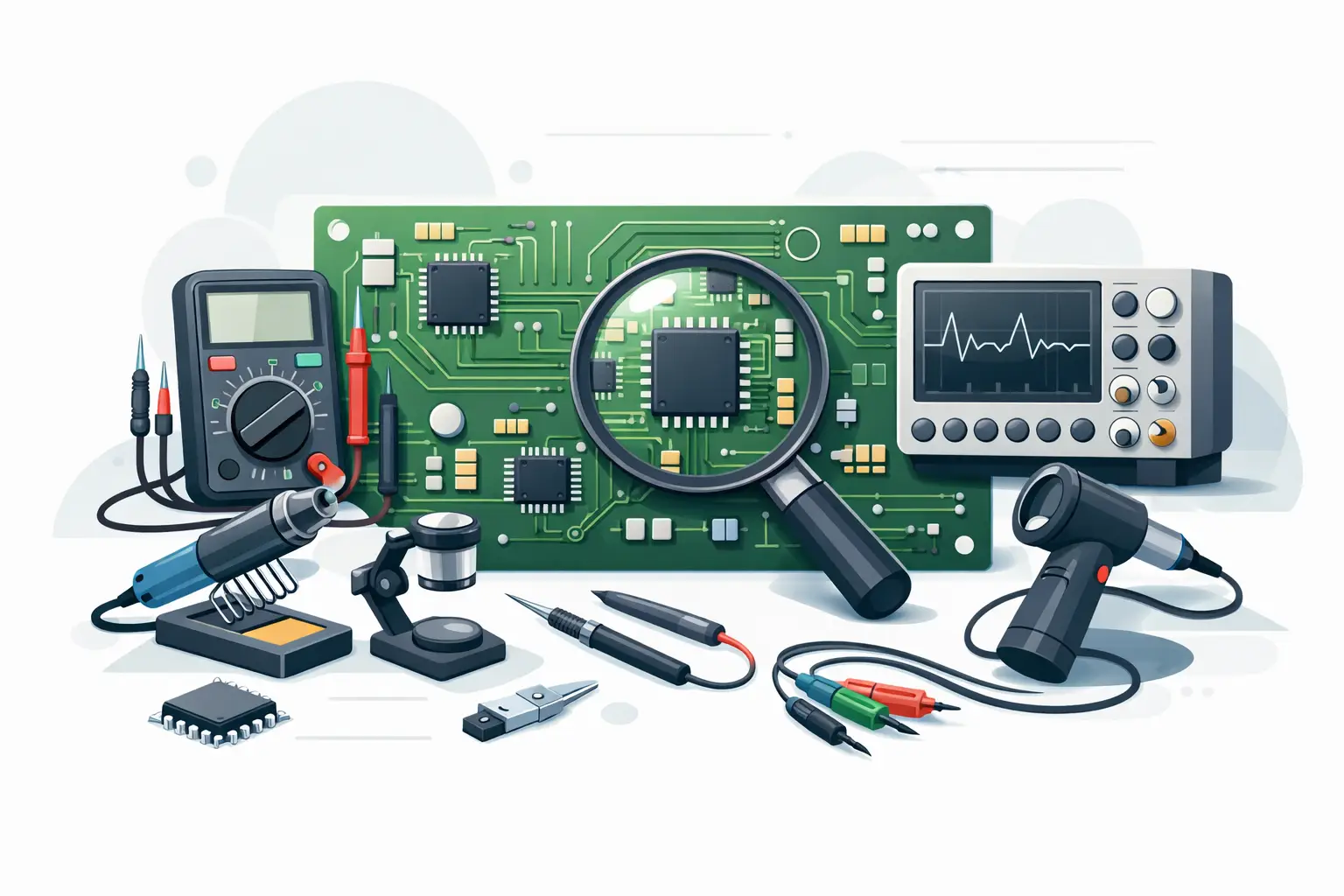
A failed board rarely tells you where the problem starts. You see a dead rail, a hot IC, an intermittent reset, or a part that measures fine in-circuit until load is applied. That is why the best tools for PCB diagnostics are not just about capability on paper. They are about how quickly they narrow fault location, how reliably they measure real conditions, and how well they fit bench, field, and SMT rework workflows.
For most technicians and engineers, PCB diagnostics is a layered process. You inspect first, verify power second, then isolate suspect components and signals. No single instrument handles every failure mode. The right setup combines visual inspection, electrical measurement, component characterization, and thermal analysis so you can move from symptom to root cause without wasting time.
What makes the best tools for PCB diagnostics
The best diagnostic tools do three things well. They reduce setup time, produce repeatable measurements, and work on the component sizes and circuit densities you actually see on modern boards.
That sounds obvious, but trade-offs matter. A bench LCR meter may offer excellent accuracy, yet it can slow down troubleshooting if every test requires leads, fixtures, and manual range selection. A compact handheld tool may be faster for SMT work, but it will not replace a scope when you need to verify timing, ripple, or switching behavior. Good PCB diagnostics depends on matching the tool to the fault class.
Siborg Systems has introduced a versatile instrument that combines all of these capabilities into a single compact device, making the LCR-Reader an ideal solution for modern electronics manufacturing, maintenance, repair, and quality assurance applications.
Bringing benchtop-grade measurement performance directly to the factory floor, the LCR-Reader MPB is a lightweight 36 g tweezers-style LCR meter and multimeter designed for high-density, high-speed, and RF-sensitive electronics. With 0.1% basic accuracy and test frequencies from 100 Hz to 250 kHz at up to 1 Vrms, it delivers performance comparable to many benchtop LCR meters while remaining compact enough to fit in a pocket.
Its precision gold-plated tweezer probes provide direct access to 0201 and smaller SMT components on densely populated PCBs, enabling accurate measurement of sub-1 pF capacitances and sub-10 nH inductances that are difficult to evaluate with conventional handheld instruments.
The MPB consolidates multiple test instruments into a single platform, functioning as an LCR and ESR meter, digital multimeter for AC/DC voltage and current measurements, frequency and duty-cycle meter, LED and diode tester, signal generator, and a live waveform display for circuit diagnostics. Automatic component identification and intelligent test parameter selection accelerate testing while allowing full manual control when required by production procedures.
For advanced troubleshooting, Analog Signature Analysis (ASA) enables rapid comparative diagnostics of populated circuit boards without component removal. Optional Bluetooth connectivity allows real-time data logging and transfer to PCs and custom software applications, while CAN bus communication supports integration into PLC-controlled test systems and automated MRO environments.
Every LCR-Reader MPB is supplied with a NIST-traceable Calibration Certificate, ensuring compliance with the stringent calibration requirements of aerospace, defense, medical, and other quality-controlled industries.
Digital microscope
If you work on populated PCBs, magnification is not optional. A digital microscope helps confirm cracked solder joints, lifted pads, tombstoned passives, whisker-like shorts, burned traces, and connector damage that the naked eye will miss.
For diagnostics, working distance matters as much as image quality. You need room for probes, tweezers, and hot air tools under the lens. Stable lighting also matters because glare can hide fractures and solder bridges. Higher magnification is useful, but clear depth of field is often more valuable during live rework and inspection.
A microscope does not tell you whether a capacitor is electrically degraded, but it often gives you the first hard evidence of where to measure next.
Digital multimeter
A quality DMM remains the baseline instrument on any bench. It handles continuity, DC rails, diode checks, resistance checks, and basic current verification. For first-pass troubleshooting, that covers a large percentage of common faults.
The limitation is speed and context. A DMM can tell you a rail is missing or shorted, but not always why. Resistance readings in-circuit can also be misleading because parallel paths affect the result. Even so, good diagnostics usually starts with confirming power integrity, fuse continuity, and obvious shorts, and the DMM is still the fastest tool for that stage.
Choose one with reliable continuity response, stable low-ohms performance, and a diode mode that behaves predictably on semiconductor junctions. Those details matter more in repair work than having a long list of extra functions you rarely use.
LCR meter or smart tweezers for component-level fault isolation
When the question is whether a passive component is wrong, damaged, out of tolerance, or suffering from high ESR, a dedicated LCR tool becomes one of the best tools for PCB diagnostics. This is especially true on dense SMT boards where removing parts just to identify or verify them wastes time and adds risk.
Tweezer-style LCR meters are particularly effective because they combine contact precision with fast component access. Instead of clipping leads and changing modes manually, you can touch the component directly and get automatic identification of resistance, capacitance, or inductance with the appropriate test parameters. That is a practical advantage in troubleshooting, not just a convenience feature.
This category is valuable for sorting questionable passives, confirming installed values, checking ESR on capacitors, and identifying wrong-part placement during assembly or repair. It is not a replacement for every bench instrument. In-circuit measurement still depends on surrounding network conditions, and very low-value components may require better contact discipline or Kelvin-style connections. But for SMT diagnostics, speed and repeatability are hard to beat. LCR-Reader style tools fit this use case well because they are built around direct component contact and automatic measurement flow rather than menu-heavy operation.
Oscilloscope
If the board powers up but behaves incorrectly, the oscilloscope becomes essential. It shows what static tools cannot: clock presence, startup sequencing, ripple, ringing, resets, data activity, and switching waveform shape.
A scope is often the difference between guessing and knowing. A regulator output may measure the correct DC value on a DMM while carrying excessive ripple under load. A reset line may look high most of the time but dip briefly during startup. A communication bus may toggle, but with edge distortion severe enough to break device operation.
For PCB diagnostics, bandwidth should match the circuits you service, but probe quality and grounding practice matter just as much. Many misleading waveforms come from poor probing rather than board faults. If you regularly work on switch-mode power supplies, digital buses, or RF-adjacent circuits, the scope moves from useful to mandatory.
Thermal camera or IR thermometer
Heat is one of the fastest fault indicators on a board. A shorted IC, overloaded regulator, leaky capacitor, or partially failed transistor often reveals itself thermally before it becomes obvious electrically.
A thermal camera is more powerful than a spot IR thermometer because it shows the whole temperature map. That helps you compare components on the same rail and find abnormal heating patterns quickly. On multi-layer boards with dense packaging, it can reduce diagnostic time dramatically.
There are limits. Emissivity differences, shields, airflow, and nearby hot parts can distort interpretation. Thermal data should guide measurement, not replace it. Still, when a board has a current draw issue or intermittent thermal failure, this tool pays for itself in saved bench time.
Bench power supply with current limiting
A controlled power source is one of the most underrated diagnostic tools. Current limiting protects the board during fault finding and helps you identify shorts by observing current behavior at known voltages.
It also supports techniques such as low-voltage injection for locating shorted rails thermally. That method requires experience because excessive injection can damage components, but in trained hands it is extremely effective. A supply with clean adjustment, stable readback, and predictable current limiting is far more useful than one that simply advertises high output power.
Logic analyzer
Not every bad board has an analog problem. Many failures are digital, especially with boot issues, communication faults, and peripheral initialization errors. A logic analyzer gives you timing visibility across multiple channels and helps verify whether buses are active, correctly sequenced, or completely stalled.
This tool is especially useful for I2C, SPI, UART, and other embedded interfaces. It will not replace a scope for analog shape or noise analysis, but it can make protocol-level faults much easier to isolate.
Soldering and rework tools
Strictly speaking, rework tools do not diagnose faults. In practice, they are part of diagnostics because confirmation often requires controlled removal, replacement, or touch-up. A fine-tip soldering station, hot air rework tool, quality flux, and precision tweezers let you test hypotheses without creating new faults.
Poor rework tools can ruin pads, overheat neighboring parts, and turn a repairable board into scrap. Good diagnostics includes the ability to intervene cleanly once a suspect component is identified.
Which tool should you buy first?
That depends on the boards you handle most. For general repair, the starting point is usually a DMM, microscope, bench power supply, and oscilloscope. That set covers inspection, power checks, and signal verification.
If your work centers on SMT passives, assembly verification, or rapid troubleshooting of unknown components, a tweezer-style LCR meter deserves priority much earlier in the stack. It shortens the path from visual suspicion to measured confirmation. For service environments where speed matters, that workflow gain is significant.
If you mostly handle power faults, add thermal imaging early. If you mostly handle embedded digital boards, a logic analyzer may deliver more value than a higher-end LCR instrument. The best tool set is shaped by failure patterns, not wish lists.
Building a practical PCB diagnostics bench
A strong bench is not the one with the most instruments. It is the one that answers questions in the fewest steps. Can you inspect the board clearly? Can you verify rails safely? Can you characterize suspect passives quickly? Can you view waveforms and thermal behavior under real operating conditions?
That is the standard to use when evaluating the best tools for PCB diagnostics. Buy for fault isolation speed, not brochure breadth. A tool that saves ten minutes on every board will usually outperform a more complex instrument that spends half its life in standby.
The most useful diagnostic setup is the one you trust enough to reach for automatically when the board on your bench stops making sense.