
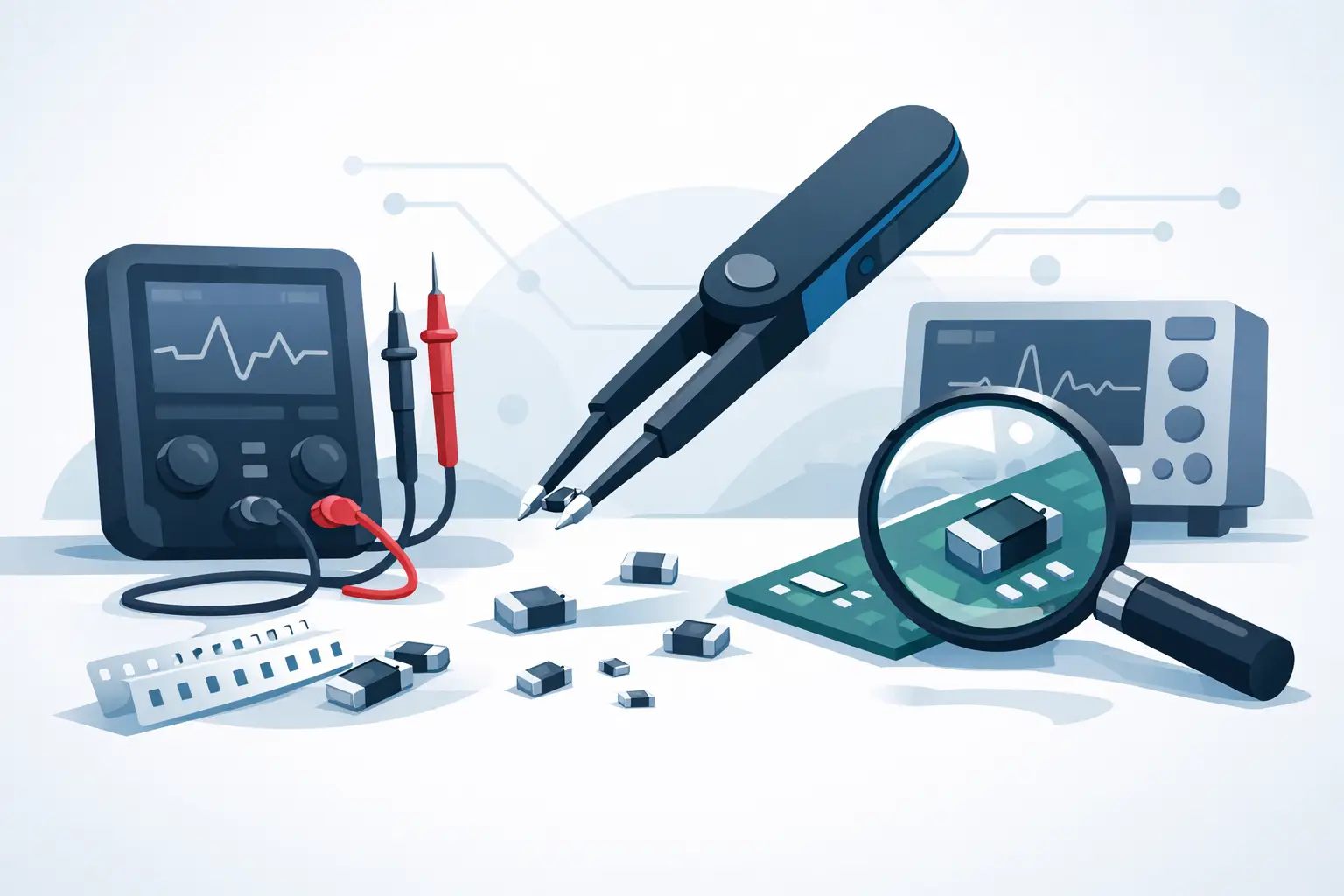
A 0402 resistor on a crowded board can turn a simple check into wasted bench time fast. The right smd resistor measurement tool cuts through that problem by letting you contact the part cleanly, read the value quickly, and move on without fighting test leads, unstable readings, or constant range changes.
For engineers, repair technicians, and SMT assembly teams, that matters more than it sounds. Resistor verification is rarely an isolated task. It usually happens in the middle of troubleshooting, incoming inspection, rework, or production checks, where speed matters but bad readings cost more than a few seconds. A tool that measures accurately but slows the workflow can be just as frustrating as one that is fast but inconsistent.
What an SMD resistor measurement tool needs to do well
At a basic level, the job seems simple: touch the component and read resistance. In practice, small package size, adjacent parts, operator hand movement, and in-circuit influence make the task less forgiving. That is why tool design matters as much as measurement range.
A useful smd resistor measurement tool should provide stable contact on small terminations, fast automatic measurement, and enough accuracy to distinguish close values without hesitation. If the tool forces the user to switch modes manually, fight probe placement, or interpret drifting readings, it stops being a measurement aid and becomes another source of error.
For SMT work, tweezer-style instruments are often the most efficient format because the probe geometry matches the component geometry. Instead of trying to land two separate probes on a tiny chip resistor, the operator grips the part from both ends in one motion. That sounds like a small ergonomic detail, but on dense boards it changes the whole pace of testing.
Why conventional meters often struggle
A standard handheld multimeter can measure resistance accurately enough in many situations, but it is not always the best fit for SMD resistors. The problem is not the resistance function itself. The problem is access, contact stability, and setup friction.
Using two loose probes on 0603 or 0402 parts is awkward even for experienced technicians. One hand may need to steady the board, the other has to place both probes, and nearby components can interfere with tip placement. If the board is populated densely, probe slip becomes likely. That leads to inconsistent readings or accidental shorts across neighboring pads.
Benchtop LCR meters provide higher precision and deeper test options, but they are not always practical for quick checks. They may require fixtures, test leads, parameter setup, and more bench space than field or repair work allows. For production engineering or lab characterization, that can be acceptable. For fast identification and troubleshooting, it can be excessive.
This is where compact automatic LCR tweezers have a clear advantage. They reduce setup time and make resistor checks feel closer to direct inspection than instrument operation.
Key specifications that actually matter
Not every specification has equal value for resistor work. Buyers often focus first on range, but for most SMD resistor measurement tasks, usability and reading stability are just as important.
Accuracy and resolution
If you are sorting values, verifying assemblies, or checking precision resistors, basic resistance range is not enough. Look at the stated accuracy across the range you will actually use. A wide-range instrument with weaker accuracy in common low-value or mid-value bands may be less useful than a tool with narrower but better-controlled performance.
Resolution also matters when comparing nearby nominal values or evaluating drift. A stable, repeatable reading is generally more useful than a display that shows extra digits but wanders under real hand contact conditions.
Automatic component identification
For mixed benches and fast troubleshooting, automatic identification saves time. A tool that recognizes whether the part is a resistor, capacitor, or inductor reduces operator input and cuts menu interaction. That is especially valuable when working through populated boards where the component under test is not always obvious at a glance.
Probe design and tip geometry
This is one of the most overlooked selection points. Fine, durable tweezer tips with appropriate spacing make it easier to contact chip resistors without touching adjacent components. Good spring force and tip alignment improve repeatability. Poor mechanical design will show up immediately in day-to-day use, even if the electrical specs look competitive on paper.
Measurement speed
A slow measurement cycle breaks concentration during repetitive work. Fast acquisition is critical when checking multiple parts in sequence or moving through fault isolation on an assembled PCB. The tool should settle quickly and display a usable value without repeated repositioning.
Calibration and confidence
For quality control, production support, and professional service environments, calibration support is not optional. A tool used to approve parts, verify assemblies, or document test outcomes needs traceable confidence behind the measurement. This separates serious instruments from low-cost convenience devices.
In-circuit measurement is useful, but it has limits
Many users want one answer to a common question: can an SMD resistor measurement tool read parts in circuit? Sometimes yes, but it depends on the surrounding network.
If the resistor is isolated enough from parallel paths, the reading can be reliable and fast. If neighboring components create alternate current paths, the measured value may be lower than the resistor’s actual standalone value. That is not a tool failure. It is the reality of measuring in a live network topology, even on an unpowered board.
Experienced technicians use in-circuit resistance readings as a diagnostic clue, not blind proof. If the reading is suspicious, lifting one side of the component may still be necessary. The better tool helps you get to that decision faster by giving a stable first reading instead of adding uncertainty.
Choosing the right format for your workflow
The best smd resistor measurement tool depends on where and how it will be used.
For bench troubleshooting and board repair, a handheld tweezer-style LCR meter is usually the most efficient option. It minimizes setup, reaches tight component spacing, and supports repeated measurements with one instrument. For mobile work, portability becomes even more important because carrying a benchtop meter and accessories is rarely practical.
For incoming inspection, component sorting, and general electronics work, automatic measurement speeds up repetitive checks. In this environment, users benefit from a tool that can identify and measure multiple passive component types instead of resistance only. That flexibility reduces bench clutter and keeps the process consistent.
For advanced lab evaluation or design verification, a benchtop instrument may still be the right answer when you need deeper parameter control, fixture integration, or documented precision at specific test conditions. But many day-to-day resistor checks do not need that level of overhead.
A well-designed tweezer meter often sits in the most productive middle ground: fast enough for troubleshooting, accurate enough for professional use, and compact enough to stay within reach.
Features that improve real SMT work
Some features look minor in a spec sheet but make a measurable difference in use. Automatic ranging is one of them. It removes manual range selection and helps maintain flow during repeated tests. Backlit displays are another practical gain when working under bench lights, microscopes, or less-than-ideal field conditions.
Manual test frequency control can matter too, although more for capacitors and inductors than resistors. Bluetooth logging or app connectivity is useful when documenting measurements, comparing readings over time, or sharing data during inspection and repair. These features are not mandatory for every buyer, but they can be worthwhile if reporting or traceability is part of the job.
Build quality also deserves attention. In SMT environments, tools are handled constantly, packed for travel, and exposed to flux residue, ESD-safe surfaces, and repetitive contact wear. A device with solid tip construction, dependable housing, and supported accessories will usually outlast cheaper options that look similar in a catalog.
When a specialized tool pays for itself
If you only measure an occasional resistor on an open board, a standard meter may be enough. But once SMD work becomes routine, the economics change quickly. Time lost repositioning probes, double-checking unstable values, or removing components unnecessarily adds up.
A specialized instrument earns its place by shortening measurement time and reducing avoidable mistakes. That value shows up in faster rework, fewer component identification errors, and smoother fault isolation. For repair shops, service departments, and production teams, those gains are practical, not theoretical.
This is why many professionals move toward automatic tweezer-based LCR tools such as those used across the LCR-Reader product family. The appeal is straightforward: direct contact, fast identification, and measurement performance that fits real SMT workflows instead of forcing the work to adapt to the instrument.
When you are comparing options, do not just ask whether the tool can measure resistance. Ask how quickly it reaches a stable reading, how confidently it handles tiny parts, and whether its accuracy and calibration support match the decisions you need to make. The right answer is usually the one that keeps your hands moving and your readings trustworthy.