
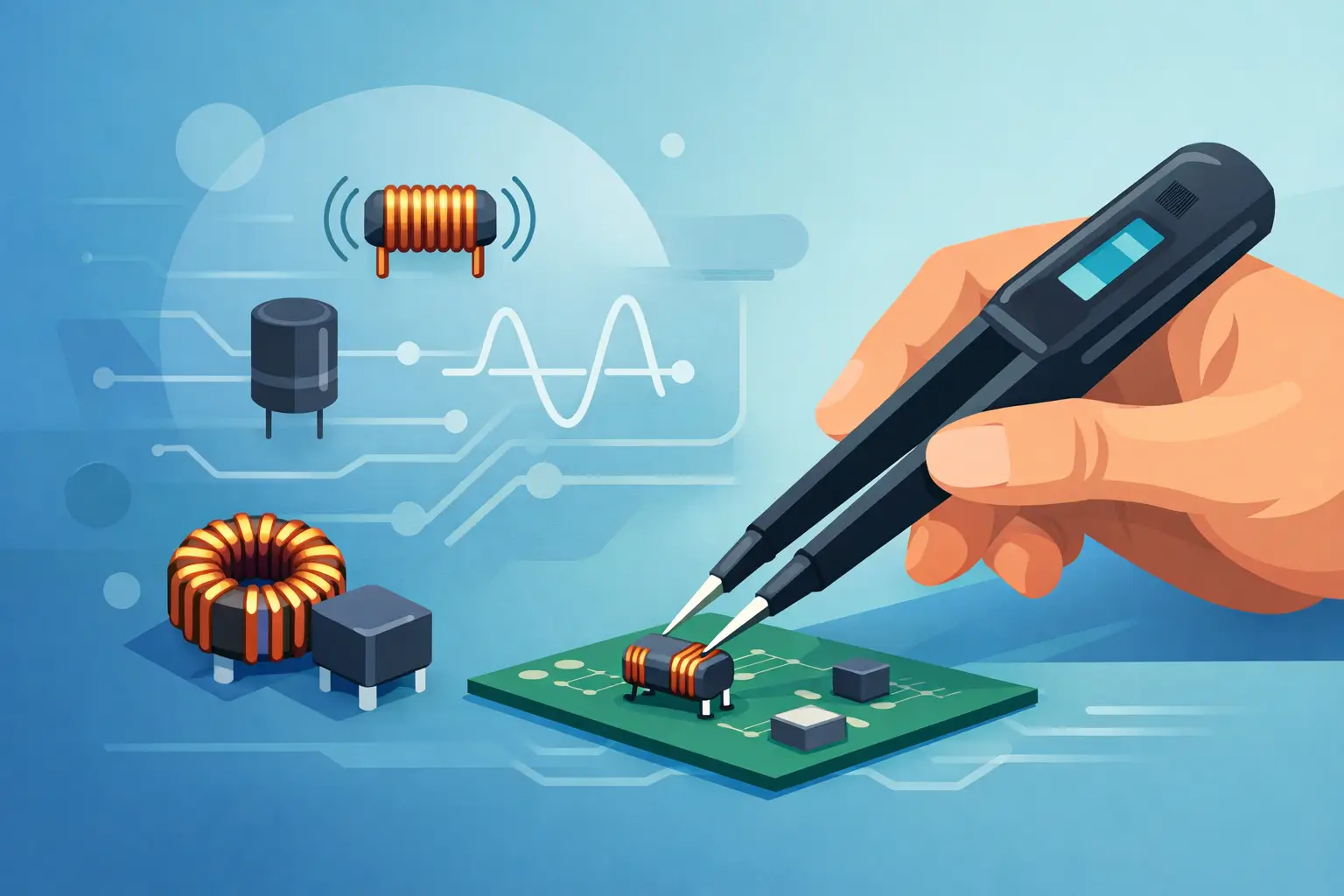
A 0402 inductor does not give you much room for error. If your probes slip, your fingers add movement, or your meter setup takes longer than the actual diagnosis, the measurement is already less useful. That is exactly where inductor measurement tweezers make sense – they shorten the path between picking up a component and getting a reading you can trust.
For technicians and engineers working with SMT boards, the appeal is straightforward. You need to identify inductance quickly, separate good parts from suspect ones, and avoid wasting time with clip leads, probe juggling, or bench instruments that are more capable than the task requires. Tweezers built for LCR measurement solve a very specific problem: how to measure tiny components accurately enough, fast enough, and repeatedly enough for real bench work.
What inductor measurement tweezers actually do
Inductor measurement tweezers are handheld LCR instruments with tweezer probes integrated into the meter body or connected as a dedicated measurement head. They are designed to contact both ends of a component at once, which makes them especially effective for surface-mount inductors, ferrite beads, resistors, and capacitors.
For inductors, the instrument applies an AC test signal and calculates inductance from the component’s response. On better instruments, that process is automatic. The meter identifies the component type, selects a suitable measurement mode, and displays the primary value without requiring the user to step through menus. In practical terms, that means less time deciding which function to use and more time verifying the part in front of you.
That simplicity matters because inductor troubleshooting is rarely isolated. You may be checking a handful of suspect coils in a power section, confirming reel contents before assembly, or comparing values on salvaged boards where part markings are absent or ambiguous. In those cases, setup friction is not a minor annoyance. It slows down the workflow and increases the chance of error.
Why tweezers work better for small inductors
The main advantage is contact geometry. With standard multimeter probes or clip leads, measuring a small inductor often becomes a mechanical problem before it becomes an electrical one. The part is too small to hold comfortably, the probes slide apart, and the reading jumps while you try to keep pressure stable.
Inductor measurement tweezers put both contacts into one hand. That improves alignment and reduces handling movement. On SMT parts, especially 0603, 0402, and similar packages, that difference is significant. A stable grip does not guarantee perfect accuracy, but it does improve repeatability under normal bench conditions.
There is also the question of stray effects. Traditional leads add parasitic inductance, resistance, and capacitance that can distort low-value measurements. Tweezers do not eliminate all parasitics, but the shorter measurement path and fixed probe spacing help reduce them. When the instrument is designed around that geometry and paired with proper calibration, the result is a more practical tool for small-value inductors than general-purpose handheld meters.
Where they fit in real electronics work
In production support and rework, speed is usually the deciding factor. If you are sorting components, confirming BOM substitutions, or checking whether a removed inductor is still within range, you want immediate results. A tweezer-style meter is faster to position on loose SMD parts than a benchtop fixture and more controlled than handheld probes.
For board-level troubleshooting, the value depends on context. If the inductor is isolated well enough in-circuit, tweezers can give you a fast answer. If the surrounding network heavily influences the reading, the result may only be directional. That is not a flaw in the tweezers. It is simply the reality of in-circuit measurement. Parallel paths, nearby semiconductors, and coupled components can all affect the displayed inductance.
Field service is another strong use case. A compact handheld instrument is easier to carry than a full LCR meter setup, and it is often good enough for fault isolation, incoming inspection, and replacement verification. This is one reason tools in the LCR-Reader category have become common on repair benches. They reduce the time between suspicion and confirmation.
What to look for in inductor measurement tweezers
Not all tweezer meters perform the same way with inductors. Measurement range is the first practical check. If you work mostly with low-value power inductors or RF coils, the instrument must resolve small inductance values cleanly. If your work includes larger choke coils, the upper range matters more.
Accuracy and resolution should be considered together. A display with fine resolution is useful only if the measurement engine and calibration support it. For example, a low-value inductor that shows changing digits with every slight movement is not giving you actionable precision. Stable readings matter more than extra decimal places.
Test frequency is another major factor. Inductance is frequency-dependent, and the same component can read differently at different test frequencies. Higher-end instruments may allow manual frequency selection, while entry-level models may rely on automatic test conditions. Neither approach is universally better. Automatic mode is faster and simpler for routine work, while manual control is valuable when you need to compare measurements against a datasheet specification taken at a defined frequency.
Equivalent series resistance can also matter. In many troubleshooting cases, the inductor’s nominal value is only part of the story. Losses, damage, or poor construction may show up as abnormal resistance or unstable readings even when the inductance appears close to expected. A meter that can provide related LCR information gives you a better picture of component condition.
Inductor measurement tweezers vs standard LCR meters
A benchtop LCR meter still has advantages. It typically offers wider ranges, more test frequencies, better fixtures, and higher overall precision. If you are doing formal component characterization or incoming inspection under controlled conditions, a benchtop instrument may be the right answer.
But that is not the whole market. Many users are not trying to characterize a component to lab-grade depth. They are trying to verify, sort, troubleshoot, and move on. In that environment, inductor measurement tweezers are often the more efficient choice because they remove setup time and reduce handling complexity.
The trade-off is simple: dedicated tweezers prioritize speed, portability, and direct contact on small parts, while benchtop meters prioritize broader capability. If your workflow is mostly bench troubleshooting, SMT assembly support, and quick component checks, tweezers often deliver better day-to-day value than a larger instrument used below its full capability.
How to get reliable readings from inductor measurement tweezers
Good technique still matters. Clean probe tips and stable contact pressure make a measurable difference, especially on oxidized pads or tiny terminations. If the component is loose, place it on a non-conductive surface and avoid touching the metal ends during measurement.
Calibration is just as important. Instruments designed for precision component measurement should support zeroing or calibration to account for probe and fixture effects. That step is easy to skip when you are in a hurry, but it has a direct impact on low-value measurements.
You should also match the tool to the job. If you need to compare readings to a datasheet tested at a specific frequency, use an instrument that gives you that control. If your goal is pass-fail troubleshooting, an automatic meter may be the faster and better fit. This is where product tiering matters. Some users need basic speed and convenience, while others need tighter accuracy, expanded functions, or Bluetooth data handling.
Choosing the right tool for your bench
The best inductor measurement tweezers are not necessarily the ones with the longest feature list. They are the ones that fit your component sizes, value range, workflow, and accuracy requirements. A repair technician working on consumer electronics may value instant identification and portability above all else. An engineer validating SMT assemblies may care more about calibrated performance, manual frequency options, and repeatability across a wider range of components.
This is why specification sheets deserve a close read. Look at inductance range, basic accuracy, test conditions, supported component types, and whether the instrument is designed for true one-hand use. Ergonomics are not secondary here. If the tweezers are awkward to hold or the contact tips do not line up cleanly, even a capable measurement engine becomes harder to use in practice.
For many professionals, a handheld automatic LCR tweezer meter from a specialized maker such as LCR-Reader strikes the right balance. It gives enough measurement performance for real SMT troubleshooting without forcing the user into a slower bench setup for every small part check.
When a tiny inductor is the component standing between you and a finished repair, the right tool is the one that turns that check into a quick, repeatable step instead of a small battle with probes, leads, and wasted time.