
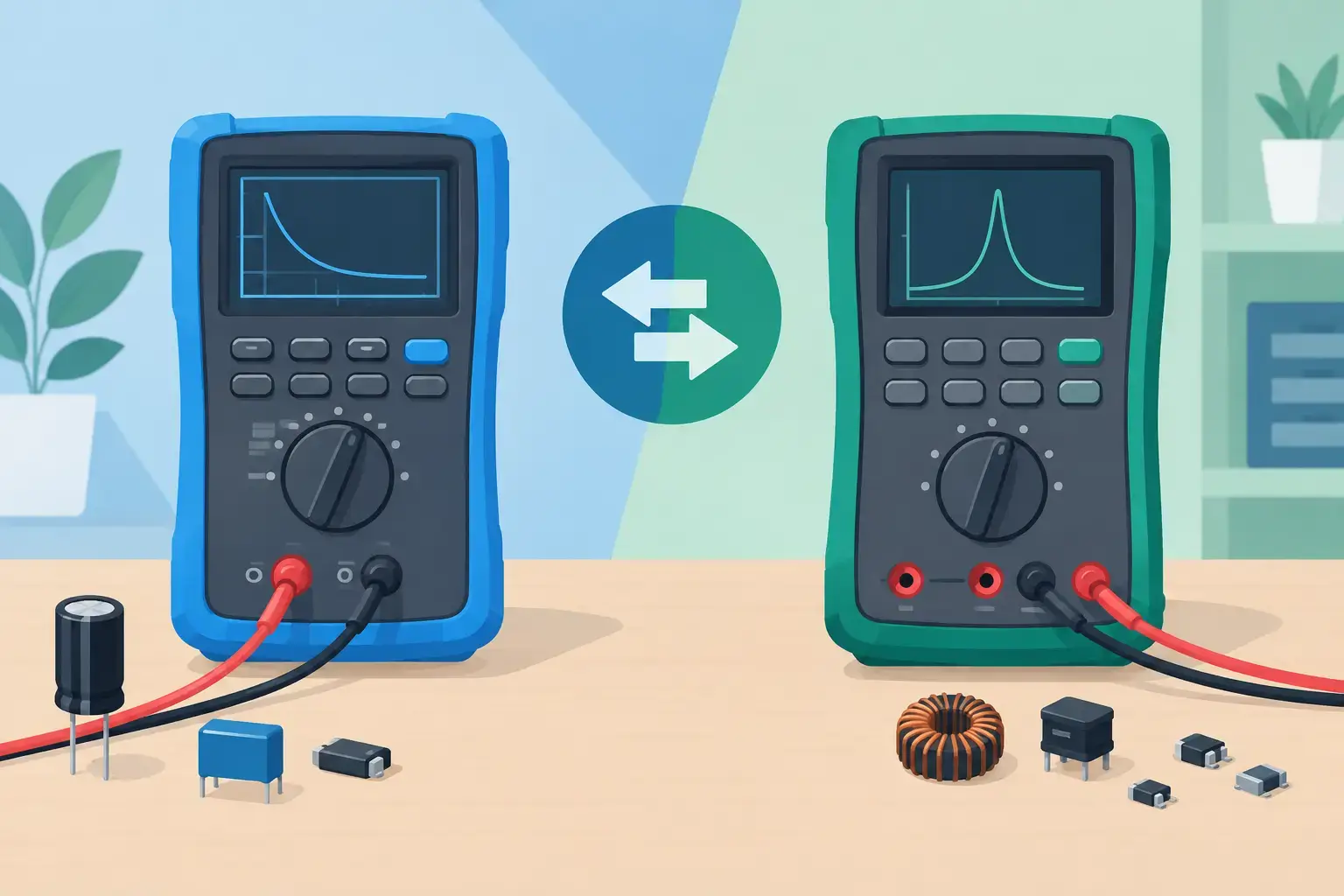
A failed electrolytic capacitor can still show close to its marked capacitance while its equivalent series resistance has risen enough to destabilize a power supply. That is where the ESR meter versus LCR meter decision becomes practical rather than academic. One instrument can quickly expose a common capacitor failure mode; the other can identify and characterize a much wider range of components.
For repair technicians, production personnel, and engineers working with small SMD parts, the right choice depends on the fault being investigated, the measurement required, and whether the component is isolated from the circuit. An ESR meter is purpose-built for a narrow task. An LCR meter is a broader measurement instrument that can often perform ESR measurement as part of capacitor analysis, while also handling resistance and inductance.
What an ESR Meter Measures
ESR means equivalent series resistance. A real capacitor is not an ideal capacitance value: its leads, electrodes, electrolyte, and internal construction introduce a small resistive element in series with the capacitance. That resistance dissipates energy as heat and becomes increasingly significant in switching power supplies, DC-DC converters, motor drives, and other circuits with ripple current.
An ESR meter applies an AC test signal and reports that series resistance, generally in ohms. Many dedicated ESR meters are optimized for quick capacitor checks and may use a fixed test frequency. Their appeal is speed. Place the probes across a suspected capacitor, compare the reading with an expected value for that capacitor type and rating, and move to the next part.
This is especially useful when diagnosing aged aluminum electrolytic capacitors. As an electrolytic dries out or degrades, ESR may increase long before a simple capacitance check identifies a problem. A high ESR reading can indicate a capacitor that is no longer suitable for low-impedance filtering, even if its capacitance appears acceptable.
However, ESR is not a complete capacitor diagnosis. A low ESR result does not prove the capacitance is correct, leakage is acceptable, or the capacitor will withstand rated voltage. It also does not identify a resistor, confirm an inductor value, or distinguish a capacitor from every other possible component in an unknown assembly.
What an LCR Meter Adds
An LCR meter measures inductance (L), capacitance (C), and resistance (R). Depending on the instrument and mode, it may also report secondary parameters such as ESR, dissipation factor (D), quality factor (Q), impedance, phase angle, and DC resistance. These values provide a more complete description of how a component behaves under the selected test conditions.
The test frequency matters. Ceramic capacitors, film capacitors, electrolytics, inductors, and ferrite devices can produce different readings at 100 Hz, 1 kHz, 10 kHz, or higher frequencies. A capable LCR meter lets the user select a frequency or automatically applies appropriate conditions, then measures the component using series or parallel equivalent models where applicable.
That flexibility is valuable when the component itself is unknown. A technician can touch a pair of tweezer probes to an SMD part and determine whether it behaves as a resistor, capacitor, or inductor, then obtain the value without first changing leads, selecting a function, or guessing a range. For component sorting, board-level troubleshooting, and incoming inspection, that workflow saves time and reduces measurement errors.
An LCR meter can also measure ESR as part of capacitance testing when its specifications include that parameter. The key distinction is that ESR is one result within a broader analysis, not the instrument’s only purpose.
ESR Meter Versus LCR Meter: Key Differences
| Measurement need | ESR meter | LCR meter | | — | — | — | | Equivalent series resistance | Primary function | Available on models that specify ESR measurement | | Capacitance value | Usually limited or unavailable | Core measurement | | Inductance value | Unavailable | Core measurement | | Resistance value | Not the primary purpose | Core measurement | | Unknown SMD component identification | Limited | Strong fit, particularly with auto-identification | | Test-frequency control | Often fixed | Varies by model, with advanced units offering selectable frequencies | | Fast capacitor fault screening | Strong fit | Strong fit when ESR is supported |
The table describes the functional difference, but the measurement setup matters just as much. A dedicated ESR meter can be an efficient fault-finding tool for technicians who mainly service power electronics with electrolytic capacitors. An LCR meter is usually the better long-term bench tool when the work includes passive-component verification, SMD rework, repair, assembly, or quality control.
In-Circuit Testing Has Limits
In-circuit ESR testing is useful, but it is never immune to the surrounding circuit. Parallel capacitors can make ESR appear lower than it is. Nearby resistors, semiconductor junctions, coils, transformers, and IC circuitry may add alternate current paths that distort the measurement. A meter may correctly measure the impedance presented at the probes while that impedance does not belong solely to the component under test.
The same caution applies to LCR measurement. If an accurate component value is required for documentation, matching, or acceptance testing, isolate at least one lead of a through-hole part or remove the SMD component. For populated boards, use in-circuit readings as diagnostic evidence, then confirm suspicious results out of circuit.
Always discharge capacitors before measurement. A charged capacitor can damage a sensitive instrument and create an unsafe condition. Also consider capacitance size and rated voltage. An LCR or ESR reading at a low AC test level does not replace a leakage test, insulation-resistance test, or full voltage stress test where those checks are required.
Why Probe Geometry Changes the Workflow
Traditional benchtop LCR meters can deliver detailed measurements, but connecting tiny 0201, 0402, or 0603 components with clip leads is slow and can introduce contact resistance, lead inductance, and unstable connections. For low-value resistors and low-impedance capacitors, those errors are not trivial.
Tweezer-style LCR instruments address that problem at the point of contact. The component is held directly between two conductive tips, which improves repeatability and makes it practical to test loose SMD parts or access closely spaced board locations. A compact handheld meter also eliminates the setup burden of a bench instrument when the job is a quick verification rather than a full characterization session.
Automatic component identification is particularly useful in rework and troubleshooting. Instead of setting the meter to capacitance, then resistance, then inductance, the instrument determines the likely component type and applies its measurement routine. Advanced models may still provide manual control when a specific test frequency, parameter, or equivalent circuit model is needed.
LCR-Reader handheld instruments are designed around this workflow: direct tweezer contact, automatic LCR identification, and fast measurement of small passive components. For users who require ESR results, selection should still be based on the individual model’s ESR range, accuracy, test frequency, and supported parameters rather than on the product category alone.
How to Choose for Your Bench
Choose an ESR meter when capacitor health is the recurring question. It is a focused tool for finding high-ESR electrolytics in switch-mode power supplies, consumer electronics, amplifiers, and aging industrial boards. Its limitations are acceptable when the job rarely involves identifying unknown passives or measuring inductance.
Choose an LCR meter when one instrument must support broader electronics work. It is the more appropriate option for verifying resistor values, checking capacitor tolerance, sorting inductors, identifying unmarked SMD components, and comparing suspect parts with known-good samples. For repair work, verify that the meter explicitly specifies ESR measurement if capacitor ESR is a required diagnostic parameter.
For precision work, compare more than the headline measurement range. Review accuracy at the values you actually measure, test frequencies, series and parallel modes, resolution, calibration method, probe configuration, and whether the meter supports the component packages used in your process. A wide range is not automatically useful if accuracy falls short at low resistance, small capacitance, or low inductance.
The most effective instrument is the one that answers the question in front of you with minimal handling and defensible accuracy. If the question is whether a capacitor has developed excessive loss, start with ESR. If the question is what the component is and whether it meets its expected electrical value, an LCR meter gives you the clearer path forward.