
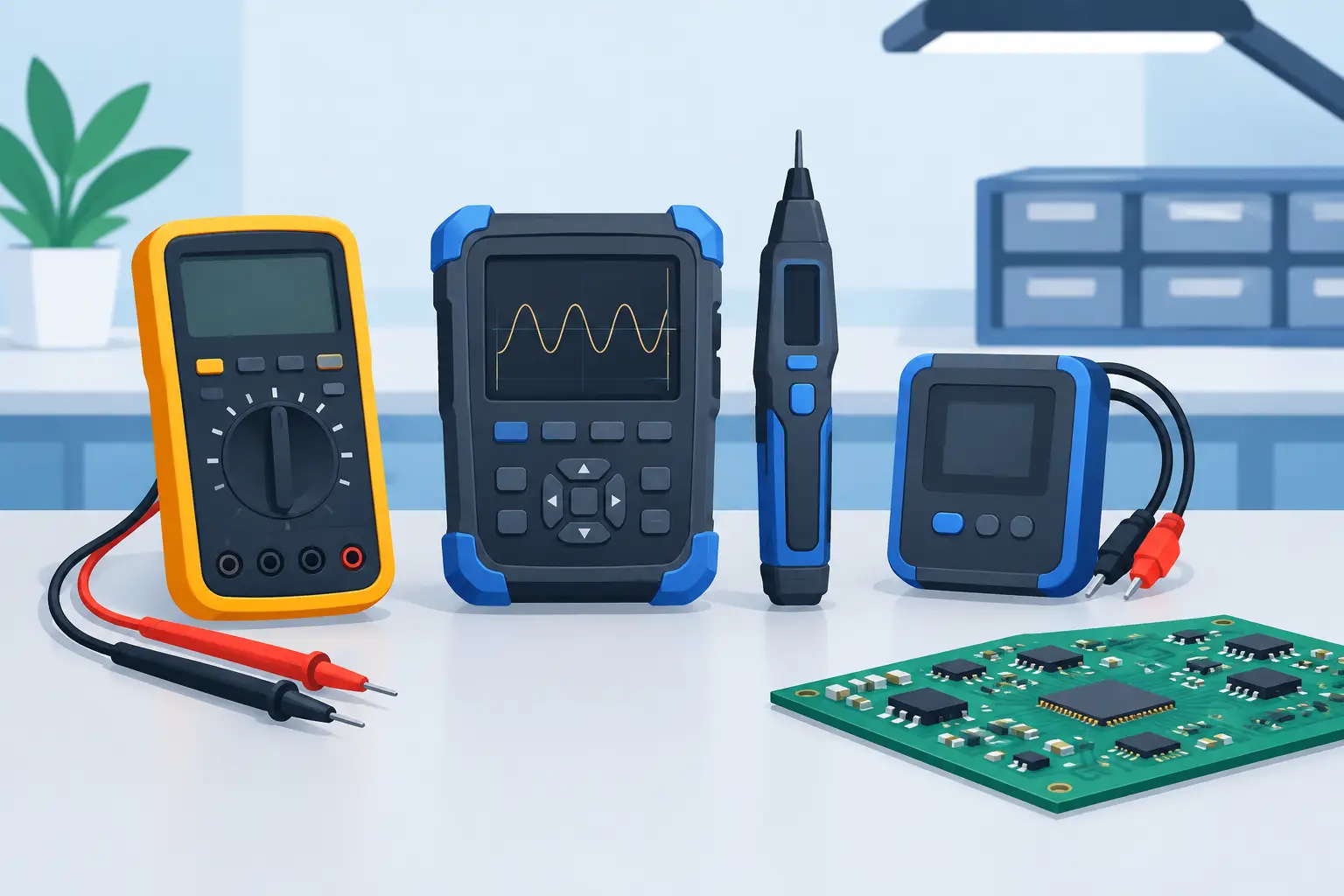
A mislabeled 0402 capacitor or an intermittent resistor can hold up an entire repair long after the obvious fault has been ruled out. The best portable electronics testers reduce that delay by identifying a component at the point of contact, without moving parts to a benchtop instrument or configuring a series of manual settings. For SMT troubleshooting, that difference is not convenience alone. It is a faster, more controlled measurement workflow.
Portable testers range from basic multimeters to dedicated LCR and ESR instruments. They do not serve the same purpose. Selecting the right tool starts with the measurements required, the components being handled, and whether work happens on loose parts, populated boards, or both.
What the Best Portable Electronics Testers Must Do
A useful portable electronics tester must first make reliable electrical contact. That is especially critical with surface-mount devices, where ordinary meter probes can slip, bridge adjacent pads, or require two hands. Tweezer-style probes place both measurement contacts in one hand, making them particularly effective for resistors, capacitors, inductors, LEDs, and diodes in 0201, 0402, 0603, and larger packages.
The second requirement is automatic component recognition. A general-purpose meter often asks the operator to select resistance, capacitance, continuity, diode, or another mode before testing. That approach is acceptable for occasional work, but it adds avoidable steps during inspection, rework, and fault isolation. An automatic LCR tester identifies the component type, selects an appropriate measurement function, and displays the relevant value when the probes touch the part.
Accuracy is the third requirement. A reading is only useful when the tester’s stated accuracy, test conditions, and calibration status support the decision being made. For example, a capacitor measured at a low test frequency may behave differently when measured at a higher frequency. ESR is also frequency-dependent. A tester should make its operating conditions clear and provide a repeatable method for calibration verification.
Portability matters after those fundamentals are met. A compact instrument should be easy to hold, have enough battery capacity for practical use, and retain accuracy after normal field or bench handling. Small size without stable probes, readable results, and a dependable calibration process does not improve productivity.
Match the Tester to the Measurement Task
The term portable tester covers several instrument categories. Each is appropriate for a different stage of electronics work.
Digital multimeters for general electrical checks
A handheld digital multimeter remains necessary for voltage, current, continuity, and many basic resistance checks. It is the right first tool for checking power rails, fuses, wiring, batteries, connectors, and transistor junctions. However, standard multimeter leads are not optimized for measuring tiny SMT components, and capacitance readings are often slower or less informative than dedicated LCR results.
A multimeter is not a replacement for an LCR meter when component tolerance, inductance, dissipation, or ESR affects the diagnosis. It answers whether a circuit has voltage or continuity. It may not answer whether a capacitor has degraded electrical characteristics.
Tweezer LCR and ESR meters for SMT components
For discrete parts and densely populated boards, a tweezer-style LCR meter is usually the most productive portable format. The probes grip the component or touch each end of a mounted part directly. This reduces lead movement and makes it easier to test components in places where standard clips and probes are impractical.
These instruments measure resistance, capacitance, and inductance while automatically determining the appropriate function. Models with ESR capability add useful information for evaluating capacitors, particularly in repair work where an electrolytic or polymer capacitor may look physically normal but no longer meet circuit requirements.
The strongest choice depends on the required ranges and controls. Entry-level automatic testers suit component sorting, basic repair, and routine identification. Advanced models may add manual frequency selection, diode testing, wider measurement ranges, Bluetooth data capability, or other controls useful for documented inspection and engineering analysis.
LED and diode testers for junction checks
LED testers serve a narrower but valuable role. They can identify LED polarity and provide a quick functional check of individual LEDs, display backlight strips, and diode junctions. They should not be evaluated as substitutes for LCR instruments. A device designed to test LEDs may confirm that a diode conducts, while an LCR meter evaluates the passive components surrounding it.
Technicians working on displays, lighting assemblies, and power boards often benefit from both tools. The correct choice follows the fault path rather than a single-device rule.
Specifications That Actually Affect Results
Product descriptions often lead with a long range list. Ranges matter, but several practical specifications deserve equal attention.
Test frequency and test signal level
Capacitance, inductance, impedance, and ESR readings vary with test frequency. A meter that provides a fixed automatic frequency is efficient for many everyday checks. A meter with selectable frequency gives experienced users more control when comparing components to datasheet conditions or investigating frequency-sensitive behavior.
Test voltage also matters. Semiconductor junctions and certain circuit paths may react differently depending on the applied signal. For populated-board measurements, a controlled low-level test signal helps reduce the risk of activating surrounding circuitry or producing misleading readings.
Resolution versus accuracy
A display with many digits can create false confidence. Resolution is the smallest display increment. Accuracy defines how close the result can be to the actual value under specified conditions. When comparing testers, look for both the stated accuracy and the conditions behind it, including range, frequency, temperature, and calibration interval.
For sorting components with wide tolerances, moderate accuracy may be sufficient. For verifying precision resistors, production inspection, or matching capacitors in a sensitive circuit, accuracy and repeatability should drive the decision.
Probe geometry and Kelvin measurement
Probe tips should be fine enough for small components but strong enough for repeated use. Replaceable tips and proper tip alignment support consistent contact. Insulated or carefully spaced tips also help prevent accidental contact with adjacent pads.
Kelvin measurement becomes more relevant as resistance values decrease. It separates the current path from the voltage-sensing path, reducing error from probe and contact resistance. A portable tester with a Kelvin connector or compatible probes can be a better fit for low-resistance work, cables, shunts, and production checks where milliohm-level differences matter.
Calibration support
A portable tester should not be treated as permanently accurate because it passed an initial factory test. Calibration procedures, certified calibration availability, and suitable fixtures are part of the measurement system. Before purchasing, determine whether the instrument can be checked or calibrated in a way that matches your quality requirements.
This is especially relevant for repair businesses, contract manufacturers, laboratories, and quality-control teams that need traceable records. For a hobby bench, a simple user calibration process may be sufficient. The right level depends on the consequences of a wrong measurement.
A Practical Selection Framework
Start with the smallest component you expect to measure. If 0402 and 0201 devices are common, handheld tweezers with fine, stable tips are more useful than conventional test leads. If work centers on cable harnesses and power supplies, a quality multimeter may take priority.
Next, define whether you need loose-component measurements, in-circuit measurements, or both. Loose components provide the cleanest and most definitive result. In-circuit readings are fast but can be influenced by parallel paths, semiconductor junctions, and nearby capacitors or inductors. A good tester speeds up screening, but it cannot eliminate circuit topology from the interpretation.
Then consider the data required. Resistance, capacitance, and inductance cover a large share of passive-component work. ESR becomes more useful for capacitor diagnosis. Manual frequency control and Bluetooth output are worthwhile when measurements must be compared, recorded, or performed under a defined procedure.
Finally, assess operator time. A less expensive meter can cost more over time if every reading requires range selection, awkward probe positioning, and repeated verification. An automatic tweezer instrument such as an LCR-Reader model is designed to remove those steps: touch the component, confirm the result, and proceed to the next suspect part.
Common Errors When Using Portable Testers
The most frequent error is treating an in-circuit result as the isolated component value. A resistor may read lower because of a parallel network. A capacitor may appear larger because other capacitors are connected across the same rails. When the reading conflicts with the circuit behavior, lift one end of the component or remove it for confirmation.
Dirty, oxidized, or damaged probe tips are another source of unstable readings. Keep tips clean, inspect alignment, and replace worn tips when contact becomes inconsistent. Allow the instrument to complete its startup or open-probe calibration procedure before precision work.
Do not compare a measurement to a nominal marking without considering tolerance and test conditions. A 10 kΩ resistor with a 5% tolerance is not expected to display exactly 10.000 kΩ. Likewise, a capacitor’s marked value does not by itself define acceptable ESR or dissipation at every frequency.
The best portable electronics tester is the one that gives a trustworthy result quickly enough to fit the job. For SMT work, that usually means precise tweezer contact, automatic LCR identification, clear test conditions, and calibration support that matches the level of accountability required. Choose the instrument around the components and decisions in front of you, then let the measurement shorten the path from suspected fault to verified repair.