
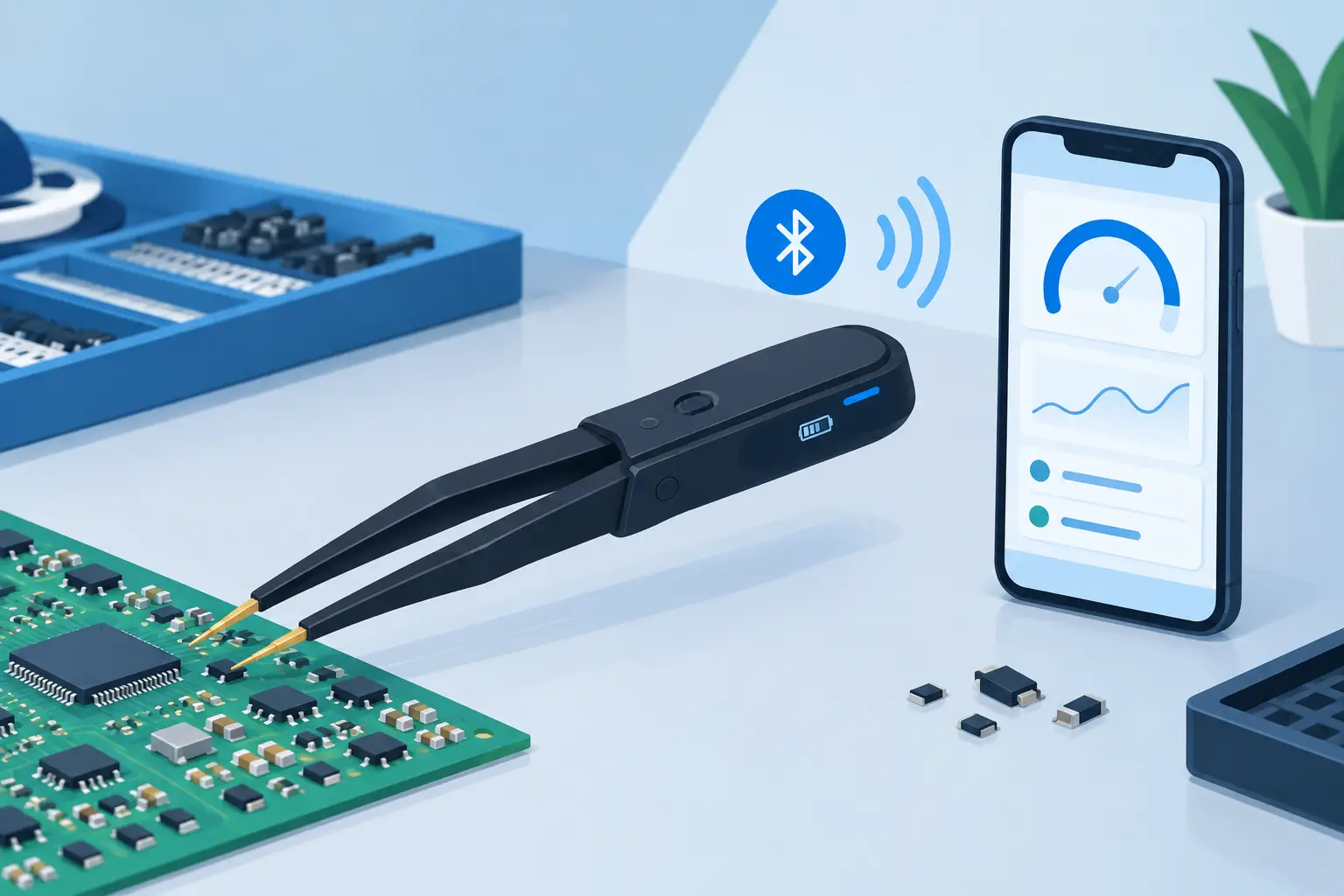
A 0402 capacitor does not wait politely for a test setup. On a crowded board, the difference between finding a suspect part immediately and spending ten minutes chasing a misleading reading often comes down to how quickly the meter can contact, identify, and record the component. This Bluetooth tweezer meter review focuses on whether wireless connectivity adds practical value to the core job: making dependable L, C, R, ESR, and diode measurements on small components.
For repair benches, production support, and prototype labs, a Bluetooth tweezer meter is not simply a handheld LCR meter with an app attached. The best use case is a workflow where automatic component recognition and direct tweezer contact handle the immediate measurement, while Bluetooth preserves readings, supports documentation, or makes difficult work easier to see away from the board.
What a Bluetooth Tweezer Meter Should Do Well
The tweezer format is the starting point. Conventional LCR meters can deliver excellent measurement performance, but they often require test leads, clips, fixtures, range selection, and enough bench space to use them comfortably. For loose SMT components or accessible pads, tweezer probes reduce that friction. Touch both terminations, stabilize the part, and let the instrument determine whether it is seeing resistance, capacitance, inductance, or a diode junction.
That speed matters most when components are very small, parts are mixed in trays, or an operator must compare several locations on a board. A good instrument should provide a stable reading promptly, with a display that remains legible while the user is holding the probes at an angle. Its tips must be fine enough for small packages but durable enough to tolerate routine bench use.
Bluetooth does not improve the fundamental measurement by itself. Accuracy still depends on the meter’s analog front end, test conditions, calibration, probe contact, and the component under test. Wireless capability is valuable when it extends those measurements into a useful process rather than becoming another screen to configure.
Bluetooth Tweezer Meter Review: Where Wireless Helps
The clearest benefit is measurement capture. A technician diagnosing an intermittent assembly may need to document readings at multiple test points before rework begins. Writing each value by hand creates opportunities for transcription errors, especially when capacitance, ESR, and resistance values are changing with temperature or board state. A Bluetooth connection can place the live reading on a phone, tablet, or computer for recording and comparison.
A larger remote display is also useful in awkward positions. Consider a board mounted in a fixture, inside equipment, or under a microscope. The operator may be able to reach the component while having limited visibility of the meter’s built-in screen. With a properly implemented companion application, the numeric result can remain visible without forcing the user to change probe position just to read the display.
Wireless logging has value in quality control as well. When incoming components are checked against expected values, saved readings can support lot verification, failure analysis, and process records. The benefit depends on how the software handles data. A useful application should make it clear what was measured, when it was measured, and which measurement mode or test frequency was used. A stream of unlabeled numbers is not a quality record.
Bluetooth is less compelling for a simple one-off measurement. If the technician only needs to confirm that a resistor is 10 kOhm or that a capacitor is shorted, the meter’s own display should remain the primary interface. The instrument must be fully productive when no mobile device is nearby, charged, paired, or permitted in the work area.
Measurement Quality Comes Before Connectivity
The most important question in any meter review is not whether it pairs quickly. It is whether the readings are credible for the component and test conditions involved. Surface-mount work exposes the limitations of careless measurement technique very quickly.
For low-value resistors, contact resistance and oxidized terminations can distort results. For small capacitors, probe spacing, hand movement, and stray capacitance become significant. Inductors may require appropriate test frequency to produce a meaningful value, while electrolytic capacitor evaluation often needs ESR information rather than capacitance alone. A Bluetooth model should provide the same disciplined measurement capability expected from a professional handheld LCR instrument, including suitable ranges, stated accuracy, and a defined calibration process.
Automatic identification is a major workflow advantage, but it is not magic. A meter can identify a component correctly only when the part is electrically isolated enough for its behavior to be recognizable. Parallel paths, semiconductors, charged capacitors, and nearby circuitry can cause an in-circuit reading to differ substantially from the component’s marked or nominal value.
This is particularly relevant when troubleshooting assembled boards. A low resistance measurement may represent a real short, but it may also be the combined effect of several parallel loads. A capacitance reading can be affected by other capacitors on the rail. The right practice is to use the initial in-circuit result as evidence, then isolate or lift a component when the diagnosis requires certainty.
Test Frequency and ESR Are Not Minor Details
Two capacitors with the same nominal capacitance can behave very differently at the frequency relevant to a circuit. The ability to select or verify test frequency is therefore valuable for users working beyond basic component sorting. It helps make readings more relevant when evaluating inductors, ceramic capacitors, and electrolytic capacitors with ESR concerns.
ESR is especially useful in repair work, but it must be interpreted in context. An apparently high ESR result may indicate a degraded capacitor, poor probe contact, or a test condition that does not match the component’s intended operating behavior. The meter should report its test conditions clearly enough that the user can make an engineering judgment rather than treating every number as an automatic pass or fail.
Probe Design Determines Everyday Usability
A Bluetooth feature set cannot compensate for poorly designed probes. Tweezer tips must align reliably, open with controlled pressure, and retain sufficient spring tension to contact small terminations without pushing a component across the bench. The housing should be balanced enough for long inspection sessions, with a display position that does not force an unnatural wrist angle.
Replaceable tips and access to calibration fixtures are also practical considerations. Tips wear, bend, collect residue, and occasionally get damaged by rushed work. A meter designed for long-term professional use should allow maintenance rather than treating the probes as disposable. Regular calibration checks are equally relevant when measurements are used for production, inspection, or documented repair decisions.
Before measuring, clean the tips and component contacts when needed. Keep the tweezer arms separated before touching the part, and avoid gripping the component so hard that the tips slide onto adjacent pads. For very small packages, stabilization under magnification can matter more than another digit of display resolution.
App Experience: Useful Tool or Added Friction?
Bluetooth performance should be evaluated as a workflow, not a checklist item. Pairing should be direct, reconnecting should be predictable, and the application should not obstruct a quick reading. If the meter requires repeated permissions, lengthy setup, or a mandatory account before showing a measurement, the wireless feature is adding friction to a tool chosen for speed.
Data export is worth considering for teams that document work. Some users only need a live numeric display. Others need saved measurements that can be assigned to a repair ticket, inspection sample, or engineering report. Those needs are different, so buyers should verify that the available software supports their actual recordkeeping process rather than assuming Bluetooth automatically means useful traceability.
Battery impact is another trade-off. Continuous wireless communication can reduce operating time compared with display-only use. For field work or long production shifts, the practical question is whether Bluetooth can be enabled only when logging is needed. A meter that remains efficient as a standalone instrument gives the operator more control.
Who Should Choose a Bluetooth Model?
A Bluetooth tweezer meter is a strong fit for technicians who document repairs, engineers comparing measurements across a prototype, and quality personnel who benefit from captured inspection data. It is also useful where the meter display is difficult to view directly, such as microscope-based rework or equipment service.
For users who primarily sort loose components or perform quick bench checks, a non-Bluetooth automatic tweezer meter may offer better value if its accuracy, ranges, and ergonomics are equivalent. The wireless function should justify its cost through time saved, clearer records, or easier access to readings.
Advanced users should also look beyond Bluetooth when comparing instruments. Manual test-frequency selection, diode testing, extended ranges, stated tolerances, calibration support, and available accessories can have a larger effect on day-to-day capability. Product lines such as LCR-Reader make more sense when the selected model matches the measurement task rather than simply offering the longest feature list.
A well-chosen Bluetooth tweezer meter earns its place on the bench when the connection disappears into the background: contact the component, trust the measurement conditions, save the result when it matters, and return attention to the circuit in front of you.