
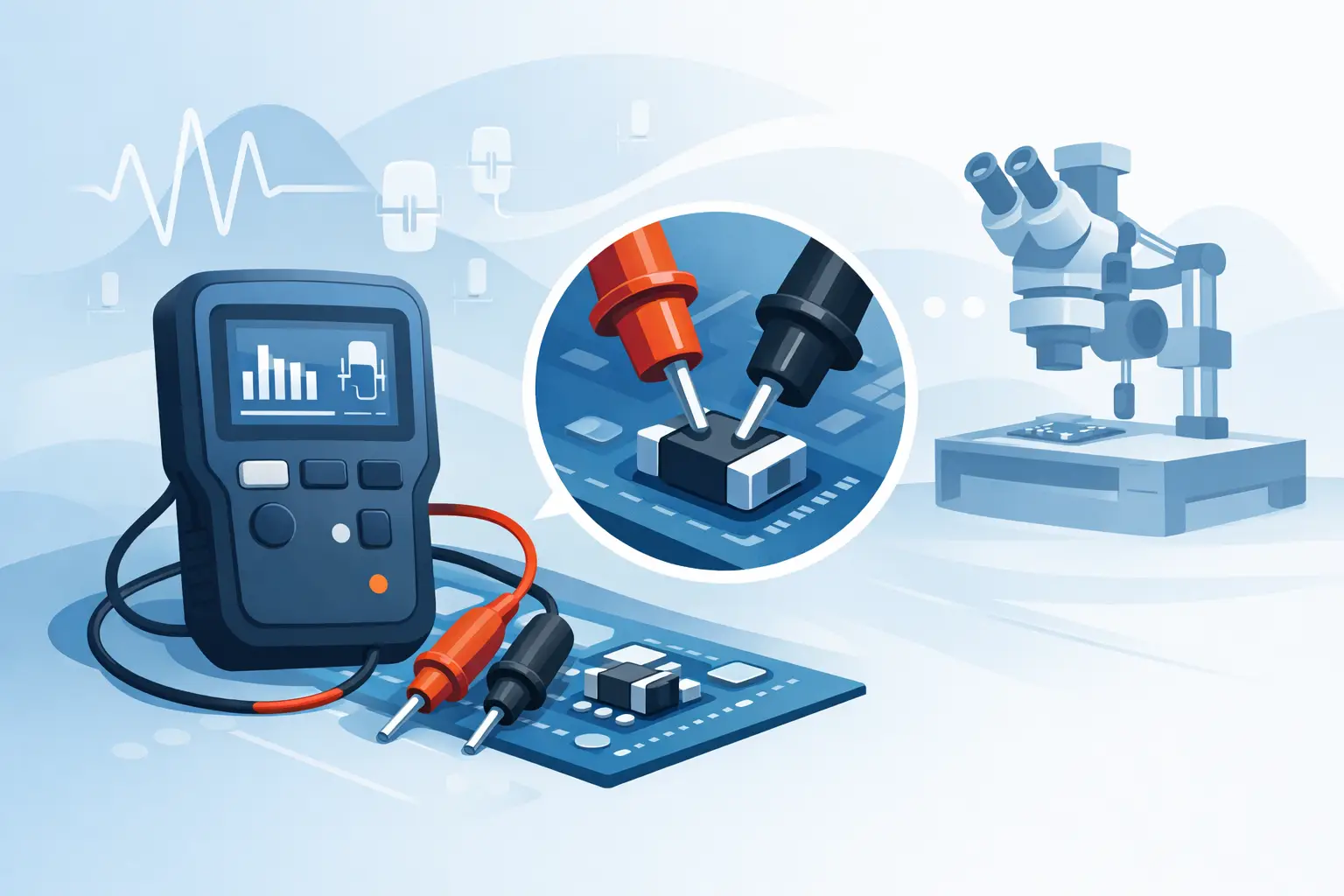
A 0402 capacitor does not wait for a convenient bench setup. When a board has an intermittent rail, a suspected decoupling failure, or an unmarked component pulled from inventory, the useful instrument is the one that can identify and measure it at the point of work. This portable capacitance analyzer review focuses on what separates a genuinely effective handheld analyzer from a basic capacitance meter.
For SMT troubleshooting, capacitance is only one part of the decision. The instrument must make reliable contact with small terminations, distinguish a capacitor from a resistor or inductor, apply an appropriate test signal, and provide a result quickly enough to support real repair workflow. A compact form factor alone does not make a tool suitable for that job.
What a Portable Capacitance Analyzer Should Measure
The name can be misleading. A dedicated capacitance meter may be adequate for sorting known, through-hole parts, but it offers limited value when the component type is uncertain or when ESR is the actual failure indicator. A capable portable analyzer is better understood as a handheld LCR instrument with capacitance measurement as one of its primary functions.
At minimum, look for automatic identification of resistance, capacitance, and inductance. Automatic mode selection matters because it removes a common source of operator error: measuring a component in the wrong mode or at an unsuitable test condition. In repair work, the result should appear after the probes contact the component, not after navigating several menus.
ESR measurement is particularly valuable for electrolytic and some polymer capacitors. A part can retain a capacitance value close to nominal yet develop excessive ESR, affecting filtering performance, ripple, and regulator stability. Capacitance alone cannot identify every degraded capacitor.
Diode testing is also useful in a handheld troubleshooting instrument, although it is not a capacitance function. A technician tracing a short or checking a populated board benefits when the same tool can identify nearby passive parts and verify semiconductor junction behavior without changing instruments.
The Measurement Details That Determine Trust
A displayed value is not automatically a dependable value. Portable instruments should be evaluated by measurement conditions, stated accuracy, repeatability, and the physical quality of the connection to the device under test.
Test Frequency Is Not a Minor Specification
Capacitance is frequency-dependent in practical components, especially electrolytics and ceramic capacitors with certain dielectric materials. ESR also changes substantially with frequency. An analyzer that uses a fixed automatic test frequency can be fast and effective for general identification, while a model with manual frequency selection gives advanced users more control when comparing a measurement to a datasheet condition or investigating a frequency-sensitive circuit.
Neither approach is universally better. Automatic selection is preferable when speed and consistent routine measurement are the priorities. Manual selection becomes more valuable for engineering validation, incoming inspection, and diagnostic work where the measurement condition must be documented or reproduced.
Do not compare readings from two instruments without checking their test frequencies and measurement methods. A difference may reflect the test condition rather than an inaccurate meter.
Accuracy Must Include the Range and Condition
Manufacturers often state a best-case accuracy figure, but the useful question is where that figure applies. Review the capacitance range, resolution, stated accuracy by range, and any limitations at the low and high ends. Small capacitance values can be strongly affected by fixture and probe parasitics. Large values may require more settling time or be outside the most accurate portion of a portable instrument’s range.
For component sorting, repeatability may matter as much as absolute accuracy. If a meter consistently separates 100 nF, 1 µF, and 10 µF parts, it can prevent placement errors even where a laboratory bridge would provide a tighter absolute result. For quality control or specification verification, traceable calibration and documented accuracy become more significant.
A calibrated instrument also supports confidence over time. Calibration is not simply a certificate stored in a file. It is evidence that performance has been checked against known standards under defined conditions. Users with controlled processes should consider whether the manufacturer provides calibration support, suitable fixtures, and a practical path for periodic recertification.
Open and Short Compensation Protect Low-Value Work
Probe capacitance, lead resistance, and contact effects can distort readings, particularly with low-value capacitors and low-resistance parts. Bench instruments use fixtures and compensation routines for this reason. A well-designed portable analyzer reduces these errors through short probe paths, stable mechanical construction, and calibration procedures appropriate to its probe system.
Before judging an instrument on a few-picofarad or low-ohm reading, allow it to warm up if specified, inspect the probe tips, and perform the recommended calibration or compensation procedure. Dirty, oxidized, or worn tips can create a measurement problem that looks like an instrument problem.
Why Tweezer-Style Probes Change the Review
For surface-mount work, probe geometry is as important as electrical specifications. Standard test leads are flexible and versatile, but they require two-handed positioning and can slip across adjacent pads. On densely populated boards, that can slow diagnosis or introduce the risk of accidental shorts.
Tweezer-style probes put both contacts under direct control in one hand. This makes it practical to grip 0201, 0402, 0603, and larger components, depending on tip condition and operator access. The component can be measured before removal, after removal, or while sorting loose parts from a reel or tray.
The trade-off is access. Tweezers are not ideal for every location. Tall components, recessed connectors, or parts surrounded by mechanical obstructions may require Kelvin probe connectors or conventional leads. A practical portable system should support the way components are actually encountered rather than assuming every device is easily accessible from above.
Tip design and replacement availability deserve attention. Fine tips improve access to small pads, but they can wear or become contaminated. A tool intended for daily repair should have serviceable tips and clear maintenance guidance.
In-Circuit Measurement Requires Judgment
No portable capacitance analyzer can repeal circuit theory. In-circuit capacitance readings can be affected by parallel capacitors, leakage paths, semiconductor junctions, inductors, and the rest of the network connected to the measurement point. A result that differs from the label or schematic does not automatically identify a bad part.
The analyzer is most useful in circuit when it supports comparison. Measure matching channels, compare an expected-good board to a suspect board, or look for a capacitor with dramatically different ESR or capacitance relative to similar parts. When a reading is ambiguous, lift one terminal or remove the component for confirmation.
Powered-circuit measurement should be avoided unless the instrument documentation expressly permits it. Discharge capacitors before testing. Stored energy can damage the analyzer, corrupt the reading, or create a safety hazard. This is especially relevant for power supplies, motor drives, and high-voltage equipment.
Portable Capacitance Analyzer Review: Choosing the Right Level
Entry-level automatic LCR tweezers are a strong fit for technicians and serious hobbyists who need rapid identification of unmarked passives, basic capacitance checks, and SMT rework support. Their advantage is simple operation: contact the part and read the result.
Advanced handheld models justify their cost when the work requires broader ranges, tighter specifications, ESR capability, diode test functions, manual frequency selection, data connectivity, or formal calibration support. Bluetooth-enabled instruments can be useful for recording measurements or viewing results where direct screen access is inconvenient, but wireless capability should not outweigh core measurement performance.
For many users, the best buying decision is not the instrument with the longest feature list. It is the model whose measurement ranges, accuracy, test conditions, and probe configuration match the parts and boards handled every day. LCR-Reader-style automatic tweezers are especially effective where rapid SMT identification is the primary task; more configurable models make sense when the workflow demands controlled test conditions.
A Practical Evaluation Procedure
Evaluate a new analyzer using known components, not only unknown scrap-board parts. Start with several capacitors across the values most common in your work, then include a low-ESR electrolytic, a resistor, an inductor, and a diode if supported. Check whether the instrument identifies each component correctly and whether readings are stable after repeated contact.
Next, test usability at the bench. Measure components on a populated board with normal lighting, normal hand position, and the access constraints you encounter in repair. Note whether the probes can reach the terminations without touching adjacent components, whether the display remains readable, and whether measurements settle quickly.
Finally, verify support details before making the tool part of a controlled process. Confirm the calibration method, availability of replacement tips and accessories, battery or charging arrangement, repair options, and documentation for measurement limits. These factors determine whether a portable analyzer remains useful after the first week of ownership.
The right handheld analyzer earns its place by reducing uncertainty at the component level. When it provides stable readings, repeatable contact, and measurement conditions appropriate to the task, it turns a suspected capacitor from a guess into the next informed step in the repair.