
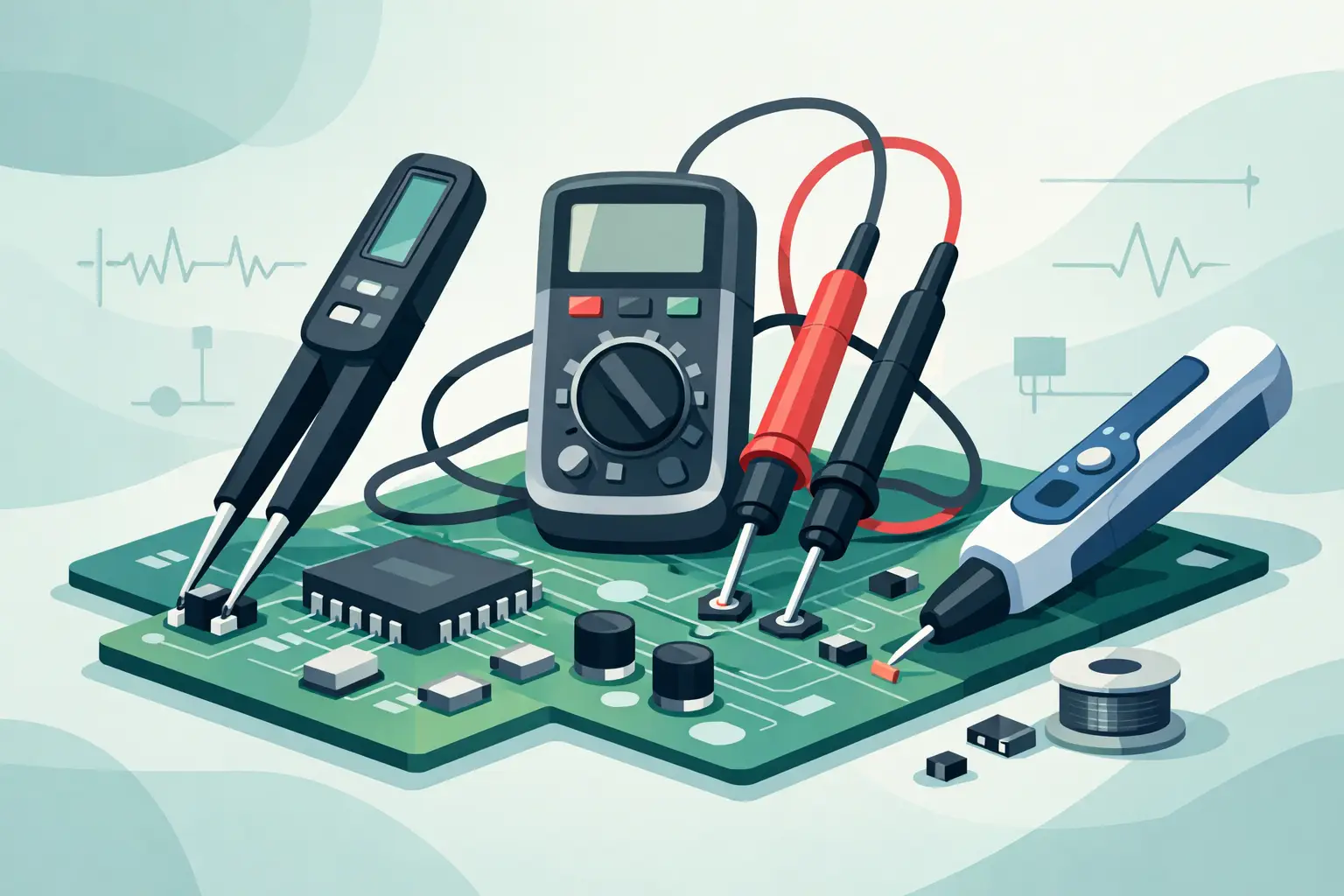
A 0402 capacitor does not leave much room for measurement error. Standard multimeter probes can slip, test leads add parasitic effects, and removing a component from a board often takes longer than the diagnosis itself. The best tweezer meter alternatives address that problem by combining Kelvin-style contact, automatic component identification, and portable LCR measurement in a tool designed for work at the component level.
The right choice depends on more than whether a meter has tweezer-shaped probes. For SMT repair, incoming inspection, and production troubleshooting, the important questions are which parameters it measures, how it behaves on in-circuit parts, whether its test conditions can be controlled, and how reliably it holds calibration. A low-cost tool that identifies a resistor correctly may be adequate for sorting loose components. It may not be the right instrument for measuring low-value inductors, capacitor ESR, or parts on a populated board.
What a Tweezer Meter Must Do Well
A useful alternative to a conventional Smart Tweezers-style instrument should make the first measurement fast and credible. That begins with automatic recognition of resistance, capacitance, and inductance. The meter should choose an appropriate measurement mode without requiring the operator to move leads, select ranges, or work through a menu before every part.
For serious work, automatic operation is only the starting point. ESR measurement is valuable when evaluating electrolytic and ceramic capacitors, particularly when a capacitor looks normal on a basic capacitance test but has degraded performance. Diode testing matters in repair workflows, while selectable test frequency becomes relevant when component behavior must be checked under a specific condition rather than at one fixed frequency.
Probe geometry also matters. Fine, durable tips let the operator isolate a small chip component without bridging adjacent pads. Spring pressure should be controlled enough to maintain contact without pushing a component off the board. A handheld instrument is only productive if it can be used repeatedly without hand fatigue or constant tip adjustment.
Best Tweezer Meter Alternatives by Application
Rather than treating every handheld LCR device as interchangeable, match the instrument class to the job. The table below identifies the practical differences that matter at the bench.
| Instrument type | Best fit | Main advantage | Trade-off | |—|—|—|—| | Entry-level automatic LCR tweezers | Component sorting, student labs, basic repair | Fast identification with minimal setup | Limited manual control and advanced functions | | Professional automatic LCR/ESR tweezers | SMT repair and inspection | Automatic measurement plus ESR and wider capability | Higher cost than a basic checker | | Manual-frequency tweezer meter | Engineering validation and difficult components | Test frequency can be selected to suit the part | Requires more measurement knowledge | | Bluetooth-enabled handheld meter | Documentation and repeatable workflows | Results can be captured or reviewed digitally | Connectivity is unnecessary for many quick repairs | | LED test tweezers | Fast LED polarity and basic LED checks | Direct support for LED troubleshooting | Not a replacement for full LCR characterization | | Kelvin probes with a handheld LCR meter | Larger parts, connectors, and awkward boards | Flexible contact geometry | Less convenient than integrated tweezers for tiny SMT parts | | Benchtop LCR meter with fixtures | Lab characterization and quality control | Broad setup control and detailed analysis | Slower and less portable for board-level troubleshooting |
Entry-Level Automatic LCR Tweezers
An entry-level automatic meter is the practical choice when the goal is to identify loose parts quickly. It can separate resistors from capacitors and inductors, show the measured value, and eliminate the repeated lead swapping required by a conventional handheld meter. This is especially useful for technicians working through mixed reels, salvaged components, or unmarked parts.
Its limitation is test flexibility. If a design engineer needs to compare a capacitor at multiple test frequencies, verify a low ESR reading, or work near the edge of the meter’s range, an entry-level device may provide too little control. It solves the basic identification problem well, but it is not automatically the lowest-cost answer once rework time and misidentified components are considered.
Professional Automatic LCR and ESR Meters
For daily SMT troubleshooting, a professional automatic LCR/ESR tweezer meter is usually the most balanced alternative. It keeps the fast touch-and-read workflow while adding the parameters needed to make a stronger repair decision. ESR, diode functions, better resolution, and expanded ranges can prevent a technician from treating a measurement as a simple pass or fail result.
This category is appropriate when a meter is used on boards rather than only at a parts bin. In-circuit readings still require judgment. Parallel paths, nearby components, semiconductor junctions, and power rails can affect the result. A good handheld meter reduces setup time, but it cannot remove circuit interactions. When a value is questionable, compare it with a known-good board, isolate one side of the component, or confirm it with an appropriate bench instrument.
LCR-Reader instruments fit this category with a progression from straightforward automatic measurement to models offering advanced functions, manual frequency selection, and wireless data capability. The useful distinction is not the feature count alone. It is whether the added function supports the measurements performed every day.
Manual Frequency Models for Engineering Work
Frequency selection is one of the clearest dividing lines between a convenient component checker and an engineering measurement tool. Capacitance, inductance, impedance, and ESR can vary with test frequency. A part that appears acceptable at one condition may behave differently at the operating range that matters to the circuit.
Manual-frequency operation is therefore valuable for design verification, failure analysis, and incoming quality checks. It is also useful when comparing a measured component against a manufacturer specification that calls out a particular frequency. The trade-off is that the operator must understand what the selected condition means. More controls do not improve a measurement if they are chosen arbitrarily.
Bluetooth Meters for Traceability
Bluetooth adds value when readings need to be recorded, shared, or retained as part of a repair and inspection process. A technician can capture measurements instead of copying values by hand, while a lab can use the connection to support repeatable documentation. This may be worthwhile for quality-control groups, field service organizations, and teams troubleshooting the same product family.
For a single bench used mainly to identify parts, Bluetooth may not change the outcome of a repair. It should be selected for a real documentation requirement, not because wireless capability is assumed to make the meter more accurate. Accuracy comes from the measurement design, test conditions, calibration, and correct use of the probes.
Compare Measurement Specifications Before Price
The least expensive alternative is not always the most economical tool. Evaluate the published resistance, capacitance, inductance, and ESR ranges alongside accuracy specifications at the values you actually measure. A wide maximum range is useful, but low-value resolution may be more important for a technician checking chip resistors, inductors, or low-capacitance parts.
Also look for stated calibration support. Handheld instruments used in production, repair centers, or regulated environments need a credible path for verifying measurement performance over time. A calibration fixture and documented procedure can be as relevant as the initial specifications, particularly when multiple technicians depend on the same result to approve or reject components.
Tip replacement and accessory availability deserve similar attention. Fine tips are wear items in active SMT work. If an instrument supports compatible Kelvin probes or calibration accessories, it can cover more tasks without forcing the user to adopt a completely different measurement platform.
A Practical Selection Method
Start with the smallest component and the most difficult measurement in your workflow. If you routinely inspect 0201 or 0402 parts, prioritize tip spacing, contact stability, and low-value measurement performance. If failed capacitors are the common problem, make ESR capability a requirement. If engineering specifications call for defined test frequencies, choose a meter that lets you set them.
Next, decide whether the meter will be used primarily on loose components or populated boards. Loose components favor speed and automatic identification. Board-level work favors better discrimination, diode testing, and the ability to interpret readings affected by the surrounding circuit. A bench LCR meter may still be the correct verification tool for difficult cases, but it should not force a technician to remove every suspect part before making a first assessment.
Finally, verify calibration, service support, and accessories before committing to a model. A tweezer meter earns its place when it shortens the path from suspect component to defensible measurement. Choose the instrument that matches your actual components and test conditions, then validate it on known values before the next urgent board lands on the bench.