
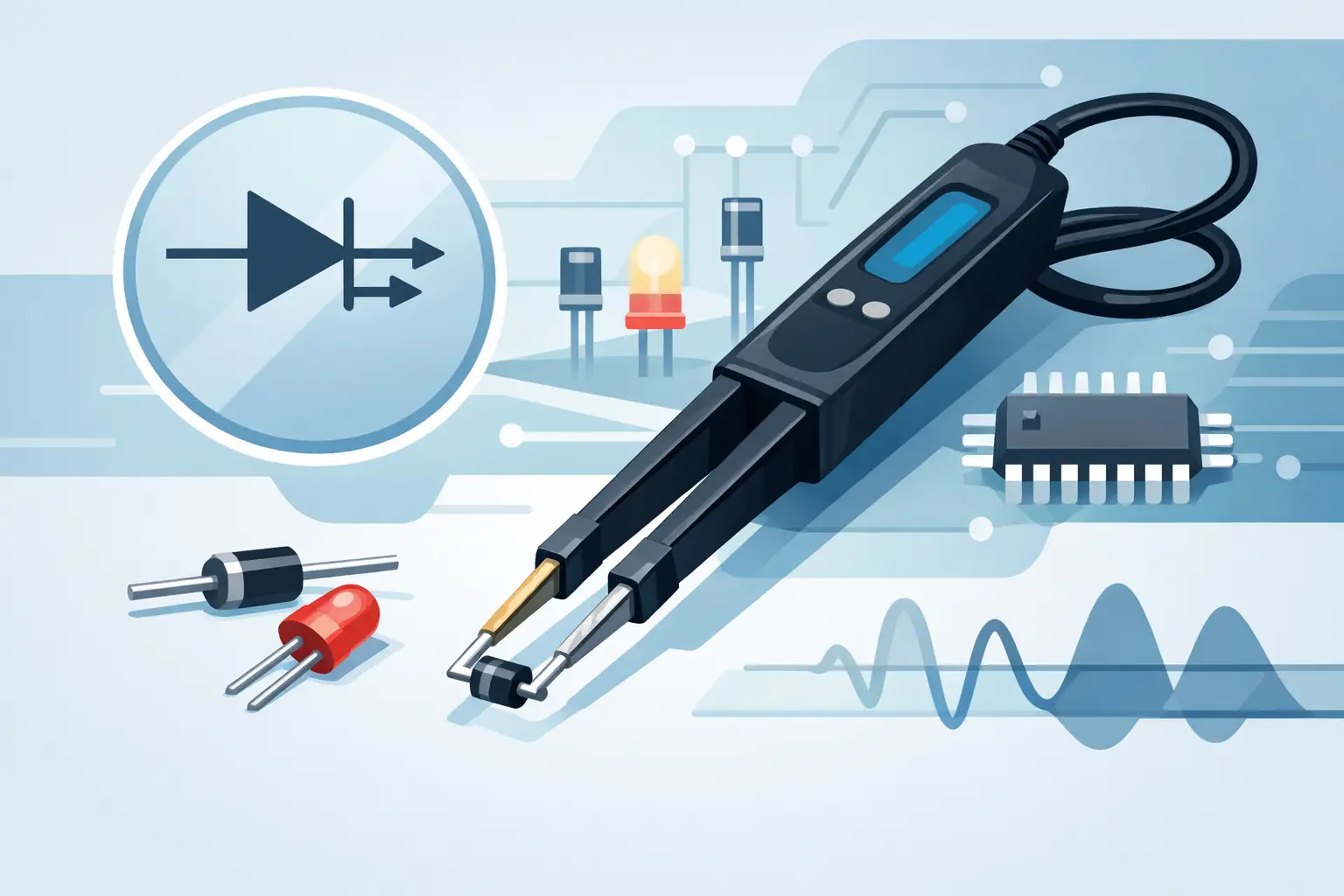
A diode hidden between dense SMT pads can turn a quick repair into a slow, error-prone job. Standard multimeter probes are often too large, too unstable, or simply awkward when you need to verify polarity, forward voltage, or a suspicious junction on a crowded board. That is where diode test tweezers make a real difference. They let you contact both ends of a small component in one hand movement, which is exactly what surface-mount troubleshooting demands.
Why diode test tweezers exist
Conventional diode testing works well on through-hole parts or widely spaced test points. It becomes less efficient when the target is a tiny SMD diode, an LED, or a protection device placed close to neighboring components. Separate probes increase the chance of slipping, reversing contact, or touching adjacent pads. On fine-pitch assemblies, that costs time and can introduce false readings.
Diode test tweezers solve a mechanical problem first. Their tweezer form factor aligns naturally with the shape and spacing of surface-mount parts. Instead of approaching the board with two loose leads, the operator grips the part from both sides. That improves contact stability and makes repeated measurements faster, especially during incoming inspection, rework verification, and field repair.
For many users, the value is not just convenience. It is repeatability. A tool that reduces hand movement and probing error can improve decision-making when you are trying to determine whether a diode is open, shorted, installed backward, or showing an abnormal forward drop.
What diode test tweezers should actually do
The basic expectation is simple: apply a suitable test current, detect forward voltage, and indicate polarity behavior clearly. In practice, performance depends on several design choices.
A useful diode test function should measure common silicon diodes reliably, but it also needs to handle Schottky devices, LEDs, and junctions with lower or higher forward voltage characteristics. If the tool only works well on one narrow diode type, it becomes less useful on real boards where multiple device families may be present. LCR-Reader family of tweezer meters covers most of diode types automatically, no adjustments required, and offer a variety of other functions: LCR/ESR, AC/DC voltage, frequency and signal generator.
Display clarity matters more than many buyers expect. During troubleshooting, you do not want to interpret vague icons or switch through menus just to confirm whether the junction is behaving normally. A clear forward voltage reading and stable indication of open or reverse condition is more valuable than extra interface complexity.
It also helps when the instrument transitions cleanly between component identification and specific test modes. Some users want a dedicated diode function. Others prefer a smart tweezer-style tool that automatically identifies parts and then allows more focused measurement. Which is better depends on workflow. Dedicated behavior can be faster for repetitive checks, while broader automatic measurement is more efficient when the component is not yet identified with certainty.
Diode test tweezers for SMT work
Surface-mount troubleshooting is where this form factor earns its place. The smaller the component, the more the mechanical design affects measurement quality.
Tip geometry is critical. Fine tips improve access to compact packages such as SOD, MELF, and small LEDs, but extremely sharp tips can wear faster or feel less forgiving on repeated use. Wider tips may be more durable, yet they can struggle on tightly packed boards. There is no universal best shape. The right balance depends on whether your work is mostly production inspection, service repair, or lab evaluation. It is also useful to have a variety of tweezer shapes, such as bent test leads
Contact pressure also matters. If the tweezers require too much force, the operator may disturb the part or the board. If the pressure is too light, readings can become unstable. Good diode test tweezers feel controlled in the hand and maintain reliable contact without demanding excessive effort.
This is one reason electronics technicians often prefer purpose-built tweezer meters over improvised accessories attached to a general multimeter. The measurement circuit matters, but the ergonomics matter just as much.
Accuracy versus speed
Not every diode test is a precision measurement task. Sometimes you only need a fast pass-fail answer. Other times, a few tenths of a volt can separate a healthy device from a suspect one.
That trade-off shapes the right tool choice. Faster instruments are useful on production benches and during repetitive fault isolation. But if speed comes with unstable readings, poor contact compensation, or weak resolution, the result may be extra retesting. A slightly slower instrument with better consistency often saves time overall.
For professional use, look beyond generic claims such as high precision. Check whether the instrument provides meaningful measurement resolution, stable contact behavior, and a calibration framework that supports confidence in the reading. A certified calibration option is especially relevant in quality control or documented service environments, where traceability matters as much as convenience.
Where diode testing fits in a broader tweezer meter
Many buyers searching for diode test tweezers are not only testing diodes. They are working on mixed boards where resistors, capacitors, and inductors need verification too. In that context, a single-purpose diode checker may not be the most efficient purchase.
A multifunction tweezer meter can reduce tool switching. If the instrument can automatically identify passive components and also provide diode test capability, it becomes more useful for troubleshooting unknown assemblies. That is particularly valuable in repair work, where one failed reading often leads to several more checks nearby.
The trade-off is cost and complexity. A dedicated diode tester may be simpler and less expensive. A broader LCR-style tweezer instrument offers more bench value, but only if the diode mode is implemented well enough to be trusted. Buyers should not assume that every multifunction tool handles diode testing with the same quality.
For users who regularly test small components by direct contact, the strongest option is usually a tweezer-style instrument designed around component measurement from the start, not a standard meter with tweezers added as an accessory. That difference shows up in contact stability, mode behavior, and ease of use.
Features worth checking before you buy
When evaluating diode test tweezers, the most useful questions are practical. Can the tool access your typical package sizes? Does it provide a stable forward voltage reading without constant hand repositioning? Can you trust it on low-drop Schottky devices as well as standard silicon junctions? Does it behave predictably on LEDs?
Power management is another real-world consideration. A portable instrument that drains quickly or requires frequent charging can become frustrating on a production floor or in field service. Likewise, display readability under bench lighting should not be treated as a minor detail. A compact tool is only productive if the reading is visible at the angle you actually use it.
Build quality deserves attention too. Tweezer instruments are handled differently from standard handheld meters. The tips see frequent mechanical contact, and the body is constantly gripped, rotated, and repositioned. A weak hinge, inconsistent tip alignment, or fragile casing will show up quickly in daily work.
If your workflow involves more than occasional diode checks, look for a tool family with service support, replacement accessories, and documented specifications. For example, LCR-Reader style instruments are typically evaluated not just on basic measurement function, but on whether they provide repeatable results, calibrated performance, and efficient operation on small SMT parts.
When diode test tweezers are the wrong tool
They are highly effective, but not universal. In-circuit diode measurements can still be affected by surrounding components. Parallel paths, semiconductor networks, and board-level leakage can produce misleading readings no matter how good the tweezers are. If the result does not make sense, it may be a circuit issue rather than an instrument issue.
They are also less ideal when the target nodes are far apart or physically inaccessible to a tweezer grip. In those cases, conventional probes or clips may be the better option. And for high-volume characterization work where data logging, swept testing, or detailed junction analysis is required, a benchtop instrument may offer more depth.
The point is not that diode test tweezers replace every meter. They solve a specific class of measurement problems extremely well: quick, direct contact testing on small components where access and stability are the main obstacles.
Choosing based on workflow, not just specs
A repair technician working on consumer electronics may prioritize fast access, one-handed use, and reliable polarity checks on tiny boards. A quality-control user may care more about consistency, calibration status, and repeatability across operators. An engineer at the bench may want diode testing as one function inside a broader precision tweezer meter.
That is why spec sheets should be read in context. Resolution, supported functions, and portability all matter, but only in relation to the work being done. The best diode test tweezers are not the ones with the longest feature list. They are the ones that reduce probing errors, shorten troubleshooting time, and give readings you do not have to second-guess.
If you regularly work with SMT diodes, LEDs, and tightly packed boards, a well-designed tweezer instrument is not a niche accessory. It is a faster and more controlled way to test the parts that ordinary probes handle poorly. Choose the tool that matches your component sizes, your accuracy needs, and the pace of your bench work, and it will earn its place quickly.