
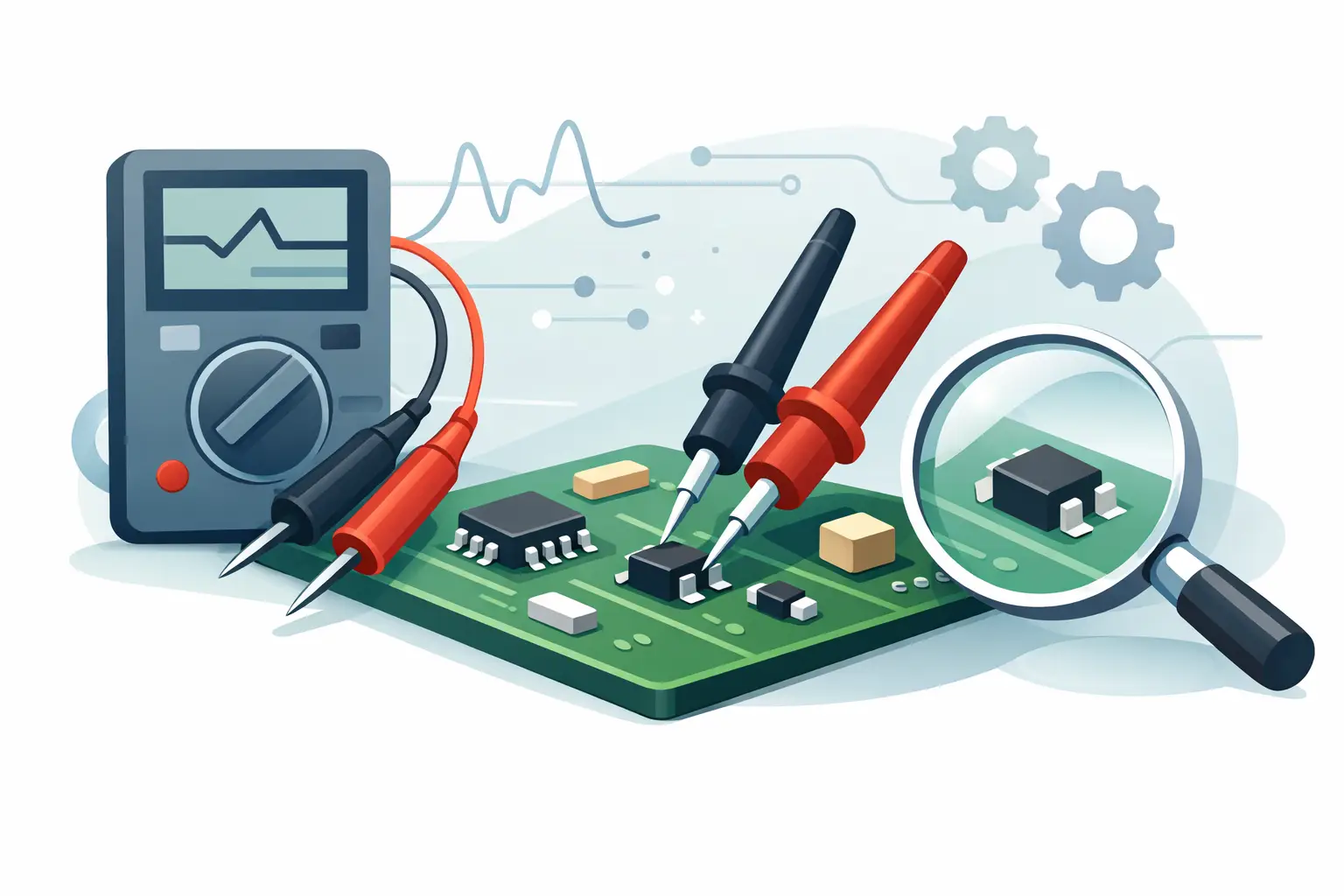
A 0402 capacitor that looks perfect can still be open. A resistor network can read wrong because of one parallel path. And an inductor that measures fine off-board may behave very differently once it is surrounded by switching noise. That is why knowing how to test SMD components is less about touching probes to pads and more about using the right method for the part, the circuit, and the fault you are chasing.
Surface-mount testing is usually constrained by size, access, and speed. Traditional probes slip. Leaded test methods add stray resistance and capacitance. Bench LCR meters can be accurate, but they often slow the workflow when you need quick answers on populated boards. For repair technicians, production teams, and engineers working around dense SMT layouts, the practical goal is simple: get a trustworthy reading without damaging the board or wasting time.
How to test SMD components without misleading readings
The first decision is whether you are testing in-circuit or out-of-circuit. That choice determines how much confidence you can place in the result. In-circuit testing is faster and usually the right starting point for troubleshooting, but it is always influenced by surrounding components, copper paths, and active devices. Out-of-circuit testing removes most of that uncertainty, but it takes longer and introduces rework risk.
For resistors, in-circuit measurements are often usable if there are no significant parallel paths. If the reading is lower than expected, the resistor may still be good and the circuit may be affecting the measurement. If the reading is much higher or open, that is usually more meaningful. Capacitors are more complicated. Capacitance can sometimes be measured in-circuit, but ESR and leakage behavior are often better indicators in power sections, especially for troubleshooting unstable rails or startup faults. Inductors can also be checked in-circuit for gross opens or major value shifts, though nearby magnetic and parallel effects can distort the result.
Semiconductors require even more caution. Diodes can often be checked with a diode mode or low-current test, but transistor junctions and IC-adjacent parts are easy to misread when other current paths exist. If the part is part of a feedback loop, power stage, or RF section, in-circuit results may be only a first pass.
Start with the right tool for the package size
If you are working with SMD parts regularly, the test fixture matters as much as the meter. Standard handheld multimeter probes are acceptable for large chip components, but they are inefficient on 0603, 0402, and finer packages. Tip pressure shifts the part, slips off the termination, or bridges neighboring pads. That creates false readings and slows down inspection.
Tweezer-style LCR meters are better suited to this work because they combine contact and measurement into one motion. You can grip the component directly, keep the contact area consistent, and reduce lead effects that come from dangling probes. For resistance, capacitance, and inductance checks, a dedicated SMD meter that auto-identifies the component type and selects the proper range is often the fastest way to sort parts, verify values, or isolate a suspect device on a board.
This is where instrument behavior matters. Auto-ranging is convenient, but it needs to be stable and fast. Test frequency also matters, particularly for capacitors and inductors. A ceramic capacitor that reads one way at a lower frequency may shift at a higher one, and ESR evaluation depends heavily on the chosen test conditions. For troubleshooting, consistency matters more than chasing one ideal reading. Use the same tool and method when comparing a suspect part to a known-good one.
A practical process for how to test SMD components
Before measuring anything, power the board down and discharge the capacitors. This sounds basic, but charged caps and residual rail voltage are still among the fastest ways to ruin a reading or damage a meter. In power electronics, check bulk capacitors explicitly rather than assuming the board is safe after shutdown.
Next, inspect the component under magnification. Cracks, tombstoning, overheated terminations, lifted pads, and corrosion often tell you more than the first electrical measurement. On multilayer ceramic capacitors, a body crack near the edge is a common failure point. On current-sense resistors, look for discoloration or solder fatigue. On inductors, inspect for chipping or signs of mechanical stress.
Then measure in-circuit if the circuit topology allows it. For a resistor, compare the reading to the marking or schematic and remember that parallel components can only pull the value down. For a capacitor, compare capacitance and ESR to the expected behavior of that location in the circuit. A decoupling capacitor near a microcontroller may not give a clean in-circuit capacitance value, but an obviously shorted or open condition is still useful. For an inductor, confirm continuity first, then check approximate inductance if the circuit does not heavily load the node.
If the reading is ambiguous, lift one side or remove the part entirely. This is the point where many troubleshooting sessions either become efficient or go off track. Desoldering every suspect component wastes time. Leaving every suspect component in place leads to guesswork. The right approach is to escalate only when the in-circuit reading conflicts with the symptom, the schematic, or a known-good board.
Component-specific test considerations
Resistors
SMD resistors are the simplest to test electrically, but they still produce false confidence. Precision resistors can drift with heat stress, and low-ohm shunts are sensitive to probe contact resistance. If you are measuring fractions of an ohm, a 2-wire reading may not be enough. Kelvin connections or a meter designed to minimize contact error improve repeatability.
When checking resistor arrays, do not assume one bad element means the whole package is obvious from the outside. Measure each section against the schematic or a reference board. In divider networks, the surrounding circuit often affects readings enough to justify lifting one end.
Capacitors
Capacitance alone does not tell the whole story. A capacitor can measure close to nominal value and still fail under ripple current, temperature, or voltage bias. For troubleshooting switched-mode power supplies and motherboards, ESR is often the more useful measurement. Electrolytics show this clearly, but small SMD ceramics and polymer parts can also fail in ways that do not look dramatic on a simple capacitance check.
Be careful with in-circuit capacitor measurements across power rails. Multiple capacitors in parallel can hide a weak part. If one capacitor is shorted, the whole rail may appear shorted. Thermal methods and selective lifting can help isolate the fault.
Inductors
For SMD inductors, continuity is only the first screen. A partially damaged inductor may not be open, but its inductance or losses may be far enough off to disrupt converter performance. Measure inductance when possible and compare with a known-good board if the exact circuit behavior matters. Ferrite bead testing can also be misleading because DC resistance is low by design while impedance is frequency-dependent.
Diodes and LEDs
Use diode mode for junction drop and polarity. On-board readings are often influenced by parallel semiconductor paths, so compare both forward and reverse behavior. LEDs can sometimes be checked with a dedicated LED test function, which is useful when visual inspection is not enough to confirm internal failure.
Common sources of bad SMD measurements
The most common error is trusting a number without considering the circuit around it. A 10 kOhm resistor that reads 4.7 kOhm in-circuit is not automatically bad. Two capacitors in parallel will not reveal which one is degraded. An inductor beside a switching regulator may produce unstable readings simply because the node is not truly isolated.
Contact quality is another issue. Oxidized terminations, uneven probe pressure, and poor tweezer alignment all affect small-value components more than people expect. Clean contact points and steady grip improve repeatability.
Test frequency and instrument resolution also matter. Cheap meters may identify component type incorrectly or take unstable readings on low-value capacitors and inductors. In production and repair environments, speed is useful only if the reading is dependable. That is why many technicians move from generic multimeters to dedicated LCR tweezers once board density increases.
When faster testing improves troubleshooting
The real advantage in SMT work is not just measuring one component accurately. It is moving through dozens of checks without breaking concentration. A good SMD test workflow lets you confirm part type, compare values, and isolate outliers quickly enough that troubleshooting remains systematic instead of speculative.
For engineers and repair technicians, that often means using a compact tweezer LCR meter for first-pass diagnosis, then escalating to bench instruments when deeper analysis is needed. A tool such as the LCR-Reader fits that role well because it reduces setup friction while maintaining the measurement discipline required for real board work.
If you want more reliable results, treat every SMD measurement as part of a decision process, not a standalone number. Measure in-circuit first, question anything affected by surrounding paths, and remove the part only when the evidence says you need a cleaner answer. That habit saves components, saves time, and usually gets you to the actual fault faster.