
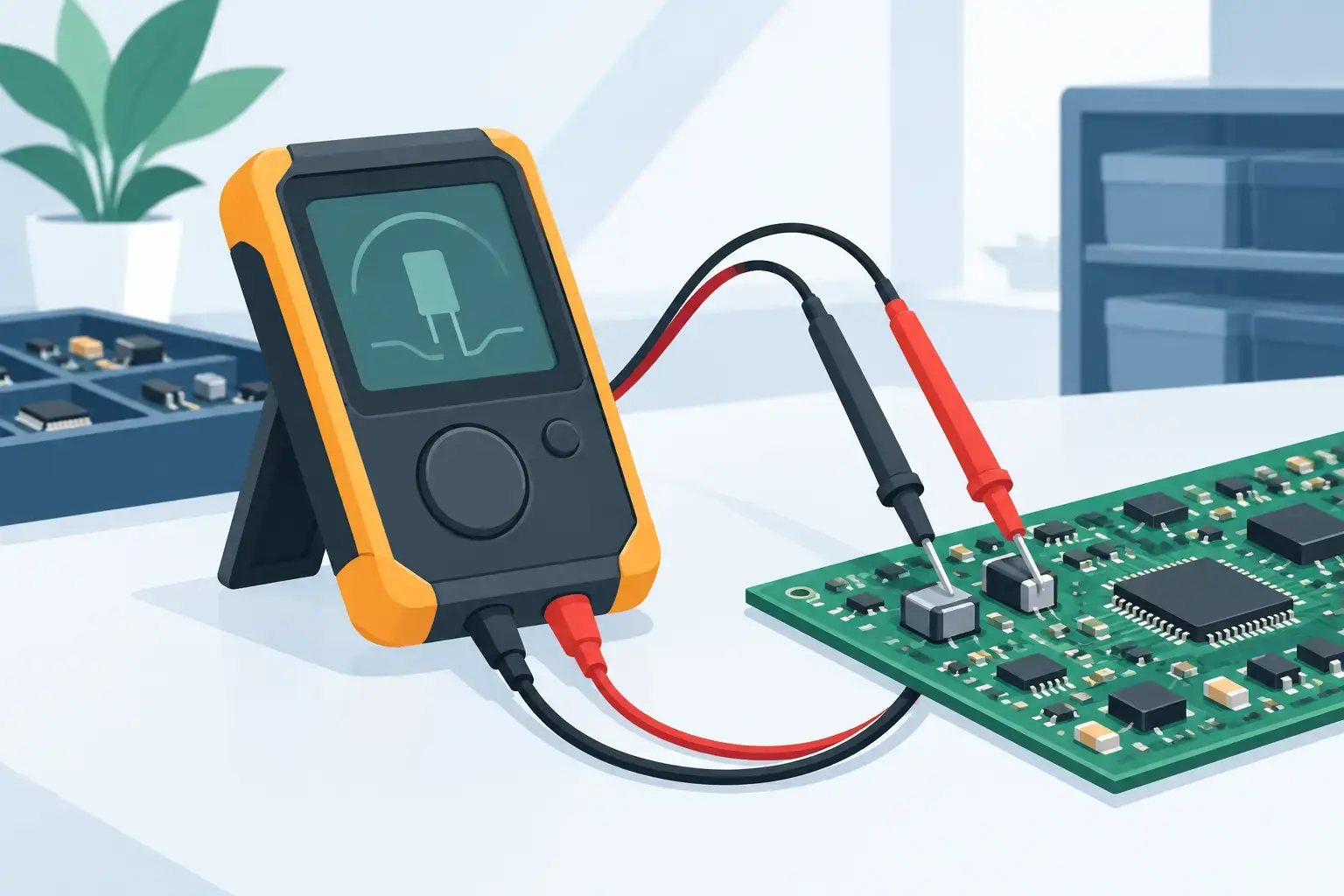
A failed capacitor rarely announces itself clearly on a crowded board. It may look normal, retain a plausible capacitance value, and still create ripple, unstable regulation, intermittent startup, or excessive heat. That is where a compact ESR meter review must go beyond the question of whether a device can display ESR. The practical question is whether it can produce a trustworthy reading quickly enough to improve real troubleshooting decisions.
For technicians working with surface-mount components, portable ESR measurement is most useful when it removes the friction of conventional test setups. A capable tweezer-style instrument should make direct contact with small parts, identify the component type automatically, select appropriate measurement conditions, and show a stable result without requiring a long menu sequence. Those requirements sound basic, but the differences between compact meters become obvious at the bench.
What a Compact ESR Meter Must Measure Well
Equivalent series resistance is the resistive loss associated with a capacitor’s electrodes, electrolyte, dielectric, leads, and internal connections. As ESR rises, a capacitor may dissipate more power and become less effective at filtering ripple or delivering transient current. ESR is particularly relevant in switching power supplies, DC-DC converters, motherboard power rails, LED drivers, and other high-frequency circuits.
A useful ESR result is not simply a low number on a display. It needs context. ESR varies with capacitance, capacitor construction, temperature, age, and test frequency. A 100 µF low-ESR polymer capacitor and a general-purpose aluminum electrolytic of the same nominal capacitance are not expected to have the same ESR. The meter therefore needs sufficient resolution and repeatability to distinguish a meaningful change from ordinary measurement variation.
For board work, contact quality is equally important. Standard probes can be awkward on 0402, 0603, and 0805 components, while their lead resistance and hand movement can affect low-resistance readings. Tweezer probes place both contacts at the component body, improving placement speed and reducing the tendency to slip onto adjacent pads. This is a major workflow advantage, not merely a smaller enclosure.
ESR alone is not enough
An ESR meter that only reports ESR can identify some failed capacitors, but it leaves gaps in component verification. On an SMT board, the unknown part under the probes may be a capacitor, resistor, inductor, diode, or a component affected by parallel circuitry. A compact LCR/ESR meter is more useful because it can identify resistance, capacitance, inductance, and ESR as appropriate.
Automatic component recognition matters most during fault isolation and rework inspection. Instead of changing modes repeatedly, the operator can move from part to part and focus on the circuit evidence. This approach is especially effective when checking a populated board against a known-good section or locating suspect parts after a power-rail fault.
Compact ESR Meter Review: The Criteria That Matter
The best purchasing decision comes from matching the instrument to the work, not from selecting the longest feature list. Four criteria usually determine whether a handheld meter becomes a daily tool or remains in a drawer: measurement confidence, contact design, operating speed, and range fit.
Accuracy, resolution, and calibration
Published accuracy specifications should be read with the specified test conditions in mind. Look for the stated measurement range, resolution, test frequency, and accuracy format. A percentage-of-reading specification may be very good at one range and less informative at the low end without an accompanying count or absolute error figure.
Calibration support also deserves attention. Any precision instrument can drift over time or be affected by damaged probes, contamination, and mechanical wear. A meter with documented calibration procedures, a compatible calibration fixture, and available repair support is a better long-term choice for professional use. For production inspection or quality-control environments, traceable calibration documentation may be a requirement rather than a preference.
Do not interpret a highly precise display as proof of an accurate in-circuit result. A board can place capacitors in parallel, add alternate current paths, or connect semiconductors that influence the measurement. The meter may be functioning correctly while the circuit prevents isolation of the individual component. When a reading is questionable, compare with a known-good board, lift one terminal where practical, or verify the circuit topology before condemning the part.
Test frequency and manual control
ESR is frequency-dependent, so test frequency affects how closely a handheld result relates to the behavior that matters in the circuit. Automatic frequency selection is fast and appropriate for routine component identification. It is usually the right starting point for repair technicians who need immediate information rather than a manual setup task.
Manual test-frequency selection becomes more valuable when comparing components under controlled conditions, evaluating parts against a datasheet, or performing repeatable engineering checks. It gives experienced users a way to apply the same conditions across multiple samples. The trade-off is simple: more control can mean more decisions. A compact meter intended for rapid troubleshooting should still make automatic operation the default.
Tweezer geometry and Kelvin contact
The physical design of the probe tips has direct influence on usability. Fine, aligned tips need enough precision to contact small chip components without bridging nearby pads, but they also need enough durability for daily bench use. Spring tension matters as well. Excessive force can move a small component or fatigue the operator, while insufficient force can create unstable contact.
Kelvin measurement techniques are particularly relevant at low resistance because they reduce the effect of lead and contact resistance. Not every compact instrument applies Kelvin methods in the same way or across every measurement mode, so buyers should examine the documentation rather than assume that any two-wire-looking probe arrangement delivers identical low-ohm performance. An external Kelvin probe option can also be useful when components are too large or inaccessible for tweezers.
Display behavior and speed
A compact meter should settle quickly, but speed without stability has little value. The display should update promptly when the tips contact a part and settle to a reading that does not wander under normal handling. Clear units and automatic range selection reduce interpretation errors when moving between milliohms, ohms, microfarads, nanofarads, and microhenries.
This is where a purpose-built handheld tool can outperform a general multimeter workflow. A multimeter may be excellent for voltage, continuity, and basic capacitance checks, yet it often requires lead changes, dial changes, and separate interpretation. A dedicated LCR/ESR instrument is designed for component-level work, where dozens of quick measurements may be needed before the fault pattern becomes clear.
Where Compact Meters Have Limits
A compact ESR meter is not a replacement for every instrument on an electronics bench. It cannot show capacitor ripple current under load, confirm power-rail noise, characterize dielectric absorption, or replace an impedance analyzer for detailed frequency sweeps. An oscilloscope, electronic load, bench LCR meter, and thermal inspection may still be necessary for difficult failures.
In-circuit measurement is the other major limitation. A low ESR reading does not prove that a capacitor is good if another parallel component dominates the result. Likewise, an unexpectedly low capacitance result may reflect a parallel path rather than a defective part. Compact meters are strongest when used as fast evidence-gathering tools within a disciplined diagnostic process.
Battery condition, dirty tips, oxidation, and damaged insulation can also affect daily usability. Cleaning the probe tips, checking zero or calibration procedures when required, and storing the instrument in a protective case are small habits that preserve measurement confidence. For a tool used around powered equipment, follow the instrument’s rated limits and do not use component-measurement tweezers as a substitute for a properly rated voltage probe.
Which User Benefits Most?
For repair technicians, the best compact ESR meter is usually the one that identifies common passive components automatically and makes reliable contact with dense SMT assemblies. Speed and ergonomics outweigh advanced manual controls if the work consists mainly of fault finding, board repair, and incoming-part checks.
For engineers and quality personnel, manual frequency options, documented specifications, calibration support, and broader ranges may justify a higher-tier model. These features help when comparing lots, checking prototypes, or creating repeatable inspection procedures. For technically capable hobbyists, an entry-level automatic LCR/ESR tweezer meter may offer the best value because it eliminates much of the setup burden while covering the measurements most often needed.
LCR-Reader instruments fit this category of workflow by combining automatic component identification with tweezer-based measurement, while higher-feature variants can add capabilities such as manual frequency selection, diode testing, extended ranges, or Bluetooth connectivity. The appropriate model depends on whether the priority is fast bench diagnosis, documented inspection work, or advanced component analysis.
The most useful compact ESR meter is the one that lets you test the next suspect component with confidence, before a minor power-rail fault turns into an hour of unnecessary rework.