
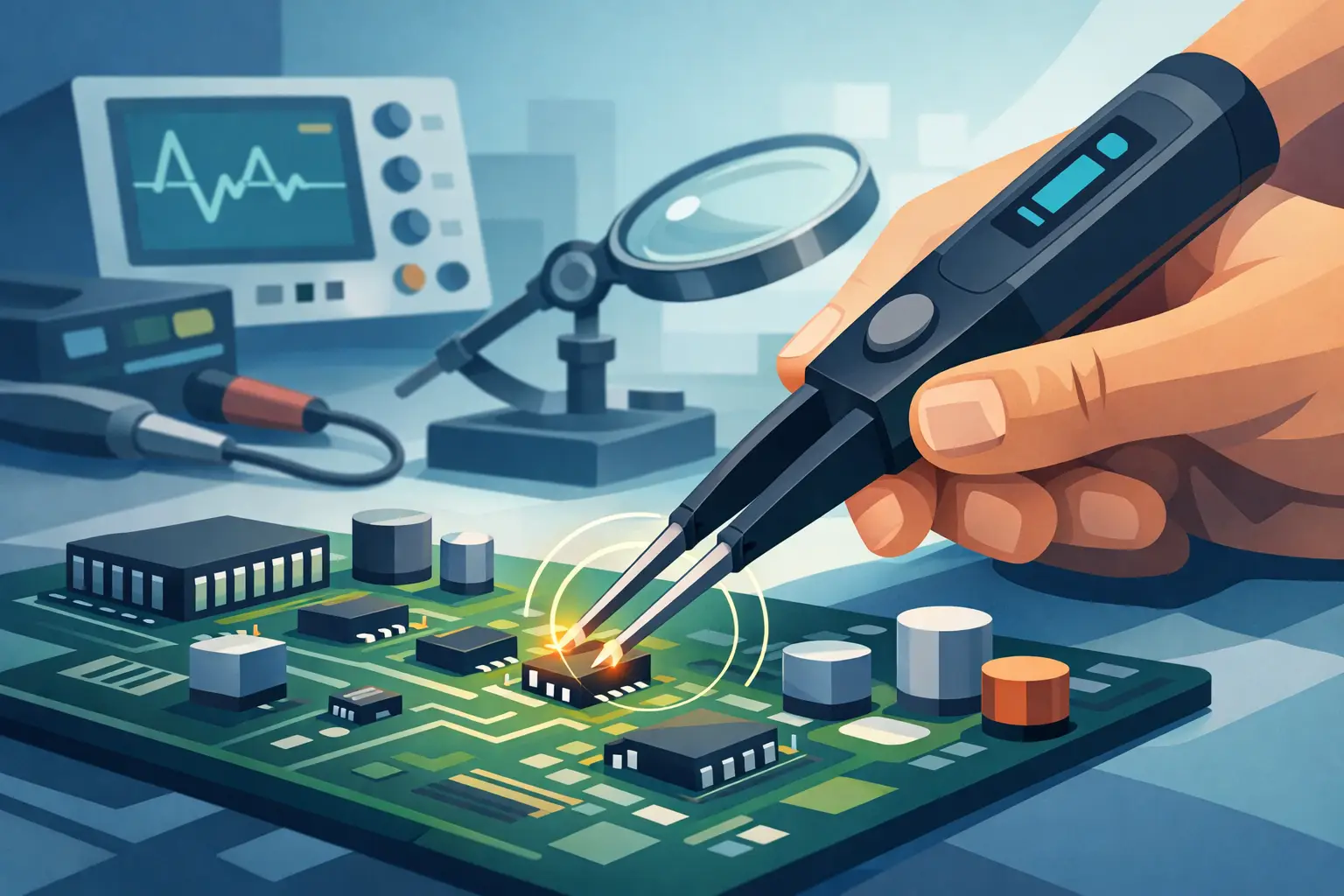
A missing value on a tiny 0402 capacitor, a questionable resistor on a populated board, or a tray of unmarked parts can turn a quick repair into a slow identification job. Entry level smart tweezers address that problem directly: touch both component terminals, let the meter identify the component type, and read the result without building a test setup around it.
For technicians and engineers working with surface-mount devices, the appeal is not novelty. It is reduced handling, faster fault isolation, and fewer opportunities to misread a component because the probes slipped or the test leads added noise. The right entry-level instrument can cover a large share of everyday resistance, capacitance, inductance, and ESR checks. The key is knowing where its automatic measurement is genuinely useful and where a more advanced meter or a controlled bench measurement is the better choice.
What Entry Level Smart Tweezers Are Designed to Do
Smart tweezers combine two probe tips, an LCR measurement circuit, display, and automatic component recognition in one handheld instrument. The tips form a short two-wire measurement path that is well suited to individual chip components. Rather than selecting resistance, capacitance, or inductance manually before every test, the instrument evaluates the component and applies an appropriate test mode.
That workflow matters most when the component is small and the question is immediate. A user may need to confirm whether a loose part is a 10 kOhm resistor or a 10 nF capacitor, compare several capacitors for an outlier, or check whether a suspected resistor has drifted far beyond its marked value. Traditional meters can perform some of these tasks, but test leads, separate probes, menu selection, and awkward contact points add time.
An entry-level model generally prioritizes automatic operation, portability, and common component ranges over specialized controls. It is a practical first instrument for bench repair, prototype work, incoming inspection, and component sorting. It is not automatically a substitute for every LCR meter in a production lab.
The Measurement Capabilities That Matter Most
A useful evaluation starts with the work being performed, not with the longest feature list. For most SMT troubleshooting, resistance, capacitance, inductance, and ESR are the core functions.
Resistance and continuity checks
Resistance measurement is often the first use case. Tweezers make it easier to contact both ends of a chip resistor without holding two separate probes at an angle. Fast automatic identification is especially useful when sorting reels, inspecting mixed loose components, or locating an open resistor on a board.
Accuracy and resolution both matter. Resolution determines how small a displayed change can be; accuracy determines how closely the reading tracks the actual value under stated conditions. A meter with a highly detailed display is not necessarily the more accurate instrument. Review the published accuracy specification, test conditions, and calibration status rather than comparing display digits alone.
Capacitance and ESR
Capacitance checks are common, but interpretation requires care. An in-circuit capacitor may be connected to parallel components, semiconductor junctions, power rails, or additional capacitance. The displayed result can therefore represent the circuit around the part, not only the part itself.
ESR measurement can help identify aging or damaged capacitors, particularly when a part has a value that appears normal but behaves poorly under load. However, ESR readings depend on test frequency, component technology, capacitance value, and connection conditions. An entry-level device can provide a fast screening result. For a final pass/fail decision on a critical component, compare against the correct specification at the relevant test frequency.
Inductance measurement
Automatic inductance measurement is valuable for identifying loose inductors and checking obviously damaged parts. In-circuit inductance readings are often less straightforward than resistance readings because nearby capacitors, parallel paths, magnetic coupling, and the board layout affect the result. If an inductor must meet a tight tolerance, remove it or use the measurement method specified by the component manufacturer.
Why Automatic Identification Improves Troubleshooting
The strongest benefit of smart tweezers is not simply that they measure several parameters. It is that they remove small decisions from repetitive work. A technician does not need to stop, choose a function, connect leads, and then reposition probes for each part. The tool is already in the hand and the tips are aligned for chip components.
That can improve consistency during diagnostics. Short, rigid probe paths reduce the moving-lead problem common with handheld meters. Fine tips also make it easier to isolate a single component in dense assemblies, provided the user can reach both terminals without contacting adjacent pads.
Automatic operation has limits. A component connected in circuit can present a mixed electrical signature, and a meter may identify the dominant response rather than the intended component category. This is not a failure of the instrument. It is a reminder that a measurement is always a result of the device under test and its electrical environment.
Where Entry-Level Models Fit Best
Entry-level smart tweezers are a strong fit when speed and convenience matter more than extensive manual control. They are particularly effective for repair benches, field kits, educational labs, electronics hobbyists, and engineers who need a secondary meter for quick component verification.
They are also useful in incoming inspection. When a small batch of unmarked or mixed SMT parts arrives, automatic measurement can quickly separate likely resistor, capacitor, and inductor values. The results should still be checked against the purchase specification when traceability or acceptance criteria are strict, but the initial sorting process becomes much faster.
For repair work, the instrument is most effective as part of a sequence. First inspect the board for physical damage and contamination. Then check for shorts and obvious resistance anomalies. Use capacitance and ESR readings as screening data, and isolate or remove the component when circuit paths make the reading ambiguous. This approach avoids replacing parts based on a single in-circuit number.
What You Give Up at the Entry Level
Lower cost does not mean low value, but it usually means fewer controls and fewer specialized functions. Depending on the model, an entry-level instrument may not offer manual test-frequency selection, advanced equivalent-circuit choices, data logging, Bluetooth connectivity, diode testing, extended ranges, or the highest available measurement accuracy.
Manual frequency selection becomes important when measurements must match a component datasheet or a production test procedure. A capacitance or ESR value taken at one frequency may not match a value measured at another. For general identification and troubleshooting, automatic parameter selection is often the faster option. For controlled characterization, a model with explicit frequency control is preferable.
In-circuit work also highlights the difference between convenience and complete isolation. Tweezer-style meters excel when there is a clear path to the component terminals. They cannot eliminate parallel circuit paths, charged capacitors, or powered-board hazards. Always de-energize the board, discharge capacitors appropriately, and follow the instrument’s stated input limits.
How to Choose Entry Level Smart Tweezers
Start with the component sizes and values you encounter most often. Fine, durable tips are essential for 0402, 0201, and similarly compact devices, but the tool also needs enough spacing and control for larger components. Check whether replacement tips, calibration fixtures, and service support are available. A precision handheld meter is only as useful as its contact quality and ability to remain within specification over time.
Next, review the published ranges and accuracy for resistance, capacitance, inductance, and ESR. Do not assume that a broad nominal range means equal performance across it. The lower and upper ends of a range may have different accuracy limits, and small-value capacitors or very low resistance measurements can be particularly sensitive to tip condition and zeroing procedures.
Calibration support deserves the same attention. For occasional component sorting, a user may only need routine verification against known standards. For quality control, repair documentation, or professional service work, traceable calibration and a defined recalibration path matter. LCR-Reader instruments are built around this practical progression, from straightforward automatic tools to models with more advanced control and connectivity.
Finally, consider the display and handling. A readable screen, stable readings, sensible auto power behavior, and an ergonomic grip have a direct effect on daily productivity. Specifications establish capability, but contact repeatability determines whether the instrument is pleasant to use for hundreds of measurements.
Getting Reliable Results From a Tweezer Meter
Good technique is simple but not optional. Keep the tips clean, undamaged, and aligned. Before measuring low values or tight-tolerance components, use the instrument’s recommended zeroing or calibration procedure. Contact the component terminals firmly without scraping pads or bridging neighboring conductors.
For loose parts, measure the same component more than once and rotate it if the geometry allows. Stable repeated readings build confidence that the contact is good. For in-circuit parts, compare the measurement with an identical component elsewhere on the board when possible. A comparative reading can reveal an outlier even when the exact in-circuit value is not the nominal value.
Entry-level smart tweezers are most valuable when treated as fast diagnostic instruments rather than magic component analyzers. Use them to narrow the fault, verify the likely part, and decide whether isolation or deeper testing is warranted. That is enough to save significant time on a crowded SMT board.