
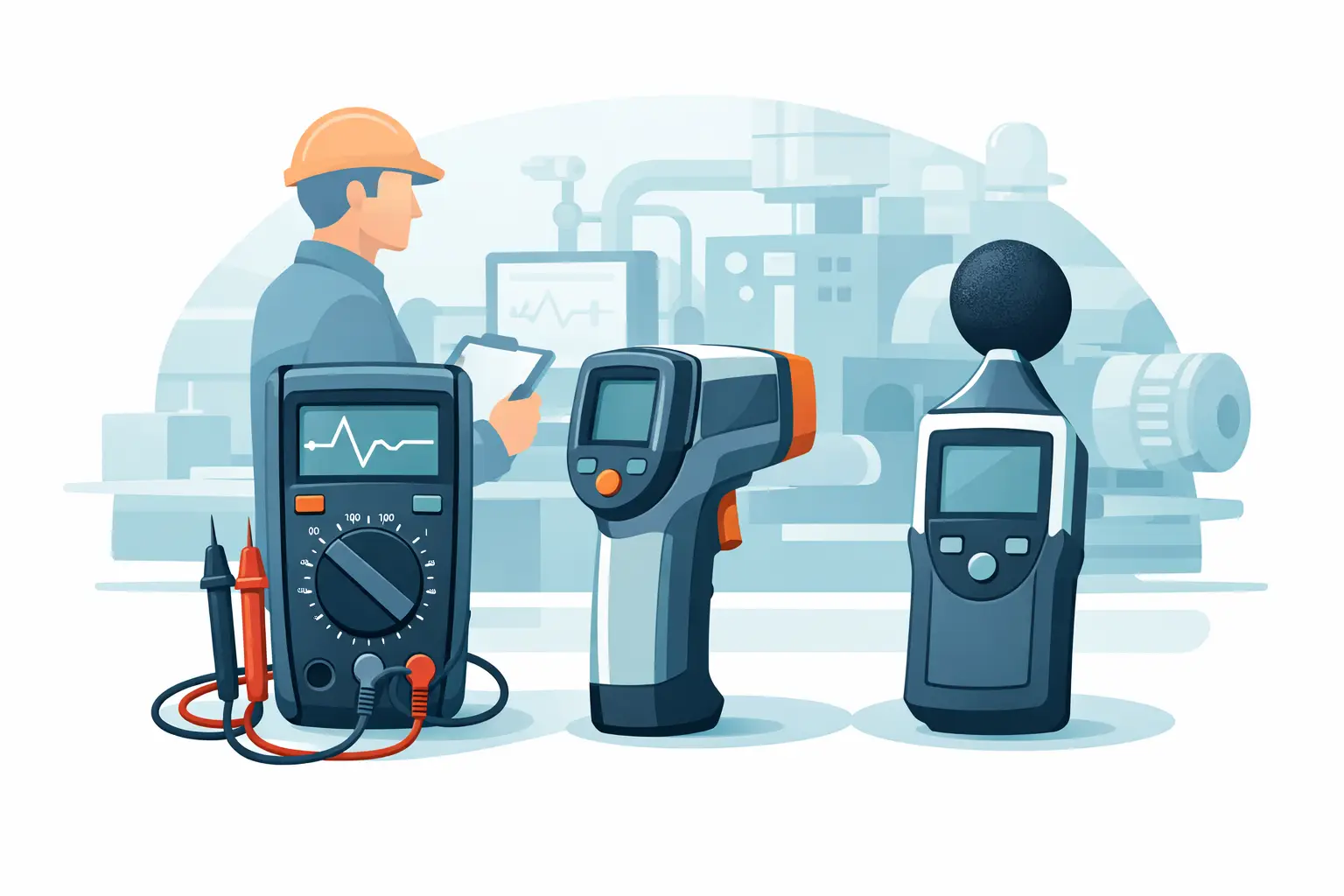
A meter that is excellent for field voltage checks can be the wrong instrument for identifying a 0402 capacitor on a populated board. That distinction matters when evaluating the best handheld meters for engineers. The right choice is not the meter with the longest feature list. It is the instrument that produces a reliable measurement quickly enough to improve the actual work in front of you.
For electronics design, production, repair, and quality control, handheld meters generally fall into several specialized categories. A digital multimeter remains essential, but it does not replace an LCR meter, an ESR meter, or a portable oscilloscope when component-level decisions are required. Engineers get better results by matching the meter to the measurement problem, the component package, and whether the device under test is in or out of circuit.
What Makes a Handheld Meter Suitable for Engineering Work?
A useful engineering meter needs more than a display and a pair of probes. It must have a measurement range appropriate to the job, known accuracy at the relevant range, repeatable contact quality, and a workflow that does not introduce avoidable errors.
Resolution is often confused with accuracy. A meter may display many digits while still carrying an uncertainty that makes those digits meaningless. For example, measuring a low-value resistor, capacitor ESR, or small inductance requires specifications that remain credible near the lower end of the range. Test frequency also matters. Capacitance and inductance are frequency-dependent in real components, while ESR is particularly sensitive to the test conditions used.
Ergonomics should not be treated as a minor issue. When troubleshooting dense SMT assemblies, conventional probes can slip, bridge adjacent pads, or require a third hand. Tweezer-style contacts reduce that friction by holding both terminals at once. For a bench engineer who measures dozens of parts per day, that change can save more time than a marginal improvement in display resolution.
Best Handheld Meters for Engineers: Match the Type to the Task
The following categories cover the most common engineering requirements. They are complementary tools, not interchangeable versions of the same instrument.
| Meter type | Best use | Primary limitation | | — | — | — | | Digital multimeter | Voltage, current, continuity, diode checks, general diagnostics | Limited component characterization | | Handheld LCR meter | Resistance, capacitance, inductance, and component sorting | Results can be affected by parallel circuit paths | | ESR meter | Capacitor health and low-resistance loss checks | Does not fully characterize capacitance or inductance | | LCR tweezer meter | Small SMD component identification and board troubleshooting | Less suitable for high-energy electrical measurements | | Clamp meter | Non-invasive current measurement in power systems | Not intended for small-component testing | | Portable oscilloscope | Signals, ripple, transients, timing, and communication activity | More setup and interpretation than a basic meter |
Digital Multimeters for Core Electrical Checks
A quality handheld DMM is the baseline tool for nearly every engineer. It verifies supply rails, checks continuity, measures resistance, and confirms whether a diode junction is behaving as expected. For field service and power electronics work, pay close attention to input protection, CAT rating, current range protection, true-RMS capability, and voltage accuracy.
The limitation appears when the question changes from “Is this rail present?” to “What is this unmarked component?” A DMM’s capacitance mode may provide a rough value under favorable conditions, but it typically will not select the optimal test frequency, report ESR, or reliably identify a component still influenced by the surrounding circuit. A DMM is essential, but it is not a full component analyzer.
Handheld LCR Meters for Component Verification
An LCR meter measures inductance, capacitance, and resistance, giving engineers the data needed to verify incoming parts, sort mixed components, check rework, and diagnose suspect passives. It is especially valuable when markings are absent, incomplete, or impossible to read on miniature packages.
For meaningful comparison, look beyond the maximum stated range. Review accuracy for capacitance, inductance, and resistance separately. Check available test frequencies, measurement speed, automatic component identification, and whether the meter supports calibration verification. A meter that performs well with a 10 uF capacitor may behave very differently with a low-value inductor or a milliohm-range resistor.
Manual frequency selection is useful when an engineer needs to match a test condition to a component specification. Automatic mode is preferable when speed is the priority. The best choice depends on whether the work is repetitive production inspection, repair diagnosis, or detailed component validation.
ESR Meters for Capacitor Troubleshooting
Equivalent series resistance is one of the fastest indicators of aging or failed electrolytic capacitors. A capacitor can still show a plausible capacitance value while its ESR has risen enough to cause ripple, instability, heating, or startup problems. This is common in power supplies, motor drives, consumer electronics, and older industrial controls.
A dedicated ESR function is useful because it focuses on the loss characteristic that a standard capacitance measurement may miss. However, ESR alone is not a pass or fail verdict. Compare the reading against the capacitor type, value, voltage rating, temperature, and manufacturer data where available. Very low ESR can be normal for modern polymer capacitors, while a similar reading may be unexpected for another capacitor technology.
LCR Tweezers for SMT Work
For dense boards and loose surface-mount parts, LCR tweezers are often the most efficient handheld format. The operator touches both ends of a resistor, capacitor, or inductor directly, and the meter identifies the component type and applies the appropriate measurement mode. This removes the need to manage two probes, select a function, and stabilize contact on pads only fractions of an inch apart.
This format is particularly effective for incoming inspection, board repair, component sorting, and verifying values after rework. Devices such as the LCR-Reader are designed around this workflow, combining automatic LCR measurement with tweezer contacts that make small-component handling practical at the bench.
The important trade-off is circuit context. In-circuit readings can be distorted by parallel components, semiconductor junctions, and active circuitry. If a result does not agree with the expected value, isolate one side of the component or compare it with an identical location on a known-good board. Fast automatic measurement supports diagnosis, but it does not eliminate engineering judgment.
Clamp Meters for Power and Field Systems
Clamp meters solve a different problem: measuring current without opening the circuit. They are appropriate for mains-powered equipment, battery systems, motors, HVAC controls, and power distribution. A DC clamp meter with sufficient low-current resolution can also help identify standby-current faults and unexpected load behavior.
Do not select a clamp meter based only on its maximum current rating. A meter designed for hundreds of amps may be poor at resolving small current changes in embedded or low-power systems. For electronics engineers, a separate DMM or current shunt measurement is often needed when precision below an ampere matters.
Portable Oscilloscopes for Problems a Meter Cannot See
A meter reports a value. An oscilloscope shows behavior over time. When a supply rail has ripple, a clock line is intermittent, a PWM signal is incorrect, or a communication bus is inactive, a handheld oscilloscope provides evidence that no static meter reading can supply.
Portable scopes involve trade-offs in bandwidth, sample rate, memory depth, triggering, probe quality, and user interface. They are not replacements for a precision LCR meter or DMM. They are the correct tool when the failure is dynamic rather than purely resistive, capacitive, or conductive.
How to Build a Practical Meter Kit
Most engineers do not need every meter in every situation. A focused electronics bench kit usually starts with a protected, accurate DMM and adds an LCR or LCR tweezer meter when passive components are part of the daily workload. An ESR-capable instrument becomes valuable for repair-heavy work, while a portable scope is justified when power integrity and digital timing are regular concerns.
For field and power applications, add a clamp meter suited to the expected current range and safety category. For SMT assembly and repair, prioritize fine-pitch contact, automatic identification, stable low-value measurement, and calibration support over features that will rarely be used.
Calibration deserves attention in both purchasing and ownership. A meter may be highly capable when new, but confidence in its readings depends on maintaining traceability and checking performance against suitable standards. Use the proper fixture or Kelvin connection method when measuring low resistance or when the instrument documentation calls for it. Poor contact resistance can overwhelm the value being measured.
The most effective handheld meter is the one that turns a suspected fault into a defensible measurement with minimal setup. Choose for the components, circuits, and failure modes you encounter most often, then let accuracy, contact method, and calibration support determine the final decision.