
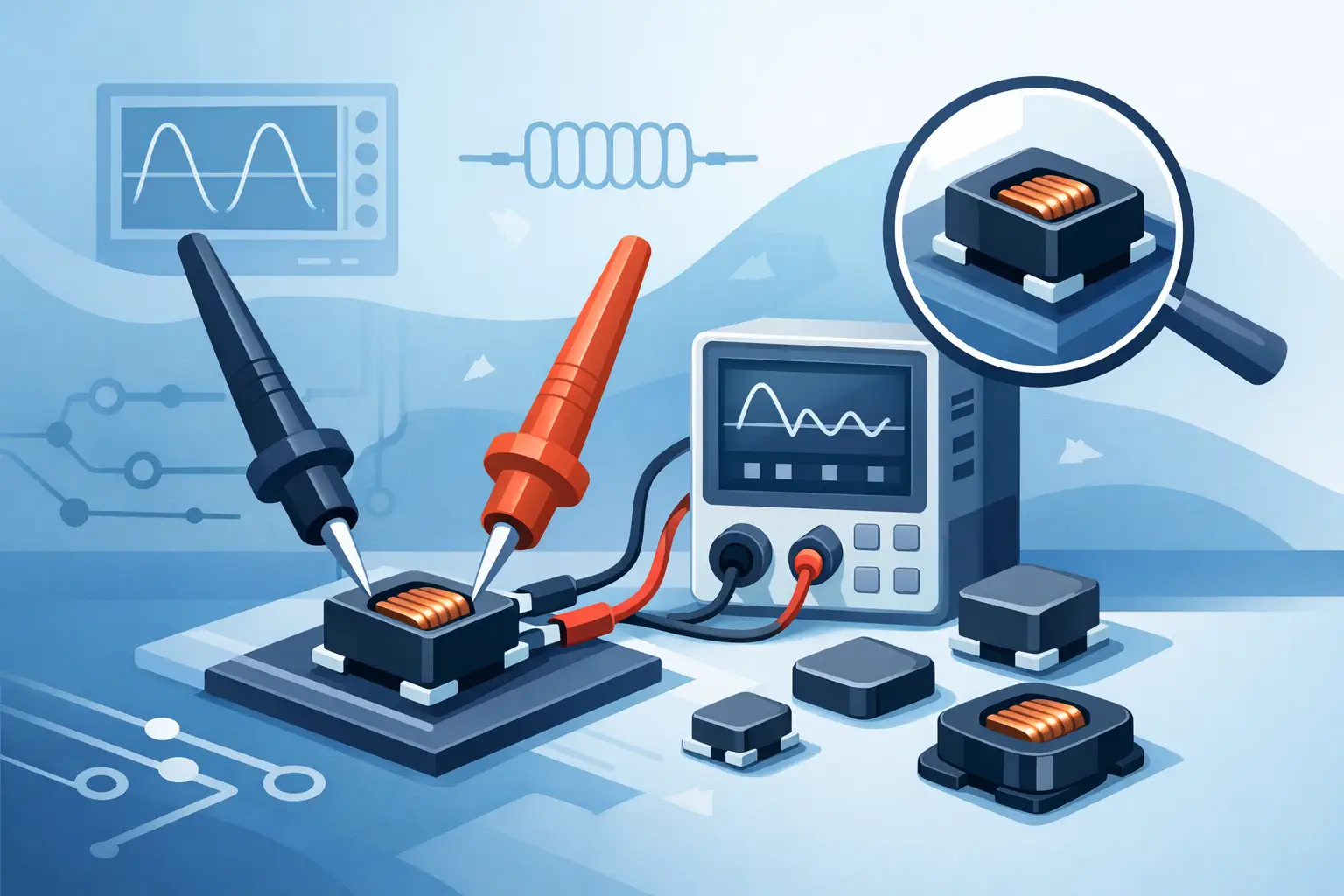
A 2.2 uH chip inductor that reads 0.8 uH on the bench is usually not defective. More often, the test method is wrong. If you need to know how to measure SMD inductors accurately, the real challenge is not just connecting a meter – it is controlling frequency, fixture effects, contact resistance, and the influence of the surrounding circuit.
For SMT work, inductance measurement has to be fast and repeatable. That matters whether you are sorting reels, checking incoming parts, diagnosing a switching regulator, or confirming that a lifted component matches the BOM. Small inductors are especially sensitive to poor probing and stray parasitics, so the tool and method matter more than many users expect.
How to measure SMD inductors without bad readings
The first decision is whether you are measuring the part out of circuit or in circuit. Out-of-circuit measurement is always the cleaner result because the meter sees only the inductor. In-circuit measurement can be useful for troubleshooting, but parallel and series components can shift the reading enough to make identification uncertain.
The second decision is the instrument. A standard DMM is not the right tool for this job because it typically measures only DC resistance. That can tell you whether the winding is open or low resistance, but it does not tell you inductance. You need an LCR meter or LCR tweezers that can apply an AC test signal and resolve the inductive reactance.
For small SMD parts, tweezer-style meters have a practical advantage. They reduce lead length, improve contact consistency, and remove much of the setup overhead that comes with bench fixtures. That matters when you are measuring 0402, 0603, or 0805 inductors where a little stray capacitance or a shaky hand can move the number.
What actually affects the measurement
Inductors do not have one universal value under all conditions. The reading depends on test frequency, test voltage, DC bias in some cases, fixture parasitics, and the part’s own tolerance and core characteristics. If a datasheet specifies inductance at 100 kHz, measuring the same part at 1 kHz may produce a different result. That is not necessarily an error.
This is where many mismatches start. A user sees 10 uH on the reel label, touches the part with a meter set to a different test frequency, and assumes the component is wrong. Before calling the part defective, compare the meter settings to the datasheet conditions.
Series resistance also matters. Real inductors include winding resistance and losses, so the displayed result may appear as inductance with a Q factor, D factor, or ESR-related parameter depending on the instrument. On very small power inductors, a stable reading often depends on the meter selecting the right equivalent circuit model automatically.
Test frequency is not optional
For SMD inductors, test frequency is one of the most important variables. RF inductors, ferrite bead style parts, and power inductors can behave very differently across frequency. A low-frequency test may be suitable for one component class and misleading for another.
When possible, measure at the frequency used by the component datasheet. If the meter supports automatic test selection, verify that the chosen frequency is reasonable for the expected value. High-value inductors are often measured at lower frequencies, while small-value inductors may require higher frequencies for better resolution.
Contact quality changes everything
Oxidized pads, unstable probe pressure, and long clip leads introduce enough error to make a small inductor look out of tolerance. This is why handheld tweezers are commonly preferred for surface-mount work. A short, direct contact path lowers parasitics and speeds up the measurement.
If readings bounce, do not assume the inductor is unstable. First check probe tip cleanliness, pressure consistency, and whether you are touching solder residue rather than the component termination itself.
Step-by-step method for accurate SMD inductor measurement
Start with the simplest case: measuring a loose component. Place the inductor on a clean nonconductive surface. If you are using LCR tweezers, make sure the tips are clean and aligned. If your instrument supports open and short compensation, perform that first, especially when changing probe fixtures or accessories.
Touch both terminals firmly and let the reading settle. Avoid squeezing too hard on very small packages, since mechanical movement can cause intermittent contact. Read not only the inductance value but also the test frequency and secondary parameter if shown. A 4.7 uH result at one frequency is not directly comparable to a datasheet spec taken at another.
Next, compare the measurement to the part tolerance. Many chip inductors are not tight-tolerance components. A measured value that looks slightly high or low may still be fully compliant. If the result is far off, remeasure the part after rotating it or cleaning the terminations. Poor contact causes more false failures than actual part damage.
For in-circuit measurement, reduce expectations. You can often identify whether an inductor is present, open, shorted, or badly shifted, but exact value confirmation is harder unless the surrounding network is simple. Parallel capacitors, snubbers, IC pins, transformers, and low-impedance rails can distort the reading significantly.
If the in-circuit result is suspicious, lift one end of the component and measure again. That single step removes most of the ambiguity.
Common mistakes when measuring SMD inductors
One common mistake is using test leads that are too long. Long leads add inductance and capacitance of their own, which is exactly what you do not want when measuring small surface-mount parts. Another is trying to measure directly on a crowded board without isolating nearby influences. In a dense power stage, the meter may be reading the network, not the inductor.
A third mistake is relying on DC resistance as a substitute for inductance. DCR is useful, but only as a supporting parameter. Two different inductors can have similar resistance and very different inductance values.
There is also the issue of saturation and bias. If you are evaluating a power inductor removed from a circuit that failed under load, a small-signal LCR reading may still look normal even though the part performs poorly under operating current. In that case, the bench measurement is only part of the diagnosis.
Choosing the right tool for SMD inductors
If your workload includes frequent SMT identification or troubleshooting, speed matters almost as much as accuracy. Bench LCR meters can provide excellent results, especially with proper Kelvin fixtures, but they are slower in day-to-day rework and inspection. Tweezer-style LCR meters are often the better fit for component-level work because they combine contact, measurement, and part handling in one motion.
The most useful features are automatic component recognition, stable low-parasitic probing, and appropriate test frequency selection. Certified calibration support also matters if you are using the readings for quality control or incoming inspection rather than casual bench checks. A tool such as the LCR-Reader is designed around that workflow, which is why it is well suited to fast SMD verification.
Still, there is a trade-off. If you need advanced characterization across multiple frequencies or detailed analysis of impedance versus frequency, a benchtop instrument will give you more control. If you need quick confirmation of small chip inductors at the bench, handheld tweezers are usually the more efficient choice.
How to interpret the number you get
A good measurement is not just a number on the screen. It is a number tied to test conditions. When an SMD inductor reads differently than expected, ask four questions: was it measured at the datasheet frequency, was it isolated from the circuit, were the contacts clean and stable, and is the observed difference outside the component tolerance?
That approach prevents wasted time and unnecessary part replacement. In practical troubleshooting, the goal is not laboratory perfection every time. The goal is a reading you can trust enough to sort good parts from bad ones and move the repair or inspection process forward.
When the setup is right, measuring SMD inductors is straightforward. When the setup is wrong, even a good part can look defective. A few seconds spent controlling frequency, contact quality, and circuit influence will usually save far more time than replacing components based on a misleading reading.