
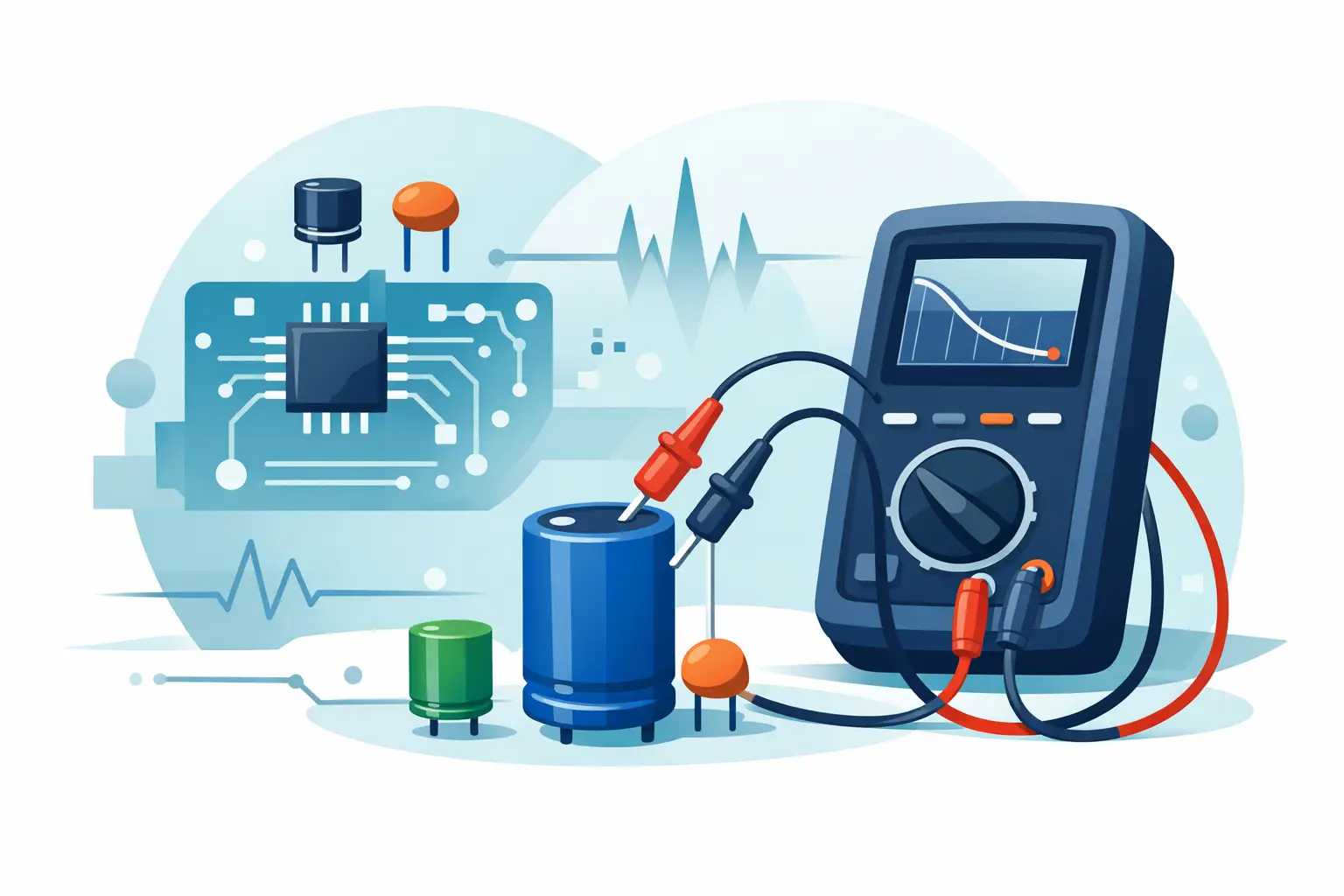
A bad capacitor rarely announces itself. On the bench, it shows up as unstable power rails, startup faults, excess ripple, or heat where there should be none. That is where an esr meter earns its place. Instead of guessing from symptoms or removing every suspect capacitor for full analysis, you can quickly check equivalent series resistance and identify parts that are drying out, damaged, or no longer suitable for the circuit.
What an ESR meter actually measures
ESR stands for equivalent series resistance. Every real capacitor includes a small resistive element in series with its ideal capacitance. That resistance is not just a theoretical detail. As ESR rises, the capacitor dissipates more power, handles ripple current less effectively, and performs worse in switching supplies, audio stages, and filtering networks.
An ESR meter applies an AC test signal and estimates that resistive component. In practical troubleshooting, this matters because capacitance alone does not tell the whole story. A capacitor can still read close to its nominal value while having ESR high enough to cause circuit failure. That is why technicians often find an apparently acceptable capacitor on a standard capacitance meter, then confirm the fault with ESR measurement.
The exact test method depends on instrument design, frequency, and signal amplitude. That means readings are not always directly interchangeable across every meter. For service work, consistency and known specifications matter more than a single number in isolation.
Why ESR matters in real troubleshooting
In switching power supplies, ESR affects ripple suppression and regulator stability. In motherboards, industrial controls, LED drivers, and telecom hardware, elevated ESR can create intermittent faults that are difficult to reproduce. The circuit may pass a basic continuity check, yet still fail under load because the capacitor no longer behaves correctly at operating frequency.
This is why an ESR meter is valuable in repair environments. It shortens fault isolation time. Instead of replacing capacitors blindly or spending time desoldering parts one by one, you can compare suspect components, spot obvious outliers, and focus your effort where it counts.
There is a trade-off, though. ESR is highly useful, but it is not the only parameter that matters. Leakage current, capacitance drift, dielectric absorption, and voltage rating still matter in design validation or deeper failure analysis. An ESR reading is often the fastest screening tool, not the only test you will ever need.
ESR meter vs LCR meter
This distinction matters because buyers often assume they are interchangeable. They overlap, but not completely.
A dedicated ESR meter is optimized for rapid capacitor health checks. It is often favored in repair because the workflow is simple and the measurement is focused. In many service scenarios, speed beats menu depth.
An LCR meter is broader. It measures inductance, capacitance, and resistance, and more capable models can also report ESR, dissipation factor, test frequency options, and additional component parameters. For users handling mixed inventories, SMT identification, incoming inspection, or design verification, that wider capability can be more efficient than carrying multiple tools.
So which is better? It depends on the job. If your primary task is capacitor troubleshooting in power electronics, an ESR-focused tool may cover most of what you need. If you regularly identify unknown parts, sort SMT components, or verify passive values beyond capacitors, an LCR-style instrument with ESR capability is usually the stronger long-term choice.
What to look for in an ESR meter
Measurement speed matters more than many buyers expect. On a busy bench, delays add up fast. A meter that identifies the component automatically, selects the proper range without manual setup, and stabilizes quickly will save real time across dozens of checks.
Accuracy and repeatability matter just as much. A rough reading may point you in the right direction, but repair decisions often depend on whether a result is marginal or clearly bad. Look for stated accuracy specifications, calibration support, and a test method suitable for low-impedance measurements.
Test frequency is another key detail. ESR varies with frequency, so the instrument’s operating point affects the result. That does not make one meter wrong and another right, but it does mean you should understand the intended application. Service technicians usually want a frequency relevant to capacitor behavior in actual circuits, while engineering users may want more control and comparison options.
Probe style also changes day-to-day usability. Traditional leads work, but tweezer-style meters are especially effective for SMT work because they let you contact both ends of a small component directly. That improves speed, reduces handling, and makes in-circuit checks more practical in dense assemblies.
Display clarity, automatic parameter selection, and low test signal levels are also worth attention. If a meter requires frequent mode changes or uncertain interpretation, it slows diagnosis. A well-designed handheld unit should reduce friction, not add to it.
In-circuit ESR testing and its limits
One reason ESR meters are popular is the ability to test many capacitors in circuit. In favorable cases, that is exactly what makes them efficient. You can move across a board quickly and identify parts with obviously elevated ESR without removing them first.
Still, in-circuit measurement has limits. Parallel components can affect the reading. Semiconductor paths, low-value resistors, and nearby network elements may distort the result. On crowded boards, a low ESR reading can reflect the circuit around the capacitor rather than the capacitor itself.
The right approach is practical, not absolute. Use in-circuit ESR as a screening method. If a reading is clearly abnormal, you likely found a strong lead. If the reading is ambiguous, compare against similar components in the same section or lift one side of the capacitor for confirmation. Experienced technicians do not rely on one measurement alone when the circuit context says otherwise.
Why form factor matters for SMT work
Bench instruments have their place, especially in validation, documentation, and controlled measurement workflows. But many repair and assembly tasks happen under time pressure and with limited space. In those conditions, portability and probe geometry matter almost as much as raw specifications.
A handheld tweezer-style instrument can often do what a lead-based meter cannot do efficiently: contact tiny pads cleanly, identify unknown passives quickly, and move from one component to the next without changing fixtures. For SMT troubleshooting, that workflow advantage is significant.
This is where a product line such as LCR-Reader fits naturally. For users who need ESR capability along with automatic LCR identification in a compact handheld format, a dedicated component-testing tool can replace slower bench habits with a faster touch-and-read process.
Common ESR meter mistakes
The most common error is treating ESR as a universal pass-fail number without considering capacitor type, value, voltage rating, and application. A low-value electrolytic in a high-frequency supply and a large capacitor in a different circuit should not be judged by the same rough expectation.
Another mistake is ignoring contact quality. Dirty leads, unstable probe pressure, oxidized component terminations, or poor alignment on SMT parts can create inconsistent readings. If the number jumps around, the connection may be the problem rather than the component.
Users also underestimate battery condition and calibration. Handheld instruments are only as trustworthy as their reference state. If readings seem off across known-good parts, verify the basics before assuming the board is full of failures.
Choosing the right tool for your bench
If you mainly repair power supplies, audio amplifiers, industrial boards, or consumer electronics with recurring capacitor failures, an ESR meter can pay for itself quickly in time saved. The benefit is not theoretical. Faster screening means less unnecessary desoldering, fewer replaced parts based on guesswork, and better confidence before reassembly.
If your work includes component identification, SMT rework, or incoming part verification, it usually makes sense to look beyond a single-purpose ESR-only device. A handheld LCR meter such as LCR-Reader MPA/MPB, with ESR measurement, automatic mode selection, and precision tweezer probes may fit the workflow better.
The right choice comes down to how you work. If the meter spends its life chasing failed electrolytics, keep the process simple. If it needs to support mixed measurement tasks across repair, inspection, and assembly, choose broader capability with clear specifications and dependable low-impedance performance.
A good ESR meter does not just produce numbers. It helps you make faster, better repair decisions with less handling, less uncertainty, and fewer wasted steps at the bench.