
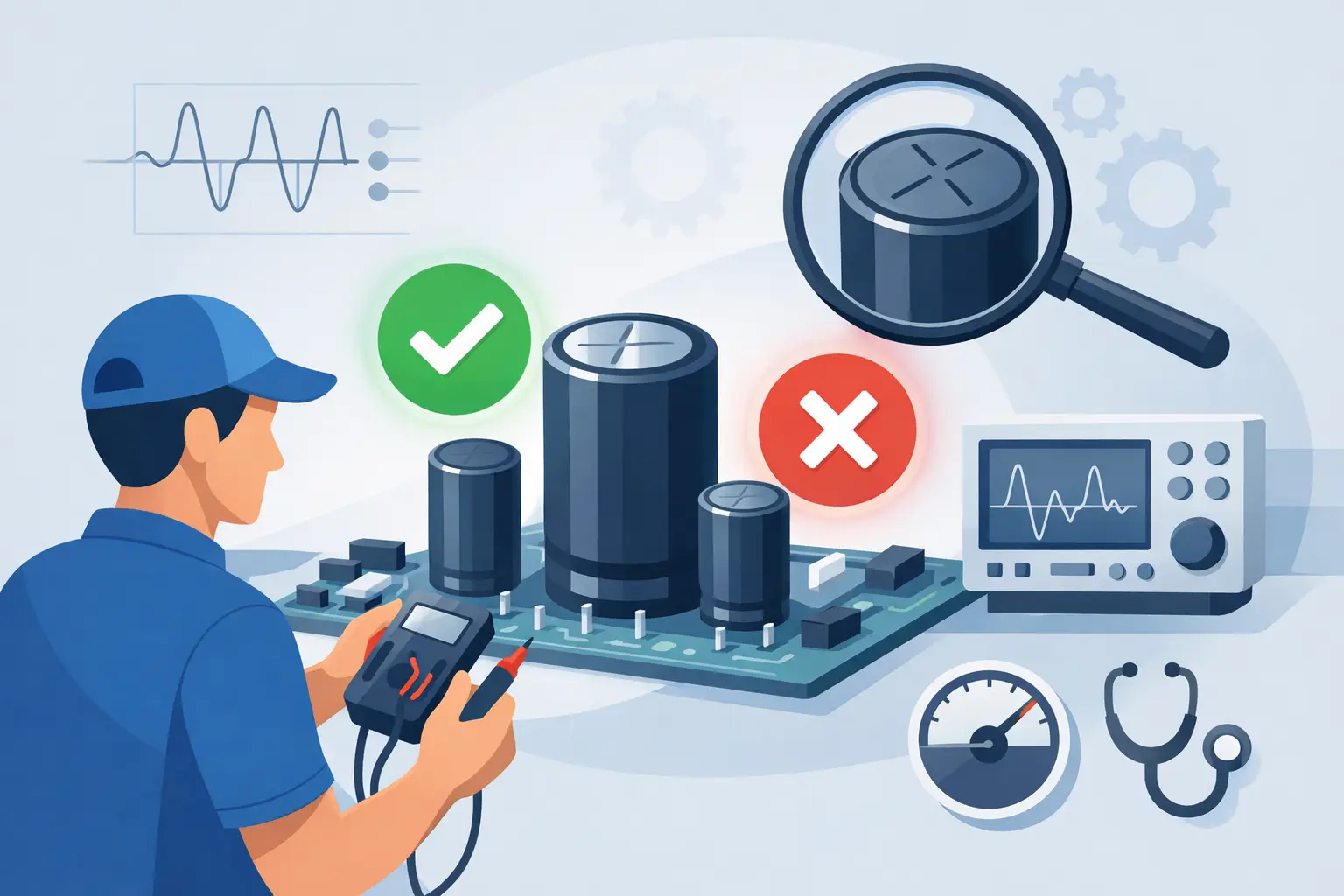
A capacitor can look perfectly normal and still be the reason a board will not start, a rail is noisy, or a timing circuit has drifted out of spec. If you need to know how to verify capacitor health, the answer is not a single reading. Good diagnosis comes from combining capacitance, ESR, leakage behavior, and context from the circuit.
For repair technicians and engineers, that distinction matters. A capacitor may still measure close to its nominal capacitance while already failing under load because ESR has climbed. In other cases, a part with acceptable ESR is unusable because leakage current is too high for the application. Verifying health means checking whether the capacitor still performs the job it was selected for, not just whether one number looks reasonable.
What capacitor health actually means
Capacitor health is application-dependent. In a bulk power filter, low ESR and ripple handling are often more important than tight capacitance tolerance. In a timing network, capacitance value and stability may be the priority. In coupling or decoupling positions, both impedance and leakage can matter depending on the circuit.
That is why visual inspection is only a starting point. Bulging aluminum electrolytics, cracked ceramic bodies, heat discoloration, or leaked electrolyte clearly indicate trouble, but many failed capacitors show no external damage. A healthy-looking component can still be open, high-ESR, leaky, or unstable at the test frequency that matters.
How to verify capacitor health with the right measurements
The most useful approach is to check four things: actual capacitance, ESR, leakage, and behavior in-circuit versus out-of-circuit. The weight you give each one depends on capacitor type.
Capacitance value
Capacitance tells you whether the part is still in the expected range. This is the first screen, not the final verdict. Many electrolytics degrade gradually, and a device that has lost 20 percent of its value may still function in some low-stress positions but fail in switching power supplies or audio filtering.
You also need to respect the original tolerance. A capacitor marked 100 uF may have been specified at plus or minus 20 percent from the start. A reading of 92 uF does not automatically mean failure. The real question is whether the measured value is outside the component’s rated tolerance or outside what the circuit can still tolerate.
ESR
ESR, or equivalent series resistance, is often the faster indicator of aging, especially for aluminum electrolytics. As electrolyte dries out, ESR rises. That increase can lead to ripple, heat, startup problems, regulator instability, and intermittent faults even when capacitance still appears acceptable.
This is where repair work often separates quick diagnosis from guesswork. If a capacitor in a power section measures near nominal capacitance but shows unusually high ESR compared with known-good parts of similar value and voltage rating, it is often no longer healthy in practical use.
For multilayer ceramic capacitors, ESR is usually very low, so the more common failures are cracking, shorts, or capacitance shift under DC bias. ESR is still useful, but not always the dominant health metric.
Leakage current or insulation resistance
Leakage matters most when the capacitor is expected to block DC, hold charge, or support timing accuracy. A capacitor can pass a capacitance check and still be leaky enough to disrupt bias conditions or drain a circuit over time.
Leakage is not always easy to verify with a basic handheld meter alone. In many cases, you need an insulation resistance tester, a bench supply with current monitoring, or a controlled test setup. For polarized electrolytics that have been stored for long periods, leakage can sometimes improve after reforming, but in production or repair work, excessive leakage is still a reliability concern.
In-circuit behavior
A capacitor does not operate in isolation on the board. Parallel paths, semiconductors, and neighboring passives affect what you read. In-circuit measurement is excellent for screening, especially for ESR, but it is not always definitive for capacitance.
If the reading is suspicious or unstable, lift one lead or remove the component. That extra step prevents wrong conclusions caused by parallel capacitance, discharge paths, or active devices influencing the measurement.
Best tools for verifying capacitor health
A standard DMM with capacitance mode is useful, but it has limits. It usually tells you only the value, often at one test condition, and may not reveal elevated ESR or borderline behavior. For actual troubleshooting, especially on SMT boards, an LCR or ESR meter is the more efficient instrument.
A dedicated LCR meter measures capacitance with better control over test conditions and can usually report ESR as well. For small SMD parts, tweezer-style meters reduce setup time and contact errors. That matters when you are sorting components, checking rework quality, or trying to isolate one bad capacitor among dozens on a dense board.
For advanced analysis, bench LCR meters and impedance analyzers offer selectable frequency and more detailed modeling. That is useful when capacitor behavior at 100 Hz, 1 kHz, or 100 kHz directly affects the application. In power electronics, frequency choice can change the reading enough to affect your diagnosis.
How to test different capacitor types
Aluminum electrolytic capacitors
Start with a discharge, then measure capacitance and ESR. Compare the result to the marked value, tolerance, voltage class, and the part’s role in the circuit. In power supply filtering, high ESR is often a stronger failure indicator than a moderate drop in capacitance.
Be careful with in-circuit readings around switching regulators. Parallel capacitors can hide a weak part. If one electrolytic in a bank looks questionable, out-of-circuit confirmation is usually worth the time.
Ceramic capacitors
Ceramics fail differently. Cracks from board flex, thermal stress, or handling can create intermittent opens or hard shorts. Capacitance may also vary with applied DC bias, so a simple bench reading at low test voltage can look fine while actual operating capacitance is much lower.
For these parts, physical condition and circuit symptoms matter as much as the meter reading. If a ceramic capacitor is in a high-stress mechanical area and the fault is intermittent, replace or isolate it even if the static reading seems normal.
Film capacitors
Film capacitors are generally stable, but they can fail from overvoltage, heat, or mechanical damage. Value drift is usually smaller than in electrolytics. Leakage and insulation resistance become more important, particularly in precision analog or timing circuits.
Tantalum capacitors
Tantalums tend to fail short or become unreliable after surge stress. ESR is useful, but current leakage and signs of overstress are just as important. If a tantalum sits on a power rail that experienced a transient event, do not rely on capacitance alone.
Common mistakes when checking capacitor health
The most common mistake is testing without fully discharging the capacitor. That risks the instrument and can distort the reading. The next mistake is trusting an in-circuit capacitance value without thinking about parallel paths.
Another problem is ignoring frequency. A capacitor measured at one frequency may not reflect its real operating condition at another. This is especially relevant for ESR and impedance-sensitive applications. Finally, avoid using a single threshold for every capacitor. A good ESR value for one part size, chemistry, and voltage rating may be completely wrong for another.
A practical workflow that saves time
If the goal is fault isolation rather than lab characterization, use a sequence that matches bench reality. Inspect the component and surrounding area first. Then measure in-circuit if your meter supports reliable screening. If capacitance or ESR looks questionable, compare against a known-good location or a replacement part of the same specification.
When the result is ambiguous, remove the capacitor and retest it out of circuit. If the board has heat exposure, ripple stress, or age-related wear, prioritize ESR checks on electrolytics in power sections. If the fault involves timing, drift, leakage, or stored charge, prioritize capacitance accuracy and insulation behavior.
A compact LCR tool with automatic identification can speed this process considerably on SMT work, where lead access is limited and repeated setup slows the job. The key benefit is not just convenience. It is reducing handling time while getting readings that are consistent enough to support a real decision.
When a capacitor is technically within spec but still not healthy
This is where experience matters. A capacitor can pass a quick bench test and still be a poor fit for continued service. Marginal ESR in a hot switching supply, unstable behavior after thermal cycling, or leakage that only appears near rated voltage may not show up in a basic low-voltage spot check.
For critical equipment, replacement is often the right call when the part is from a known weak series, exposed to heat, or tied to a failure pattern on the board. Verification is not only about proving a part is bad. It is also about deciding whether it is trustworthy enough to leave in service.
The most reliable way to verify capacitor health is to treat every reading as part of a bigger picture. Measure the value, check ESR, consider leakage, and always read the component in the context of its circuit and stress history. That is how you move from a number on a screen to a diagnosis you can stand behind.