
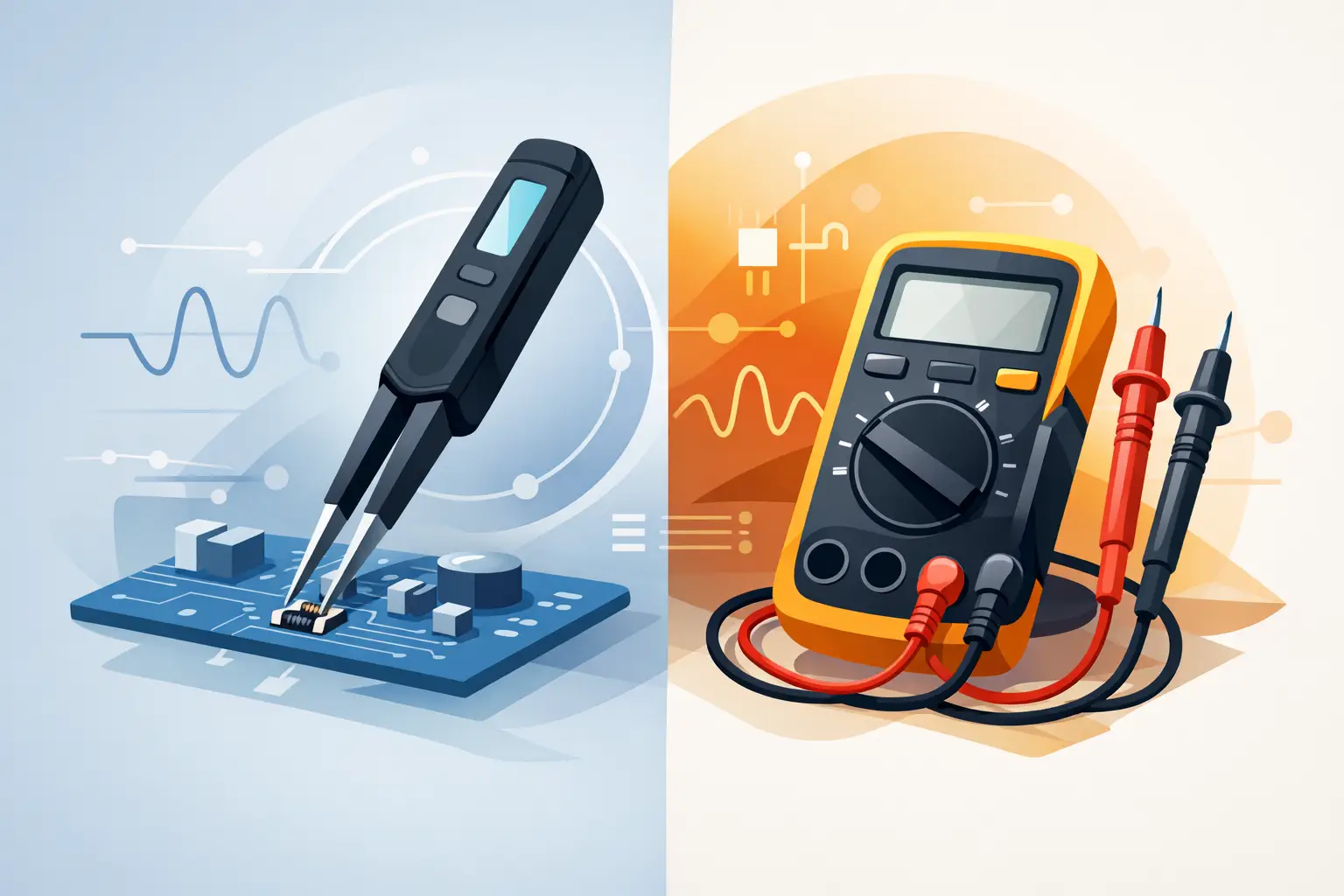
If you have ever tried to measure a 0402 capacitor with standard meter probes while keeping the part from skating across the bench, the smart tweezers vs multimeter question stops being theoretical very quickly. On paper, both tools measure electrical values. At the bench, they solve different problems, and that difference matters when speed, repeatability, and small-component access are part of the job.
Smart tweezers vs multimeter: the real difference
A multimeter is a general-purpose electrical test tool. It is built to measure voltage, current, resistance, continuity, and sometimes frequency, diode junctions, and capacitance. It is the default instrument for electrical troubleshooting because it covers a wide range of tasks across cables, power rails, connectors, batteries, and circuits.
Smart tweezers are more specialized. They are designed for direct contact measurement of components, especially surface-mount parts. Instead of two loose probes connected by leads, the probes are integrated into a tweezer form factor. More importantly, the instrument automatically identifies whether the device under test is a resistor, capacitor, or inductor and applies an appropriate measurement mode. On many models, it also reports ESR, making it far more useful for component evaluation than a standard handheld meter.
That is the core distinction. A multimeter is broad. Smart tweezers are focused. If your work revolves around assembled PCBs, SMT rework, incoming inspection, or component verification, that focus is often the reason the tweezers win.
Where a multimeter still makes more sense
A good multimeter remains essential on almost every electronics bench. If you need to verify a 12 V rail, check fuse continuity, measure current draw, confirm a transistor junction, or troubleshoot wiring between points on a board, smart tweezers are not a substitute, although LCR-Reader-MPA tweezer-meter may be.. They are not meant to replace a meter for general electrical diagnostics.
This is where some comparisons go wrong. They treat smart tweezers as a better multimeter. That is not the right framework. They are better at a narrower class of measurements. If your daily work is mostly power electronics, cable harnesses, field electrical service, or system-level fault tracing, the multimeter will do more of the heavy lifting.
Even when a multimeter includes capacitance or resistance modes, those functions are often secondary. They are useful, but not optimized for grabbing tiny SMT parts quickly and repeatedly. That is the gap smart tweezers fill.
Why smart tweezers are faster for SMT work
The strongest case for smart tweezers is workflow efficiency. In SMT environments, setup friction matters. Every extra button press, lead reposition, range adjustment, and hand movement adds time and increases error risk.
With smart tweezers, you touch the component with the tweezer tips and get an automatic reading. There is no need to select resistance, capacitance, or inductance first. There is no need to juggle separate probes. You are already holding the instrument in the same way you handle the component.
That matters in several common situations. During board repair, you can verify suspect passives directly on the board with better physical control. During rework, you can sort parts from tape, trays, or loose stock without switching tools. During incoming inspection or quality control, you can check values faster and with fewer handling errors.
For technicians who spend hours dealing with dense boards, this is not a small convenience feature. It changes throughput.
Accuracy is not just about the number on the screen
When users compare smart tweezers vs multimeter, they often look only at stated accuracy. That is necessary, but incomplete. Real measurement quality depends on the measurement method, test conditions, contact stability, and how well the instrument matches the component type.
A multimeter may have acceptable resistance accuracy but still be awkward on very small parts because the probe contact is unstable. It may offer capacitance measurement, but only after removing the component from circuit or dealing with slower response and less useful resolution for low-value parts. Inductance is often absent altogether.
Smart tweezers are designed around this problem. The Kelvin-style tweezer approach improves contact consistency on small components, and dedicated LCR-style measurement functions provide more meaningful readings for passives. On advanced models, selectable test frequency becomes especially important because component behavior changes with frequency, and a single low-frequency reading does not always tell the full story.
For capacitor evaluation, ESR is another major divider. A basic multimeter may tell you capacitance, but not the series resistance that often reveals aging or poor performance. For troubleshooting failed boards, ESR data can be the difference between replacing the right part and wasting time on parts that still measure nominal capacitance.
In-circuit testing and its limits
Neither tool is magic when measuring components in circuit. Parallel paths, nearby semiconductors, and network interactions can distort readings. That said, smart tweezers are usually more useful for quick in-circuit checks of passive components because they are designed for exactly that style of localized contact measurement.
Still, it depends on the board. A resistor inside a dense network may read lower than expected because of parallel resistance. A capacitor may appear different due to surrounding circuitry. Inductors can be even more sensitive to context. Experienced users treat in-circuit readings as diagnostic clues, not absolute proof.
The advantage of smart tweezers is not that they eliminate circuit influence. It is that they let you test more quickly, more comfortably, and often with better sensitivity to the component type you are targeting. If a reading looks questionable, then you lift one side or remove the part and confirm it.
Portability and bench practicality
A multimeter is already considered portable, but portability is not just about size. It is also about how much effort it takes to use the tool effectively for a specific task.
On a crowded repair bench, a handheld tweezer meter can be more practical than a meter with leads trailing across the work area. You pick it up, touch the component, and move on. For field service on electronics assemblies, that one-handed operation can be a real advantage.
This is one reason instruments such as the LCR-Reader family are attractive to technicians who handle SMT diagnostics regularly. The value is not only compact size. It is the reduction in measurement steps.
Cost versus value
If you only need one instrument, the multimeter is usually the first purchase because it covers more functions. For many users, that is the correct decision. It handles foundational electrical measurements that no SMT-specific tool replaces.
But if you already own a multimeter and still lose time identifying, sorting, or testing surface-mount passives, then the comparison changes. At that point, smart tweezers are not an alternative purchase. They are a productivity upgrade.
This is where value becomes more important than raw price. A specialized instrument can pay for itself if it reduces rework time, speeds incoming inspection, prevents wrong-part placement, or improves confidence during troubleshooting. For professional users, the time saved per board or per batch often matters more than the purchase difference between tools.
Which tool should you choose?
The answer depends on the work in front of you. Choose a multimeter if your main tasks involve voltage checks, continuity, current measurement, and general electrical troubleshooting. It is the broader instrument and the one every technician should own. It should be noted though that latest generation of LCR-Reader family covers not just AC/DC voltage and frequency measurement, but also LED-diode and continuity test and include built-in oscilloscope.
Choose smart tweezers if your work is centered on resistors, capacitors, inductors, and ESR measurement, especially in SMT form factors. They are the better fit for board-level component testing, inventory verification, and fast diagnosis of passive parts.
Many benches need both. The multimeter tells you whether power is present, whether a short exists, and whether a signal path is open. Smart tweezers tell you whether the tiny passive in front of you is actually the value it should be, whether its ESR is acceptable, and whether your component handling process is slowing you down more than it should.
The better question is often not smart tweezers vs multimeter as a winner-take-all choice. It is which instrument removes the bottleneck in your workflow. If the bottleneck is general electrical diagnosis, use the multimeter. If the bottleneck is small-component measurement, smart tweezers will feel less like a luxury and more like the tool that should have been on the bench already.
When your work shifts from wires and rails to dense SMT assemblies, the right instrument is the one that gives you reliable readings with the fewest interruptions.